The Donkey as Archetype

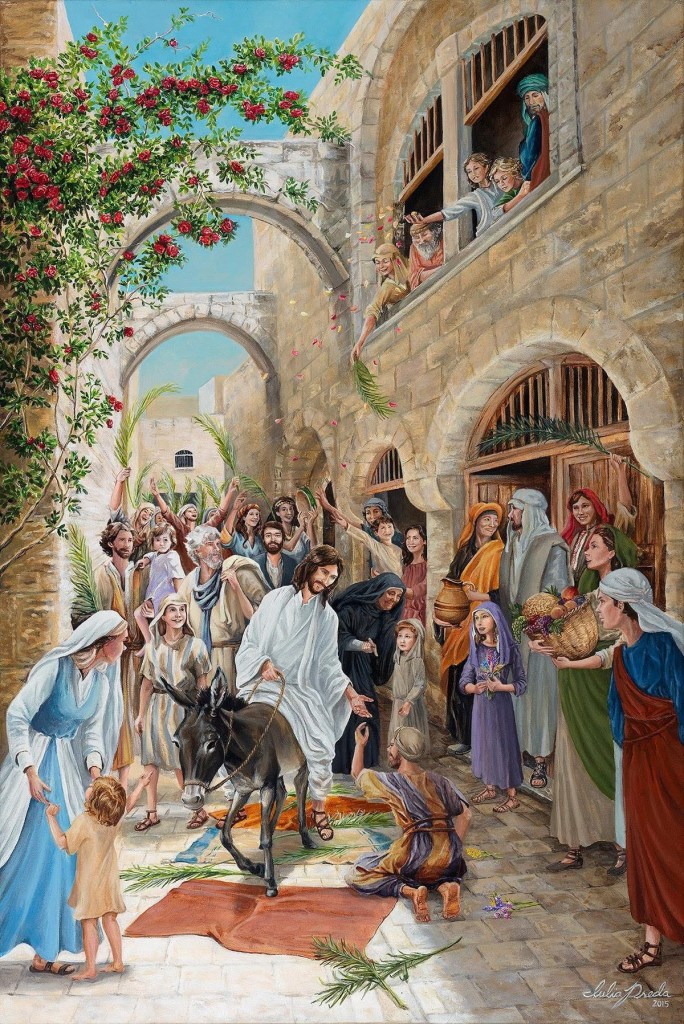
I used to think of Palm Sunday as a simple moral reversal. You expect a king on a warhorse, but Jesus chooses a donkey to teach us humility.

Now I see something metaphysical in it. In God’s eternal purpose, creation is ordered toward Christ and His Passion helps us decode what is real. The triumphal entry reveals how God exercises power in Jesus: lowly, peaceful, and brooding over Jerusalem like a mother hen.

Zechariah had already joined this donkey-riding king to the end of chariots, warhorses, and the battle bow. The warhorse in this scene represents a counterfeit power: domination mistaken for kingship. The animal itself is not evil, and martial authority is not the whole target.

The donkey is not the less glorious animal. It is the only mount that could reveal this King. Our desire for the warhorse is the inversion.

Of course Jesus says the stones will cry out if the people do not. The scene looks ironic only because we have forgotten the humility and peace of our Father.

The Figure Above the Sapphire Sea

It’s about 2am, and I must write down the journey I had through Exodus tonight.

The long office reading in Liturgy of the Hours today is Exodus 24, where Moses and the elders “see” the one who brought them out of Egypt. The text notices the clear sapphire floor beneath the figure’s feet. That odd detail sent me into Revelation and the other throne visions.

Who, precisely, sat above that sapphire sea? John tells us that no one has seen God. Calling this a preincarnate theophany names the event without telling me what Moses saw.

God lives in the Eternal Present, the unchanging and uncreated reality of eternity. Time is a creature. God is present to every moment and does not wait for Mary, the Incarnation, or the Resurrection as we wait for tomorrow.

From our place in time, the Word becomes incarnate, dies, rises, and ascends in sequence. From God’s vantage point, the whole life of Jesus stands within one eternal decree. God always wills the Incarnation. In that sense, His union with human nature in the God-man is never an afterthought.

That eternal decree does not make Christ’s humanity eternal. The Son is eternal according to His divinity; His human nature begins in Mary. Any speculation about the risen Christ acting within earlier history has to preserve that boundary.

Colossians 1 names the Son as the image of the invisible God and says that all things were created through Him. The eternal Son through whom creation comes is the same divine person who takes flesh from Mary. We awaken in time to what God eternally wills without making Christ’s humanity eternal.

That still leaves the body Moses saw. Did God fashion a temporary human form for the occasion, something like Jesus but not Jesus? What was it, and what became of it after the vision?

There is another possibility. The risen body of Jesus passes beyond the ordinary conditions of earthly life without ceasing to be a true human body. He appears behind locked doors and makes Himself present where He wills. The Transfiguration occurs before the Resurrection but displays the glory we associate with the risen Christ. None of those texts directly says that His humanity travels backward in time.

By virtue of the Hypostatic Union and His risen body now ascended, could Jesus participate in history retroactively? Could the figure above the sapphire sea be the glorified Jesus rather than a temporary form?

If so, the one who said, “Let there be light” is rightly identified as Jesus. On this Christological reading, the one who walked with Adam and Eve was Jesus. And if Moses had been able to see His hands and side, perhaps he would have seen the wounds. Exodus does not say this; it is the speculative edge of the argument. The God-man is the image of the Creator. Jesus can tell Philip that anyone who has seen Him has seen the Father.

This also changes how we read creation. Nature’s cycles conform to the Passion rather than the Passion conforming to nature. Birth, death, and new life are patterned after Christ. The distinction between the “other” and the beloved reflects the life of the Trinity. Suffering takes its final shape from the cross. From our place in time, Christ arrives after creation. In the eternal decree, His life logically precedes it.

The cosmos becomes a field of hieroglyphs, and the life of Christ is its Rosetta Stone. This is why Christ is rightly called the Archetype. Creation exists because Christ wills to draw it into the wedding chamber of divinity. As Paul says, from Him and through Him and for Him are all things.

I want to follow this into the Mass, especially the Eucharist, where the risen body of Christ hides as He hid from the disciples on the road to Emmaus and where He consecrates a better Sinai, a meeting place of heaven and earth. But that is for another night.

The Engine of the Eschaton: Jesus, Time, and the Power of the Future

Jesus heals the sick, restores the blind, raises the dead, and calms the storm. These miracles are more than divine acts within the present world. They are moments when the life of God’s future kingdom enters a world still marked by decay and death.

What if Jesus was drawing the power of that future into the present, the same restored creation the prophets glimpsed in their visions of the enthroned Lord? I do not mean that the future is an independent energy source or that the Son lacks divine power. I mean that His signs make the promised end operative in a world still under death.

The Prophets’ Vision of the Future

Isaiah saw the Lord seated on a throne, His robe filling the temple while seraphim cried, “Holy, holy, holy.” Ezekiel saw living creatures carrying the throne of God over wheels full of eyes. Daniel saw the Son of Man come with the clouds and receive everlasting dominion from the Ancient of Days.

These men were separated by time and circumstance, but their visions converge on one reality: the Lord reigning in glory over His kingdom.

They were not only predicting a distant event. For a moment they saw a future already secure in God. Their visions help name the kingdom Jesus would announce and reveal in His ministry.

Jesus and the Future Kingdom

When Jesus restored sight, multiplied loaves, and called Lazarus from the tomb, the perfected creation touched the broken one. Each miracle showed in miniature what His kingdom would do to hunger, blindness, decay, and death.

The blind man’s sight was a foretaste of a world without blindness. Lazarus walking from the tomb echoed the resurrection that will one day make all things new. The future was not replacing the present all at once. It was breaking through in signs.

Jesus did not borrow power from a future source. As the divine Son made man, He acted with the Father and the Spirit. “Drawing from the future” names the direction of the sign: the broken present receives the shape of its promised end because the kingdom is already present in its King.

The Spirit and the New Creation

The Spirit descended upon Jesus at His baptism and revealed Him as the Messiah. The Spirit did not supply a power the eternal Son lacked. Father, Son, and Spirit act together as the signs of the kingdom become visible in His ministry.

His miracles did not violate the natural order for spectacle. They showed the natural order healed. The life and glory seen by the prophets became present in a blind man’s eyes, a hungry crowd’s bread, and a dead man walking from his grave.

Jesus’ Resurrected Body: A Glimpse of the Future Creation

After the resurrection, Jesus’ body entered a new mode of life. He appeared behind locked doors and vanished from sight, yet He could be touched and ate with His disciples. He was physical, but no longer subject to decay and death.

His risen body is the clearest glimpse of the future creation. The world to come is not an escape from matter. It is matter made incorruptible.

The New Creation and the Church

This movement did not end with Jesus’ earthly ministry. Paul calls the Spirit a “deposit,” the guarantee of what is to come. The Church carries the firstfruits of resurrection life while remaining fragile and mortal.

We do not merely wait for the kingdom. Through the Spirit, we bear its fruit in the present. The kingdom the prophets glimpsed, Jesus announced, and the resurrection unveiled continues to make its claim through His body, the Church.

The new creation is already established in Christ. Through the Spirit it breaks into the world one life at a time, drawing the present toward its renewal.

Creativity as the Calling of Christians

God’s Poetry and the Call to Create

N.T. Wright once pointed out the word Paul uses in Ephesians 2:10: we are God’s handiwork, His poetry or artwork. We are not afterthoughts or assembly-line products. God made us deliberately, and He made us for good works.

That means Christians cannot spend life waiting for God to “come back and fix it all.” We are His work, made to take part in His work.

A Creative God, A Creative People

Creation bears the care of its Maker, from the stars to the smallest atom. Human beings bear His image and receive the task of cultivation and stewardship.

Christ does more than patch a broken system. He makes us new creations. Paul tells us in Philippians 2 to have the mind of Christ, and that mind turns power into service.

Our work, relationships, and care for the world should therefore show the craftsmanship of the God who made us. Christian life is active. We receive what God has made and bring our own gifts to it.

Creativity Is a Christian Calling

Genesis joins creation to cultivation. God makes the world, then gives human beings work within it. The New Testament uses the same living image: life in the Spirit bears fruit.

A line attributed to C.S. Lewis says that being in God’s image means we are made to “create in the same sense that He creates.” The wording needs a source, and the distinction matters: God creates from nothing; we receive a world and work with what He gives. We make, tend, repair, and restore because we are creatures of the Maker.

This does not require a grand artistic vocation. It can happen in code, soil, wood, meals, classrooms, families, and neighborhoods. The point is faithful attention to the part of creation placed in our hands.

Rejecting Fatalism

Christians sometimes speak as if God will destroy everything and start over, so work in the present world barely matters. That is not the New Testament hope. The kingdom has already broken into the world through Christ, and we are called to participate in it now.

We still await the fullness of that kingdom. But waiting does not mean idleness. It means bringing beauty, order, justice, and care into the places God has given us.

Our efforts do not build the kingdom by their own power. They answer the God who is making all things new. Even small acts of making and repair can bear witness to His future.

A Life of Creative Engagement

We are God’s handiwork, made in Christ for good works. So make something. Tend something. Repair what has been neglected. Use the gift instead of burying it.

As God’s handiwork, we have the privilege of becoming faithful makers under Him. Our work is not in vain.

Don’t Reinvent the Liturgical Wheel

The Mass is the Pinnacle of Western Christian Worship

When I first went to Mass, I was shocked to hear evangelical hymns. I knew them from my teenage years, Bible college, and Baptist ministry. I had expected Catholic music to sound completely foreign.

The songs were familiar. What surrounded them was not. Confession, Scripture, prayer, and Eucharist formed one act of worship. The Mass took pieces I had known for years and gave them an order and a center.

That is why I believe the Mass is the pinnacle of Western Christian worship. It is less elaborate than the Orthodox Divine Liturgy, but no less profound. It carries the wisdom of the early Church and centuries of theological reflection in a form ordinary people can pray together.

The Search for the Perfect Liturgy

Protestant traditions do not share one structure for public worship. Some reject formal liturgy and center the service on preaching or praise music. Others preserve or recover prayers and patterns from older traditions.

The recurring problem is balance: spontaneity and structure, emotion and theology, the sermon and the sacrament. A congregation may handle some of these well, but the service often depends on the gifts and preferences of whoever planned it that week.

There is no need to reinvent the wheel. The Mass brings confession, Scripture, prayer, and Eucharist into one durable form. It does not depend on a pastor having a brilliant sermon or a worship band creating the right emotional pitch.

The Eucharist at the Center

The Mass is not merely a useful tradition. Its center is the Eucharist, the memorial of Christ’s death and resurrection and the sacramental participation of the Church in His sacrifice.

This changes the purpose of the gathering. The congregation does not come primarily to hear one person speak or to manufacture an experience. The Church comes to receive Christ, offer thanksgiving, hear the Scriptures, pray, and share in the meal He gave us.

The structure has endured persecution, cultural change, and theological conflict because it does not belong to one gifted leader or one moment in history. It belongs to the Church.

What Protestants Can Recover

The Reformation rightly forced serious questions about doctrine and authority, but the break from Catholic tradition also cost many communities the structure that had formed Christian worship for centuries. Some Protestants retained or recovered much of it. Others did not.

Adopting the Mass in its full Catholic meaning would require more than copying an order of service. The Eucharist cannot be separated from what the Church believes it is. But every Western Christian can still confront the question the Mass poses: why start over each Sunday when the Church has already given us a rhythm of confession, Scripture, prayer, offering, and sacrament?

The Mass is a gift the West should not abandon. It keeps public worship communal, scriptural, and centered on Christ’s sacrifice. Protestants do not need another worship trend. They need to recover what the Church has carried all along.

God’s Love Is Without Fear

Human love is rarely pure. We love a spouse, child, friend, or cause, but fear enters with the love. We hold something back because we remember betrayal. We try to control the response because rejection would hurt. We want the other person’s good, but we also want to be affirmed, safe, and obeyed.

That does not make human love false. It makes it wounded. We can give ourselves honestly while still carrying habits of pride and self-protection that limit the gift.

God Does Not Love From Fear

God’s love is different because God does not love from fear, need, or insecurity. He does not wait for us to become safe enough to approach. In Christ, He gives Himself to sinners who can reject Him. The Cross is not a metaphor for divine affection. It is the act by which God shows what His love costs and what it intends to heal.

This does not mean that God is indifferent to our response. Love calls the beloved toward communion, obedience, and life. Grace is not earned, but neither is it aimless. God loves us as we are and refuses to leave us as we are.

Romans 8 and the Fear of Being Abandoned

Romans 8 names the pressures that make human beings doubt love: suffering, accusation, danger, death, and powers beyond our control. Paul’s answer is not that believers will avoid those things. It is that none of them can separate us from the love of God in Christ Jesus.

That claim is stronger than a feeling of reassurance. Human affection can cool when circumstances change. God’s purpose in Christ does not depend on our ability to keep ourselves emotionally steady. We can falter without discovering that He has become another frightened or withholding lover.

Learning to Receive Before We Imitate

The first response to God’s love is not to promise that we will imitate it perfectly. It is to receive it. A person who believes he must earn affection will turn even selfless love into another performance. Romans 8 interrupts that performance with the prior action of God.

From there, imitation becomes possible. We can confess the fear that makes us guarded, release some of our demand for control, and seek the good of another person without requiring an immediate return. We will do it imperfectly. The point is not to become fearless by force of will. It is to let God’s steadfast love make us less governed by fear.

Human love remains mixed. God’s love in Christ is not. That is why it can expose our limits without condemning us to them.

What the Rule of Saint Benedict Offers an Uncertain Age

Peter Zeihan argues that a retreat of American naval power would fracture the trade system built under U.S. protection. Sea lanes would become less secure, regional powers would act with fewer restraints, and countries dependent on long supply chains would face serious pressure. His book treats that scenario as the end of one world and the beginning of another.

That is a forecast, not a settled future. But it raises a useful Christian question: what kind of household and community can remain faithful when large systems become less reliable?

The Rule of Saint Benedict offers one answer. It was written for monasteries, not suburban households or geopolitical collapse. Its habits of prayer, work, stability, obedience, hospitality, restraint, and common life nevertheless show how a community can endure without making power or consumption its center.

What the Benedictine Example Can and Cannot Prove

The story is often told too neatly: Rome fell, Benedictine monks appeared, and the monasteries saved European civilization through the Dark Ages. The actual history stretches across centuries and many regions. Monasteries were not the only institutions that preserved learning, fed travelers, cultivated land, or held communities together.

Still, the Benedictine witness matters. A monastery orders ordinary life around worship rather than panic. People pray at fixed times, share work, receive guests, submit appetite to rule, and remain in place long enough to become responsible for one another. Those practices do not stop an empire from falling. They make a different kind of life possible inside the ruins.

Moderation

The Rule refuses both luxury and theatrical deprivation. For a modern household, moderation means learning to live below the limits of income and appetite. It means buying fewer things, wasting less, keeping useful skills, and refusing to let convenience become a necessity.

Gardening, supporting local businesses, and learning local sources of food can be good disciplines. They do not make a family independent of global trade. Their first value is moral: they teach patience, limits, and attention to the place where we live.

Community

Resilience is not a stockpile assembled by one anxious household. It is a network of obligations. Family meals, neighbors who know one another, parish life, shared tools, practical service, and care for the old and young create relationships that can bear weight in a crisis.

Luke 16:9 warns against treating wealth as an end and points toward relationships that outlast it. The passage should not be reduced to a disaster-preparedness slogan. It does, however, challenge the person who has money but no friends able to welcome him.

Christ-Centered Humility

Benedictine life is not a technique for surviving decline. It is a school of service under Christ. Prayer gives the community its center. Humility keeps competence from becoming domination. Hospitality prevents local loyalty from hardening into fear of outsiders.

A household preparing only to preserve itself has missed the Christian point. The aim is to become steady enough to serve: to feed someone, receive a guest, teach a child, care for a neighbor, and continue worship when the surrounding culture is frightened or disordered.

Zeihan may be wrong about the scale or timing of American retreat. The Benedictine lesson does not depend on his forecast coming true. A life ordered by prayer, restraint, work, hospitality, and durable relationships is worth building now. If harsher years arrive, those habits will already be in place.

Holiness as an Offensive Operation

In the conservative circles I knew, holiness often meant separation: avoid impurity, withdraw from corrupt culture, and remain morally unlike the world. Separation from sin is real. But my former professor Peter Gentry persuaded me that it is not the whole meaning of holiness.

Holiness is consecration. Something holy is set apart for God. The purpose matters as much as the boundary.

Consecrated to God

Gentry’s study begins with the Hebrew qadosh and the Greek hagios. Both words carry the sense of something sacred, devoted, or set apart for a divine purpose. The lexical point does not erase moral purity. It explains what purity serves.

In the Old Testament, people, places, and objects are holy because they belong to God in a particular way. Israel is called a holy nation in Exodus 19:6 because God has claimed the people for His covenant purpose. Their difference from the nations is not a private achievement. It is a vocation.

This is where the definition becomes an argument. If holiness meant only distance from contamination, withdrawal could become its own end. But consecration asks what a holy people has been set apart to do.

The Direction of the Covenants

The covenants face outward. Abraham is blessed so that the families of the earth may be blessed through him. Israel is distinguished from the nations so that God’s reign, justice, and mercy may become visible among them. In Isaiah, judgment does not end with a protected enclave. The dead-looking stump of David produces new life, and the promised kingdom reaches beyond Israel.

This mission was primarily an offensive operation, not a defensive one. By “offensive” I do not mean coercion or conquest. I mean that holiness moves toward the world in blessing, witness, justice, and service. It does not merely hold a line against corruption.

Gentry’s account also helped me see why God’s holiness cannot be reduced to aloof transcendence. God is unwaveringly devoted to His own character and purposes. His holiness appears in His fidelity, His justice, and the fulfillment of His promises. The covenant people imitate that holiness by belonging wholly to Him and carrying His purposes into the world.

Separation Has a Purpose

This does not make separation worthless. Some habits, institutions, and influences deform us. Consecrated communities and periods of withdrawal can train attention, prayer, and obedience. The mistake is treating distance itself as proof of faithfulness.

A Christian can avoid the world’s vices and still fail to love a neighbor, seek justice, welcome a stranger, or bear witness to Christ. That life may be insulated without being holy. The biblical question is not only, “What have you refused?” It is also, “What has God claimed you for?”

Holiness therefore shapes both identity and mission. We are set apart from sin because we are set apart for God. Work, family, church, public life, and cultural encounter become places where that devotion is tested. Engagement must not become compromise, but fear of compromise must not become an excuse for sterility.

The Church is holy when it belongs to God and spends itself on His purposes. Moral purity is part of that life, not its final horizon. The final horizon is a people whose common life reveals the character of the God to whom they belong.

For further reading and to explore the detailed insights presented by Professor Peter Gentry, you can access his paper, “No One Holy Like the Lord,” published in the Midwestern Journal of Theology.