The king was deeply moved, and went up to the chamber over the gate, and wept; and as he went, he said, ‘O my son Absalom, my son, my son Absalom! Would that I had died instead of you, O Absalom, my son, my son!’
— 2 Samuel 18
Absalom, the guilty son, hangs in the tree and dies a rebel. Joab and his men pierce him, and his death ends the rebellion of a false kingdom.
Christ, the innocent Son, hangs on the tree and dies the true King. After his death, a Roman spear pierces his side. His death opens the true kingdom.
David’s weeping over Absalom is an icon of God’s compassion for Adam. His wish to die in his son’s place becomes a type that Christ fulfills in his Passion, rescuing his brothers and bringing the fallen children of Adam into the kingdom of his Father.
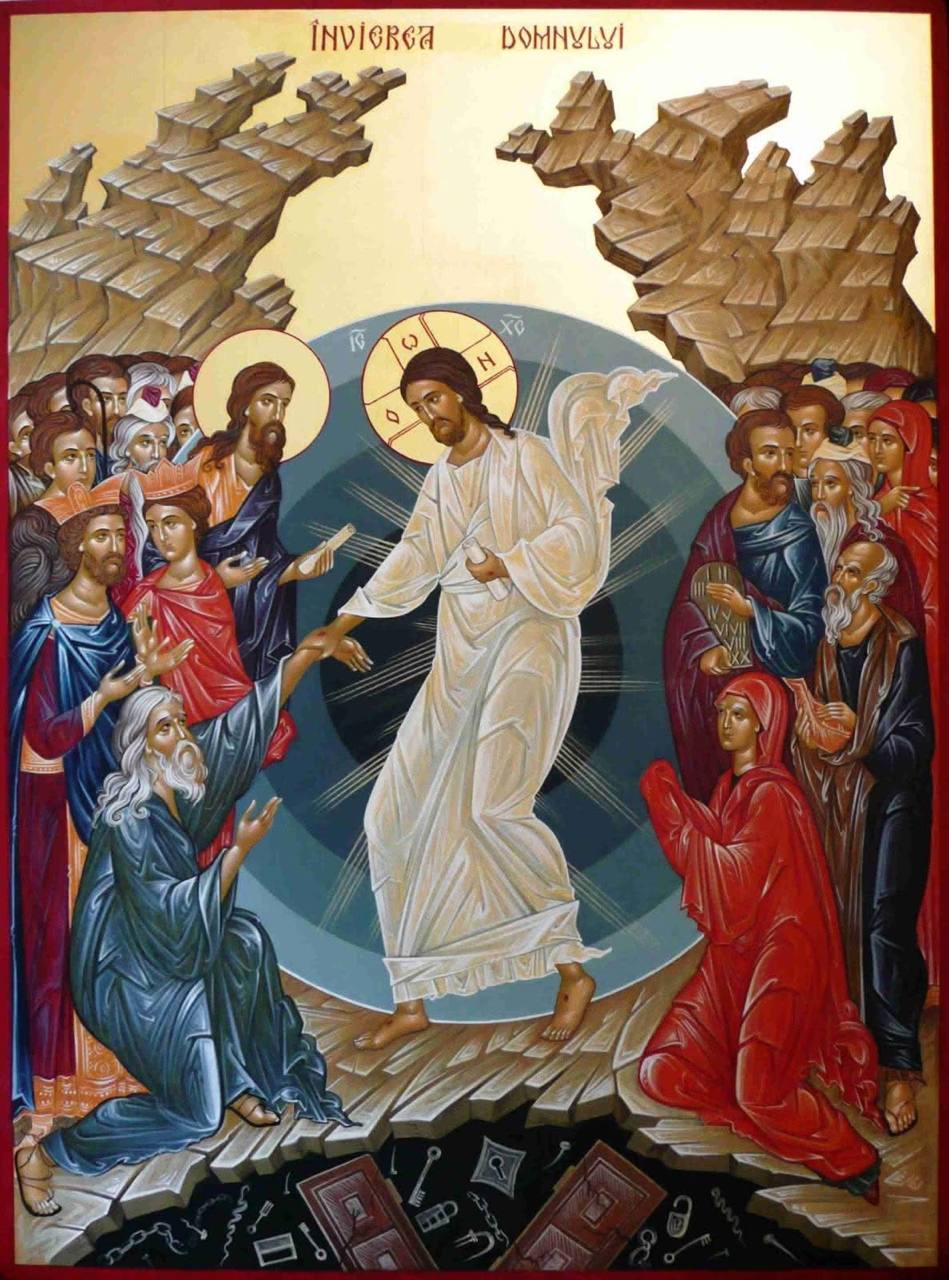
(Icon pictured: Easter and the rescue of Adam and Eve. I believe that’s David in the background.)
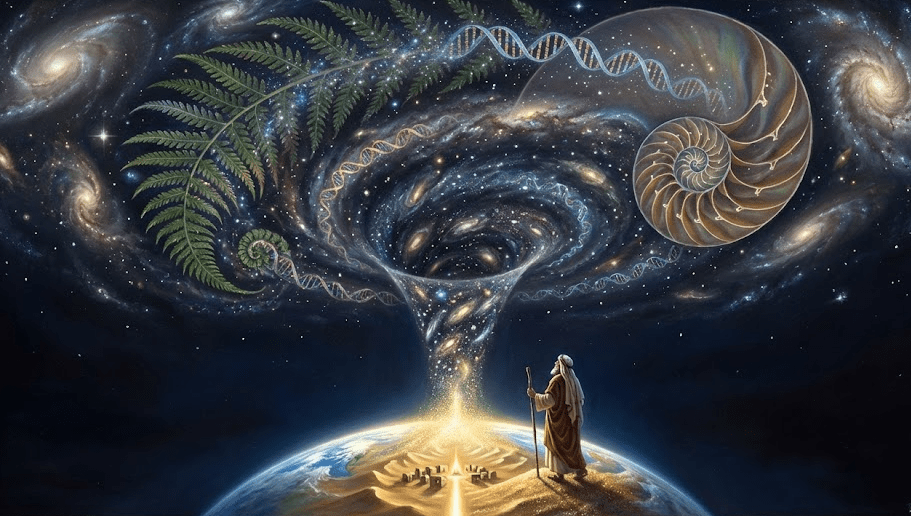
Consider the spiral: a fern uncurling, a fingerprint, a hurricane, a galaxy. The image repeats at radically different scales. It gives us a way to picture a movement Scripture makes again and again: outward toward the whole world, but inward toward a small and hidden center.
The Small and the Chosen
Israel was not selected because it was mighty among nations. Deuteronomy says the Lord set his love on Israel though it was the fewest. David was the youngest son, overlooked when Samuel came calling. Mary lived in Nazareth, the village behind Nathanael’s question: can anything good come from there? Christ says the Kingdom belongs to the little ones and its mysteries are revealed to infants.
The center of gravity in salvation history is rarely the obvious seat of power. Again and again, God chooses the hidden, the overlooked, and the least.
The Hidden Village of the Cosmos
Now lift your eyes. Our sun is one star in the Milky Way, and the Milky Way is one galaxy in a universe whose visible extent is almost impossible to grasp. Earth is very small within it.
And the Word became flesh here. The Creator became a particular man in a particular place and time: a Jew in Roman-occupied Palestine, born among animals, raised in obscurity, and executed as a criminal. If Israel was chosen among the nations, Earth has been chosen within the cosmos. Our planet is the hidden village from which salvation came.
The Icon
Here is the mystery worth pondering: God’s selection of Israel is the icon of his selection of Earth.
I mean icon in the Christian sense: a visible particular that opens onto a larger reality. The God who chose Israel also chose this small planet as the place of the Incarnation. He hides his glory in dust and ashes, bread and wine, water and oil. He counts hairs and marks the fall of sparrows. The scandal of particularity is not a problem to solve but a revelation to receive. The particular opens onto the universal; the local becomes the gate to the cosmic.
The Kingdom Within
The movement does not stop at the planetary or national. It continues inward. Christ says the Kingdom is in our midst, and the Christian contemplative tradition also traces its work within the soul. There is a hidden center in you, overlooked perhaps even by yourself, where God wishes to dwell.
The Carmelite tradition speaks of the interior castle, the deepest chamber of the soul where the King takes up residence. Meister Eckhart spoke of the Seelenfünklein, the spark of the soul; Augustine said God was more inward to him than his own inwardness. You are your own Nazareth, small and easily overlooked. That is where the weight falls: where God has chosen to dwell.
Blessed are the poor in spirit, for theirs is the kingdom of heaven.
Genesis moves quickly through creation, fall, flood, Babel, Abraham, Isaac, and Jacob. Then the book slows down and stays with Joseph for chapters. The family crisis explains how Israel ends up in Egypt, but the space given to Joseph suggests that Genesis is doing more than moving the family into position for Exodus.
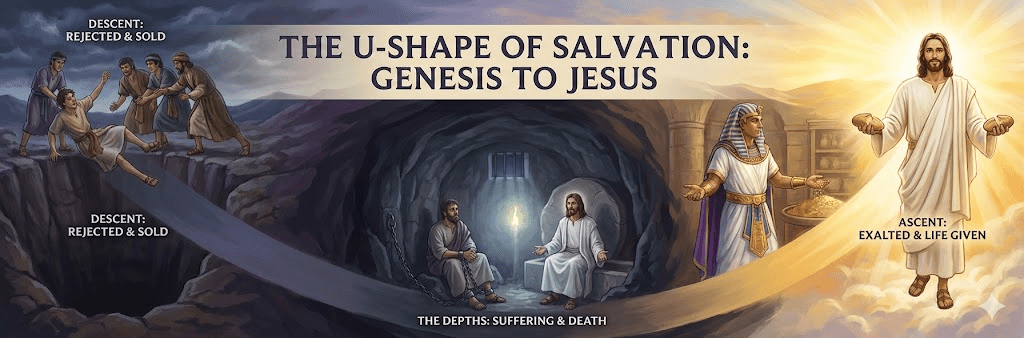
Joseph trains us to recognize the shape of salvation before Jesus arrives. His story moves through descent and rising, guilt and mercy, death and restored life. Genesis puts this rhythm in us early because Christ will fulfill it.
The story-pattern Genesis wants in your bones
Joseph is the beloved son. His brothers envy him, strip him, throw him into a pit, and sell him for silver. They return home with a lie while Joseph is carried into exile.
The path keeps descending. Joseph becomes a slave and then a prisoner, suffering as an innocent man. The story does not rush past his humiliation. It makes us sit with him there before God raises him.
Joseph is lifted to Pharaoh’s right hand and given authority over the kingdom and its storehouses. Bread is placed into his hands, and people come to Egypt for life. Eventually his brothers arrive hungry and guilty, unaware that the man who holds power over their survival is the brother they betrayed.
This is where the story could turn into vengeance. Instead it turns toward revelation, tears, mercy, and reconciliation. Joseph feeds his brothers, preserves their lives, and brings them near.
Genesis tells us how to interpret the whole movement:
“You meant evil against me, but God meant it for good… to bring it about that many people should be kept alive.” (Genesis 50:20)
Real evil happened, and the brothers remain guilty. God does not pretend their sin is harmless or secretly good. He takes the evil they intended and bends it, without endorsing it, toward the saving of many. The one they rejected becomes the one who keeps them alive.
Joseph and the cross
By the time we reach the New Testament, Joseph has given us categories for what God is doing in Christ. This is why his story fits the Fathers’ reading of the cross so well.
They did not treat atonement as a puzzle about making God willing to forgive. They proclaimed a rescue. Humanity is in bondage, corrupted, and dying. Death is an enemy; sin is more than a collection of bad choices; the devil is an accuser and destroyer. God comes down into our condition to break their hold.
Irenaeus speaks of Christ recapitulating humanity, taking up the human story from within and healing it. Athanasius speaks of the Word taking flesh so that by dying he might destroy death and restore humanity to life. When the Fathers use ransom language, they are not all diagramming a literal payment to Satan. The powers seize the innocent one, and that seizure becomes their downfall.
Joseph prepares us for that proclamation. Jesus is the beloved Son, rejected by his own and handed over for silver. He is stripped, shamed, and sent down into death, the final exile and the real pit. God raises him and exalts him as Lord. Life then pours into the world through him: bread for the starving, freedom for captives, forgiveness for sinners, and defeat for death. The disciples who abandoned him are invited near. The risen Christ meets them not with revenge but peace; he restores, feeds, and sends them. Joseph is the type, and Jesus is the fulfillment.
This pattern keeps us from making the cross a narrow mechanism. The cross and resurrection form one saving movement: Christ descends into the enemy’s territory, breaks its power, rises in victory, and gives life to a rescued people. The ascension is his enthronement, and Pentecost shares his life with the Church.
Forgiveness remains precious. Guilt, repentance, sacrifice, and judgment remain real. But the drama is larger than a courtroom scene. It is the defeat of death and the healing of the human race through union with Christ. That is why the patristic model is not an optional angle for me. It fits the larger biblical pattern, including Joseph.
Genesis teaches that God saves by turning evil back on itself. God does not become evil in order to defeat it. He overrules it and breaks it. The brothers mean evil against Joseph, but God means their act for good so that many will live. Christ is handed over for destruction, but God makes the cross the place of salvation.
The payoff
Joseph occupies so much of Genesis because his story lodges this pattern in us before we reach Bethlehem. Once we see it, the Gospels no longer feel like a new religion dropped into history. They read as the climax of a story already underway.
The right response is not admiration for a clever connection. It is to look at Christ and adore him. The God who wrote Joseph’s story has accomplished its pattern in history for the world.
He went down to bring us up. He entered the grave and made it a passage. He took what was meant for evil and made it a place of life.
An argument about Old Testament theophanies, the Resurrection, and the order of time
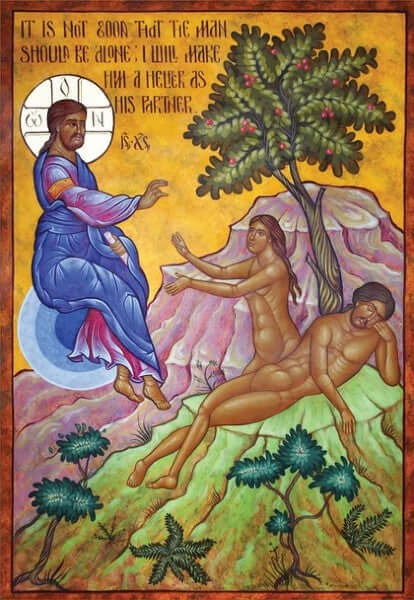
Christ creates humanity in Eden.
The man who ate beneath Abraham’s tree was the man who broke bread at Emmaus. Jacob wrestled the body that would carry the wounds of Calvary. The commander before Jericho and the fourth figure in Babylon’s furnace were Jesus: not the eternal Son wearing a temporary human disguise, but the same human being born from Mary, crucified under Pontius Pilate, raised from the dead, and taken into glory.
That is the thesis of this essay.
Christian doctrine already gives us two related claims. The eternal Son existed before Bethlehem and acted throughout the history of Israel. Many early Christians identified the Angel of the Lord and other Old Testament theophanies with that Son. I am arguing something further: after receiving a human nature from Mary and rising bodily from death, the Son makes that glorified humanity present at earlier points in created history.
I will call this retro-presence.
The claim is not that Jesus had several incarnations or a human body before Mary conceived him. It is not that Israel, Melchizedek, or an angel gradually became Jesus. It is not that Christ’s humanity created the world or caused its own existence. There is one Incarnation, one human nature, and one body, all received from Mary. The proposal is that an event later in Christ’s own human history can appear at an earlier date in the world’s history.
The Church has never defined this view, and Scripture never states the numerical identity of an Old Testament body with the body born from Mary. This is a theological argument, not Church teaching. Even so, retro-presence has a substantial biblical and patristic foundation, a basis in Catholic teaching on the risen body, and a close precedent in modern systematic theology. The case is cumulative.
Jesus was already acting in Israel
The New Testament does more than say that Israel predicted Christ. It puts Christ personally inside Israel’s history.
Paul says that the Israelites drank from a spiritual rock and that the rock “was Christ.” A few verses later he warns the Corinthians not to put Christ to the test as some of the Israelites did. The reading “Christ” in that verse is ancient and well attested, although some manuscripts read “Lord” or “God” (1 Corinthians 10:1–10).
Jude gives us an even sharper example. The current critical Greek text says that “Jesus” saved a people from Egypt and afterward destroyed those who refused to believe. “Lord” appears in other manuscripts, but the more difficult reading has strong support. Ancient copyists had an obvious reason to replace “Jesus” with the less startling “Lord” (Jude 5; textual note).
John says that Isaiah saw Jesus’ glory when he saw the Lord enthroned in the temple. Jesus says that Abraham saw his day and rejoiced, then identifies himself with the divine “I AM” who precedes Abraham. Hebrews describes Moses as accepting abuse for the sake of Christ, while Peter says that the Spirit of Christ spoke through the prophets (John 12:37–43, John 8:48–59, Hebrews 11:24–27, 1 Peter 1:10–12).
These texts establish the personal identity on which the bodily argument depends. The one Christians know as Jesus is the divine Son who saved, judged, spoke, and revealed himself within Israel’s history. The question is no longer whether Jesus was there, but how he was there.
The Lord keeps appearing as a man
Several Old Testament encounters are difficult to reduce to prophecy or inward inspiration because the divine visitor acts through a human form.
At Mamre, Abraham sees three men. He runs to meet them, washes their feet, and serves them bread, curds, milk, and a calf. One visitor is repeatedly called the Lord. The other two go down to Sodom as angels while Abraham remains before the Lord, bargaining for the city. The divine visitor sits under a tree and eats Abraham’s food (Genesis 18).
At the Jabbok, Jacob wrestles until dawn with a man who touches his hip, blesses him, and gives him a new name. Jacob says that he has seen God face to face. Hosea retells the encounter by calling Jacob’s opponent both angel and the Lord God of hosts. The figure has a body that Jacob can seize and a hand that can wound him, yet he bears divine authority over Jacob’s identity (Genesis 32:23–33, Hosea 12:4–6).
Before Jericho, Joshua meets a man with a drawn sword who calls himself commander of the Lord’s army. Joshua falls before him and is told to remove his sandals because the ground is holy, repeating the sign of the burning bush (Joshua 5:13–15).
The Angel of the Lord presents the same mystery in another form. “Angel” means messenger; the title does not settle the messenger’s nature. At the bush, the Angel appears in the flame, but the text immediately says that the Lord sees Moses and that God speaks. The speaker names himself as the God of Abraham, Isaac, and Jacob and gives the divine name: I AM (Exodus 3).
Hagar’s visitor promises descendants in his own voice, and she calls him the God who sees her. At Moriah, the Angel says that Abraham did not withhold Isaac “from me” and then swears by himself. Gideon speaks to the Angel while the narrator says that the Lord turns toward him. Manoah hears that the Angel’s name is beyond understanding, watches him rise in the sacrificial flame, and concludes that he has seen God (Genesis 16, Genesis 22, Judges 6, Judges 13).
In Babylon, Nebuchadnezzar sees a fourth figure walking unharmed in the furnace. He first calls the figure a divine being and then God’s angel. The pagan king’s words cannot settle the identity, but the scene belongs to the same pattern: God saves his people through a human figure who stands inside the fire (Daniel 3).
The individual cases differ in strength. Taken together, they present a sent figure who speaks as God, bears the divine name, receives prostration, commands armies, eats, touches, wounds, and walks in fire. The New Testament identifies the Lord of this history with Jesus.
The remaining question concerns the body that people saw.
The early Christians saw Christ in these encounters
Reading these passages as appearances of the Son is an ancient Christian practice.
Justin Martyr calls the visitor to Abraham and the speaker from the bush “Angel, and God, and Lord, and man.” He argues that this figure is the Son, distinct from the Father, who announces and carries out the Father’s will (Dialogue with Trypho 55–60).
Irenaeus says that the Son is “implanted everywhere” in the books of Moses: speaking with Abraham before eating with him, directing Noah, questioning Adam, judging Sodom, appearing to Jacob, and speaking from the bush. Elsewhere he says that it was the Word who spoke “in human shape” to Abraham (Against Heresies IV.10, IV.7).
Tertullian goes further. He says that Christ appeared to Abraham “in the flesh” before being born and was already rehearsing his dealings with humanity “in the habit of a flesh which as yet was not born” (On the Flesh of Christ 6). Novatian identifies the Angel who met Hagar and Jacob as Christ and describes Jacob as wrestling with one who was both God and man (On the Trinity 18–19).
This tradition gives the proposal real historical roots. Major early theologians believed that the Son appeared in Israel, and some described his manifestation as human and corporeal.
They did not, however, teach retro-presence. Tertullian distinguishes the flesh at Abraham’s tent from the flesh Christ later received by birth. Novatian treats Jacob’s wrestling as a figure fulfilled in the Gospel. Irenaeus says that the Son became visible and passible “in the last times” and that the prophets saw dispensations through which humanity would afterward see God (Against Heresies IV.20).
The Fathers bring us to the edge of the thesis. They identify the Person as Christ and take the bodily form seriously. They usually stop at temporary, anticipatory flesh.
Must the earlier bodies be temporary?
Augustine supplies the most influential alternative. God produced the Old Testament appearances through creatures and angelic ministry. A body could be formed for an encounter and cease when the sign was complete. At Mamre, Augustine sees three angels who may symbolize the Trinity rather than one bodily appearance of the Son (On the Trinity II–IV, III, City of God XVI.29).
There is no discarded “pre-Jesus” in this account. The temporary form has no human soul and is not personally united to the Word as Christ’s humanity is. It is a created sign. Its disappearance is no more the death of a person than the disappearance of the dove at Christ’s baptism.
This explanation is coherent and orthodox. It also divides the visible history of the Son into a series of temporary media. One body eats with Abraham, another wrestles Jacob, and another stands before Joshua. They resemble the humanity the Son will later receive forever, but none is his own.
Retro-presence offers a stronger continuity. The Son does not repeatedly approximate the Incarnation through disposable forms. Once risen, he stands within earlier history in the single humanity that is permanently his. Abraham’s guest is the fruit of Mary’s consent. Jacob holds the Lord who passed through death. The body in the furnace is the body over which death no longer has dominion.
Continuity alone does not make a theory true. The traditional account has the advantage of ordinary chronology. Retro-presence must explain how Mary’s body can act at a date before Mary gives it.
Mary remains the beginning of Jesus’ humanity
John writes that the Word became flesh and dwelt among us. Chalcedon confesses one and the same Son, eternally begotten from the Father according to divinity and born in the last days from Mary according to humanity. Any acceptable form of this thesis must keep that sequence and that dependence (John 1:1–18, Catechism 464–469).
Jesus’ human body and soul are not eternal. They do not wait in heaven for a suitable womb. Mary does not clothe a pre-existing human Jesus. The Holy Spirit causes the Son’s human conception from her substance, and that conception is the real beginning of his human life.
Retro-presence therefore cannot be a pre-incarnate body moving forward into Bethlehem. Its direction must be the reverse. The humanity begins in Mary, lives a mortal life, dies, rises, ascends, and then appears at an earlier date through divine power.
This preserves the uniqueness of the Incarnation. Mamre is not another Bethlehem. The Word does not assume a second humanity there. If the visitor is the risen Jesus, his presence at Mamre depends entirely on the Incarnation that occurs later on the calendar.
The risen body is not bound to ordinary presence
The Gospels are emphatic about bodily identity after Easter. The tomb is empty. Jesus shows the wounds, invites Thomas to touch him, and eats before the disciples. The one who died is alive in the body that died.
That body now appears with a freedom it did not ordinarily display before the Passion. Jesus enters a locked room, vanishes at Emmaus, and appears in forms his friends do not immediately recognize. Mary sees him and mistakes him for the gardener (Luke 24, John 20).
The Catechism states the point with unusual breadth. Christ’s risen body is the same authentic body that was crucified, but it is “not limited by space and time” and can be present “how and when he wills.” The risen Jesus has passed into a life “beyond time and space” (Catechism 645–646).
The Easter stories do not show Jesus visiting the past. Grief, divine concealment, and miraculous power can explain the delayed recognition and locked doors. Yet the Church’s conclusion is stronger than any one episode: the same body now possesses a mode of presence no longer confined by ordinary terrestrial space and time.
The Ascension completes the transition. The Catechism calls it the irreversible entrance of Christ’s humanity into divine glory. His body is glorified at the Resurrection; at the Ascension, that humanity is enthroned at the Father’s right hand (Catechism 659–660).
Mary Magdalene’s encounter marks one part of this transition. Jesus tells her not to hold him because he has not yet ascended. The verse does not mention the past and cannot bear the argument by itself. It does mark a change from the graspable presence of Easter morning to the ascended humanity’s new mode of manifestation. Mary’s son is not discarded; he carries the humanity she gave him into divine glory.
The ascended Christ is present at later altars and to the Church in every age. Retro-presence extends that Paschal freedom to the earlier history governed by the Son.
Two orders of time
Calling time a spiral hides the crucial distinction. The theory becomes clearer when two sequences are set beside each other.
World history runs in the familiar order:
Creation → Abraham → Moses → Mary → Birth → Passion → Resurrection → Ascension
Christ’s human life also has an irreversible order:
Conception from Mary → mortal life → Passion → Resurrection → Ascension → glorified appearance
Nothing in the second sequence is rearranged. Jesus does not have flesh before Mary gives it to him. He does not rise before he dies or ascend before he rises. The unusual claim is that the final event in his personal sequence can be placed at the date of Abraham in the first sequence.
Philosophers of time travel use a similar distinction between personal time and external time. A traveler’s arrival may be later in his own experienced sequence while occurring earlier on the world’s calendar. David Lewis used this distinction to show that backward time travel involves strange ordering without a formal contradiction (Stanford Encyclopedia of Philosophy, “Time Travel”; Lewis, “The Paradoxes of Time Travel”).
This is a logical model, not scientific evidence. Relativity has overturned the idea of one universal measure of simultaneity, and some physical theories admit time-symmetric or retrocausal descriptions. None tells us that a risen body appeared to Abraham. Einstein’s importance here is modest: physical time is stranger than common sense once assumed, so common sense cannot settle a Christological question in advance.
The model also avoids a body that creates itself. Mary remains the source of Christ’s flesh. The Holy Spirit causes the conception, and God raises and glorifies the body. A retro-present appearance depends on all of those events. It does not supply their existence.
This creates a loop among secondary historical causes. The Lord who guides Abraham and Israel helps shape the history into which he will be born. The loop is not a bootstrap, because the eternal God supplies its cause and meaning. The theory changes the relation between causal dependence and calendar order; it does not make causation disappear.
Catholic theology already knows backward efficacy
Catholic doctrine gives no example of a body visiting an earlier century. It does teach that the saving power of Christ’s later act reaches earlier persons.
Mary was preserved from original sin at the first instant of her conception “in view of the merits of Jesus Christ.” The Compendium calls this an anticipation of Christ’s merits (Benedict XVI, Compendium 96). The redemption accomplished at Calvary is applied to Mary before Calvary.
Aquinas says that the Passion is a universal cause capable of forgiving sins past, present, and future. Baptism administered before the Passion derived its efficacy from the Passion still to come. The righteous before Christ were justified through faith in the future Christ (Summa Theologiae III, q. 49, a. 1, q. 66, a. 2, q. 61, a. 3).
The liturgy rests on a related truth. Christ died once, yet the one Paschal mystery is made present in every age because all that he did and suffered participates in divine eternity (Catechism 1085).
These teachings establish retroactive efficacy, not retroactive location. The distinction matters. Calvary can save Abraham without the body of Jesus standing beside Abraham. The Eucharist is a real presence, but Aquinas insists that Christ is not locally present on the altar as a body occupies a place (Summa Theologiae III, q. 76, a. 5).
The Catholic economy nevertheless refuses the simple rule that a historical effect must always occur after its cause on the calendar. The completed act of Christ reaches backward to Mary and the saints of Israel. Bodily retro-presence would be a further mode of that Paschal sovereignty, not an entirely foreign kind of claim.
The closest scholarly precedent
This proposal has a modern theological relative.
In 2018, Sang Hoon Lee published “Toward an understanding of the eschatological presence of the risen Jesus with Robert Jenson” in the Scottish Journal of Theology. Lee interprets Robert Jenson’s account of the Son before his earthly lifetime as “the retroactive presence of the risen Jesus.” He connects that presence with the way Christ’s grace and power reach Israel and with retrocausality in physics. He also separates the proposal from Jenson’s disputed account of divine eternity so that the economic claim can be considered on its own.
Lee’s published abstract does not identify Abraham’s guest or Jacob’s wrestler with the risen body. It does show that retroactive presence of the risen Jesus within Israel has already entered peer-reviewed theological argument. The present essay gives that framework a more specific application to embodied theophanies.
It also departs from Jenson at decisive points. Jenson sometimes treats Israel itself as a mode of Christ’s pre-existence and rejects the idea of an eternal unincarnate Word. Those moves conflict with classical Catholic theology and are unnecessary here. The eternal Word exists before Bethlehem without flesh. Mary remains the unique source of his humanity. Israel is neither a preliminary incarnation nor a physical part of Christ.
Emmitt Cornelius has argued that Jenson blurs the novelty of John 1:14 and weakens the Incarnation as the climax of revelation (“‘Being Going to Be Born to Mary’,” Journal of the Evangelical Theological Society 58.2). Retro-presence can answer that objection. The Word becomes flesh once, from Mary. An appearance at Mamre would depend on that unique event rather than compete with it.
Adam was made after Christ
Genesis says that humanity was made in the image of God. The New Testament gives that Image a name: Christ is “the image of the invisible God.” Christians are predestined to be conformed to the image of the Son, and the resurrection will bring us from the image of the earthly man into the image of the heavenly man (Genesis 1:26–27, Colossians 1:15–20, Romans 8:29, 1 Corinthians 15:45–49).
The Catechism quotes an ancient Christian teaching: “the first Adam was made by the last Adam,” who stamped his image on the first. The last Adam comes later in history and remains the original pattern of the first (Catechism 359).
Tertullian draws out the bodily implication. When God formed Adam’s clay, “Christ was in His thoughts as one day to become man.” Adam’s body was already putting on the image of the Christ who would come in flesh (On the Resurrection of the Flesh 6).
This much is secure: the humanity of Christ is not an afterthought copied from Adam. Adam was formed in view of Christ. Jesus is historically Adam’s descendant and ontologically Adam’s archetype.
Retro-presence completes the pattern. The Image after whom Adam was formed is also the embodied Lord who forms and clothes him. The image texts establish Christ as Adam’s archetype; retro-presence identifies how that archetype stands within Adam’s history. Human form was designed for the Son.
Tabor and the future made visible
At the Transfiguration, the mortal body of Jesus shines with divine glory before the Passion. Moses and Elijah stand within that light and speak with him about the exodus he will accomplish at Jerusalem (Matthew 17:1–13, Luke 9:28–36).
The disciples do not literally see a post-resurrection body transported backward. Aquinas says that the light was truly the clarity of glory but present as a passing miracle, not yet as the permanent quality of a glorified body (Summa Theologiae III, q. 45).
Tabor supplies an important grammar. A future glory becomes truly visible before the historical event that permanently establishes it. The Law and the Prophets appear within the light of Christ’s coming death and Resurrection. Tabor does not identify an Old Testament body, but it makes proleptic manifestation part of the Gospel itself.
The principal objections
John says the Word became flesh
The objection is sound against any claim that Jesus possessed an eternal human nature or underwent several incarnations. It does not rule out a later state of that one humanity being made present at an earlier date. John 1:14 remains the unique origin of the humanity in either case.
A creature cannot act before it exists
In Christ’s personal sequence, the body does not act before it exists. It is conceived, glorified, and only then manifested at the earlier date. This reply requires the two orders of time described above. Anyone who holds that created time permits only one absolute ordering will reject it.
A glorified body remains a body
Aquinas says that glorification does not make a body naturally omnipresent. A glorified body remains local and moves through time; one body cannot be locally present in several places at once. Even the Eucharistic presence is non-local (Summa Theologiae III, q. 57, Supplement, q. 83–84).
This is the strongest metaphysical objection. The reply cannot be that glory turns humanity into divinity. It does not. The narrower claim is miraculous: the divine Person can locate his body at a point unavailable to it by natural bodily power. The Catechism’s language about presence “how and when he wills” leaves room for that claim, although it never applies the language to dates before the Incarnation.
Thomas would probably reject retro-presence. The proposal therefore departs from his account of bodily location, although not from a defined dogma.
Temporary signs already explain the texts
They do. Augustine’s account explains the visible forms without changing temporal order. Retro-presence is preferable only if the continuity it gains outweighs its metaphysical cost. The recurrence of one human divine visitor and the risen body’s unique freedom provide that motive; they do not compel assent.
Hebrews distinguishes Melchizedek from Jesus
Hebrews says that Melchizedek was made to resemble the Son of God and that another priest arose after his likeness. The natural reading makes Melchizedek a type rather than Jesus under an earlier name (Hebrews 7). I would not use Melchizedek as a primary case. Mamre, the Jabbok, the Angel of the Lord, Joshua’s commander, and the furnace offer stronger evidence because the text itself joins visible human action to divine identity.
The boundary at creation
The title “Christ” names one divine Person. Because actions belong to persons, Christian theology can say that the Lord of glory was crucified and that Jesus created the heavens. The Person born from Mary is the eternal Son through whom all things were made.
The human nature is not therefore a creator. Creation from nothing belongs to the divine power shared by Father, Son, and Holy Spirit. Aquinas denies that any creature can serve even as an instrument of creation ex nihilo, and the Catechism says that God creates without help (Summa Theologiae I, q. 45, a. 5, Catechism 290–292, 296–298).
The hands pierced on Calvary belong to the Person who made the stars. Those hands did not create the stars by a human operation. If they touched Adam or Jacob, they touched an already created world as part of that world.
This removes the self-creating circle from the thesis. Genesis does not happen because Christ’s body efficiently produces it. Creation happens through the eternal Son and for the Incarnation. The risen humanity enters that creation at an earlier date, but it never becomes the source of created being.
What can finally be claimed
The argument rests on conclusions with different levels of certainty.
The eternal Son is active throughout Israel’s history. The New Testament sometimes names that activity as the activity of Christ or Jesus. Several Old Testament encounters present the Lord through a tangible human form. Justin, Irenaeus, Tertullian, and Novatian identify many of these appearances with the Son. Christ’s risen body is the same body born from Mary and crucified, yet it is no longer limited by ordinary space and time. Catholic theology also recognizes that the saving efficacy of Christ’s historical act reaches backward to those who lived before it.
Taken together, those premises make retro-presence a serious theological conclusion rather than a poetic possibility. No biblical text explicitly says that the flesh at Mamre came from Mary. No Father located in this research says in so many words that Jacob touched Christ’s risen body, and the Church has not defined the identification. That limits the claim’s authority, not its explanatory force. Its closest modern scholarly precedent already argues for the retroactive presence of the risen Jesus in Israel; the embodied theophanies give that framework concrete form.
The conclusion can therefore be stated plainly:
The man at Mamre is the risen Jesus. The man at the Jabbok bears, whether visible or not, the wounds of the Passion. The commander before Jericho is the ascended king. The fourth man in the fire is the one over whom fire and death have no power. The gardener Mary met on Easter morning is the Lord who walked in the first garden.
On this account, the Old Testament does not contain a series of discarded approximations to Jesus. It contains appearances of Jesus himself, given from the far side of Easter. Mary is still the true beginning of his humanity, Bethlehem remains the one entrance of the Word into human life, and the Resurrection remains the turning point. Their fruit is present on both sides of the calendar.
History remains a line for us. For the risen Christ, the line is open at every point.
If I could go back and tell my 18-year-old self one thing, it would be this: the Bible is not enough.
I do not say that because I lost my love for Scripture. I say it because I misunderstood what it was for.
2 Timothy 3:16 was quoted to me as proof that the Bible stands alone. The text says Scripture is inspired and useful for teaching, correcting, and training, so that God’s servant may be equipped for every good work. It does not say Scripture exists apart from the Church that received, guarded, and reads it. The Bible needs the Church.
When we tried to make the Bible stand alone, we got endless arguments and church splits. Each man became his own teacher. Preachers could explain Greek grammar without governing their own lives. Movements could fill stadiums without forming disciples.
I followed John MacArthur, R.C. Sproul, Voddie Baucham, and Paul Washer. They were strong voices, but they were not the Church. Other famous leaders ended their ministries amid scandal: Tullian Tchividjian, Carl Lentz, Bill Hybels, and Brian Houston. Knowing the Bible did not by itself form a holy life.
The solution is the Church, not a better celebrity preacher. God shapes His people in a household. Scripture belongs inside that life, where the Spirit trains us through the Word, worship, discipline, and the communion of believers.
This is why the saints matter. They are not replacements for Scripture. They are the fruit of the Church. They are proof of what happens when Scripture is read, prayed, and lived within the body of Christ. Augustine confessing his sins. Monica persevering in prayer. Anthony leaving everything for God. Francis choosing poverty. Perpetua walking toward death without fear. These are the lives formed by the Church around the Word.
Read the Bible in isolation and you can invent a Christianity in your own image. Follow celebrity preachers and you can inherit theirs. A life shaped by Christ needs the Church: the Bible in her hands, the Spirit at work in her worship, and the saints as her fruit.
At eighteen, I thought I needed more knowledge and more preachers. What I really needed was the Church.
The greatest error I needed to resolve in my thinking over the past few years was reducing the cross of Christ to a transaction. In the American Protestant world that formed me, the legal image could become the whole gospel. That reduction was the cancer. Scripture’s real language of debt, ransom, and sacrifice was not. The reduction distorted both the Father and the cross.
If all Christ did was pay a legal debt, the Father can begin to look like a vengeful despot and the cross like an account balance. It becomes easy to misunderstand the cosmic problem God is addressing. I empathize with atheists who were given this vision and walked away in anger.
It took me years to recover the wider tradition of the Fathers, in which the cross is not only a settled account but God’s victory and our healing. Once I saw that, I could not reduce the cross to a transaction again.
God came to unite himself to his creation, to suffer in our human nature and thereby transfigure it. When Jesus was transfigured on the mountain, it was not a display for his three closest disciples. It was a key to the way he works: divine glory does not avoid the road through suffering and death.
Evil is not a substance but a privation of the good. God is not blocked by it. In the Incarnation, the Son enters our wounded condition without becoming evil. By suffering and dying in the flesh, he transfigures the suffering that evil introduced. What the devil intended for evil, God meant for good. The very symbol of death became the tree of life.
I long to worship the God who did not remain distant from our pain. The Son truly suffered as man while the divine nature remained unchanged. I can now suffer with hope because my suffering can be joined to Christ’s and offered for his body, the Church. There he meets us on the cross and makes even suffering a means of grace.
I tore intoThe Wizard Knight right after finishing Gene Wolfe’s celebrated Book of the New Sun. I expected another dark alien world wrapped in Wolfe’s usual obscurity. Instead I found bright meadows, talking cats, honorable knights, and a much clearer adventure.
Then I reached the final paragraph, closed the cover, and wept. The novel has not left my mind since.
If you have never read Wolfe, this is the easiest book to start with. Knights, dragons, giants, elf queens, princesses… it has everything you would expect from a fantasy adventure, with the depth of his denser books underneath.
Read it once for the adventure. Let it baffle you. Then come back and try to uncover the deeper meanings of the book.
My thesis (spoilers below)
What finally clicked for me is a simple, if startling, idea that I took in a slightly different form from a writeup from Marc Aramini, a writer who knew Wolfe personally:
Able is a child in the womb who is dying, and his adventure in Mythgarthr is a mystical kind of limbo where he gets to live a full lifetime to become a knight.
On this reading, Able still fights giants and time still runs at different speeds on each plane. But Mythgarthr is less a dimension the boy stumbles into than a limbo where a life too brief for earth can stretch out and ripen while he lies in his mother’s womb.
A few puzzle pieces that lock into place
Puzzle on first read
How it looks through the womb lens
Able’s memories are “mixed up with a little girl’s.”
An unborn son sharing the conscious overflow of his mother.
Parka’s silver bow‑string never breaks and whispers like heartbeats.
It is the umbilical cord: bright, unbroken, carrying breath and memory from mother to child.
The sea heals Able, and Garsecg calls blood “the sea inside you.”
Amniotic water and maternal blood nurturing a child who must fight for life.
Able sees the real Able in an ambulance in America.
The “real Able” (the baby on earth) glimpsed from inside the suspended moment via a vision.
Michael the Archangel pauses Able and says, “Your mother never knew you.”
Literal for a baby who will never be born alive; Michael prepares the soul to meet Christ.
The side characters now read as archetypes in a myth crafted for one child’s formation. Even the dragon Setr can be read as Able’s ego: formidable, but capable of being turned toward courage. Every quest trains Able to choose self‑gift over self‑preservation, so that when earthly death arrives he answers it like a knight.
Michael’s Message in the Last Paragraphs
At the very end of The Wizard, we read the following:
“We live in Aelfrice, and for whole days we are children again, as we were the first time I came. Children, we run and shout among the groves and grottoes of an endless wood more beautiful than any you will ever see. Children, we go to the sea I love, to splash in the shallows and play with kelpies. She has given me a new dog, a white puppy with red ears. I call him Farvan; and at night we speak to him of the play now past and the play to come and he tells us puppy things.
But we are not always children, and sometimes we lie upon our backs in fine green grass to watch the world above where time runs swift. There we saw Marder knight Wistan and Bold Berthold slay Schildstarr. Soon time will ripen, and we will come again.
Michael has found me at last, and that is why I have written this for you, Ben. He tells us of a great lord in need of a knight. I have told Michael that I will be this lord’s champion if I may bring my lady. He says it will be permitted.
We go soon. You will see this, Ben, for Michael has found a way. Do not worry about me. I am fine.
All best, Art
(Arthur Ormsby)”
I suspect this is where Wolfe meant to lead us. The “great lord” is the closest thing we get to a direct clue. I read Michael as the archangel sent by Christ to call Able, the baby-turned-knight, into the beatific vision.
My wife and I miscarried three times. I suspect Wolfe wanted to imagine what it might be like for children like ours to enter limbo. What does Christ do with infants who won’t live a full life on earth? Wolfe gives one possible answer: an earth-like adventure in which a child can grow up and be formed into a noble soul.
The book is a colorful fantasy adventure, but it also reads as a meditation on a child growing into the person he never had time to become on earth. I adore the idea. I trust the great Lord with the children we lost, and I trust that no life is too brief for him to bring it to fullness. This is an ending I can consider just, one that I can accept with great peace.
The Gospels record Jesus cleansing the temple in two places, once in John 2, near the beginning of His ministry, and again in the Synoptic Gospels (Matthew 21, Mark 11, Luke 19) during His final week.
Most of us probably remember this as one event. Some read John as placing the same cleansing thematically; others read the accounts as two events. I think the second reading makes the most sense. Jesus went up to Jerusalem regularly, and two cleansings would bookend his public ministry. If he began and ended his ministry this way, we should take notice.
The temple was where people came to worship. But trade and money-changing had taken over its outer courts. The poor bore the cost, and the place called a house of prayer had become entangled with money and power.
Jesus does not ignore it. He drives them out. If the accounts describe two events, then he begins and ends his ministry by confronting the use of religion to take advantage of people, especially the poor.
There will always be cunning minds ready to use religion for profit. That was true then and it is still true now. The Church is holy because she belongs to Christ, but her members remain sinners. Corruption by Christians should grieve us, but it should not surprise us. Refusing surprise does not mean accepting the corruption.
When we see financial scandal or religion used to squeeze the weak, we should name it, protect those harmed, and demand truthful accounting. Jesus’ cleansing of the temple shows where religion is vulnerable and what fidelity requires of us.
We were never promised that every member or leader would be clean. We were called to be faithful within the Church, which includes confronting corruption rather than excusing it. If you follow Jesus, you will face this same fight. Some tables may need to be flipped again.
Jesus cleanses the temple because it belongs to his Father and must be a house of prayer. The lesson is not that we should appoint ourselves reckless table-flippers. It is that we must neither abandon the Church at the first scandal nor make peace with corruption inside her. If the Lord took up this work twice, we should take double notice.
In a previous post, I wrote about Moses and the elders of Israel climbing Mt. Sinai and seeing the God of Israel standing above a sapphire sea. I said that what they saw wasn’t some vague, symbolic presence of God. They saw the Lord Jesus Christ, resurrected, enthroned, and whole.
That sounds strange because Jesus is born in Bethlehem long after Sinai. But God does not watch the story unfold as we do. Bethlehem, Golgotha, and the empty tomb stand present to him. That is why I believe Moses sees not a vague symbol but the risen Christ. Had Moses looked closely, he might have seen the nail scars already there.
If the risen Jesus is not confined to temporal sequence, what does that mean for the world we live in: for our choices, suffering, and joy?
John records Jesus saying, “I am the vine, you are the branches. Whoever abides in Me and I in him, he it is that bears much fruit. For apart from Me, you can do nothing.”
We usually read that as a spiritual principle. I think it reaches deeper.
“Apart from Me you can do nothing” concerns salvation, morality, and existence itself.
Israel and the Church belong to a cosmos rooted in him like branches in a vine.
Christ Before All Things: The Gospel as the Shape of Creation
We tend to imagine that Jesus entered a world already in motion. But the world exists through him and for him. I do not mean Christ as an abstraction. I mean Jesus of Nazareth: the man who preached the Beatitudes, wept at Lazarus’s tomb, bled on the cross, and walked out of the grave. His life is the original pattern of creation. The Gospels show us reality’s grain.
If Christ’s life is the pattern, then sin is a refusal of reality itself. The world trains us in self-preservation, control, transaction, and instant gratification. Fear of lack, pain, or insignificance begins to govern our choices. We may prosper for a time, but we cannot build durable lives against the one through whom all things were made.
Christ’s pattern is self-emptying love, forgiveness, patient endurance, and trust in the Father even unto death. A relationship built only on exchange becomes hollow. A career climbed through ruthless ambition cannot satisfy. An image built on concealment eventually cracks. These are not arbitrary punishments attached to a list of rules. They are the consequences of living against the grain of a creation patterned on Christ. “Apart from Me, you can do nothing”: nothing lasting or fruitful.
To live by this pattern is not to add a few “Jesus things” to an otherwise unchanged life. It is to ask, in work and relationships, “Does this choice resemble Christ?” Does it move toward service, forgiveness, truth, and dependence on the Father? Suffering remains evil and painful, but in Christ it need not be meaningless; it can become participation in the Cross and deeper dependence on the Vine. Work can become service. Possessions can become gifts. Relationships can move beyond transaction into burden-bearing love.
The Only Path That Is
Good behavior alone is too small. We must recognize the pattern and choose, moment by moment, to abide in the Vine.
To abide in him is to stand on the reality of the resurrected Christ, through whom and for whom all things were made. The Christian life is not an escape from the world. It is life in the world as it truly is, patterned after the Man on the mountain and the Lamb upon the throne.
The claim that a man has risen from the dead with an imperishable, glorified body ought to be considered ridiculous without strong evidence.
We should expect evidence across history that the same man who rose continues to act upon the earth in recognizable ways:
Recruiting his enemies through dreams and visions
Appearing humbly and hiding his appearance, teaching in ways that make hearts burn
Knitting together unlikely communities, so certain of his presence that they would rather die than deny what they encountered
Moving quietly through the world, breaking bread with the outcast, healing the brokenhearted, and resisting the proud and powerful
We might go further and call to Him directly. But prayer is not a laboratory test, and silence does not prove that the person praying was insincere. The claim must stand on more than a promised private response.
The sunrise is proven not only by the sight of the sun but by the warmth and rays of first light. If a man has truly risen and ascended, we should expect a sunlit world, warmed and colored by resurrection.