Joseph and the Shape of Salvation

Genesis moves quickly through creation, fall, flood, Babel, Abraham, Isaac, and Jacob. Then the book slows down and stays with Joseph for chapters. The family crisis explains how Israel ends up in Egypt, but the space given to Joseph suggests that Genesis is doing more than moving the family into position for Exodus.

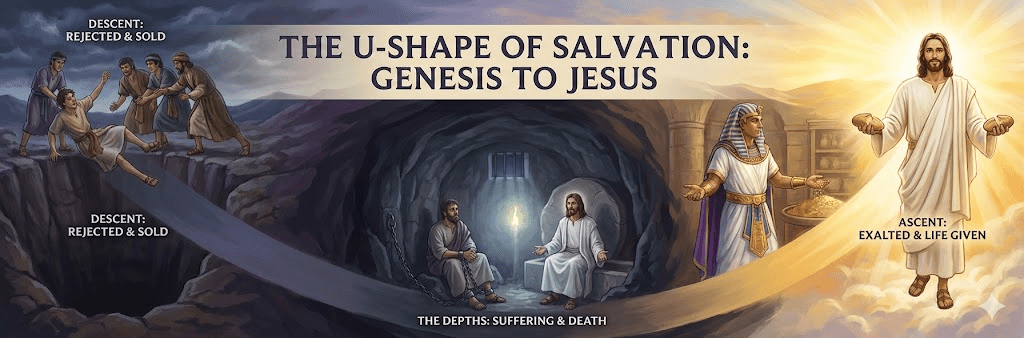
Joseph trains us to recognize the shape of salvation before Jesus arrives. His story moves through descent and rising, guilt and mercy, death and restored life. Genesis puts this rhythm in us early because Christ will fulfill it.

The story-pattern Genesis wants in your bones

Joseph is the beloved son. His brothers envy him, strip him, throw him into a pit, and sell him for silver. They return home with a lie while Joseph is carried into exile.

The path keeps descending. Joseph becomes a slave and then a prisoner, suffering as an innocent man. The story does not rush past his humiliation. It makes us sit with him there before God raises him.

Joseph is lifted to Pharaoh’s right hand and given authority over the kingdom and its storehouses. Bread is placed into his hands, and people come to Egypt for life. Eventually his brothers arrive hungry and guilty, unaware that the man who holds power over their survival is the brother they betrayed.

This is where the story could turn into vengeance. Instead it turns toward revelation, tears, mercy, and reconciliation. Joseph feeds his brothers, preserves their lives, and brings them near.

Genesis tells us how to interpret the whole movement:

“You meant evil against me, but God meant it for good… to bring it about that many people should be kept alive.” (Genesis 50:20)

Real evil happened, and the brothers remain guilty. God does not pretend their sin is harmless or secretly good. He takes the evil they intended and bends it, without endorsing it, toward the saving of many. The one they rejected becomes the one who keeps them alive.

Joseph and the cross

By the time we reach the New Testament, Joseph has given us categories for what God is doing in Christ. This is why his story fits the Fathers’ reading of the cross so well.

They did not treat atonement as a puzzle about making God willing to forgive. They proclaimed a rescue. Humanity is in bondage, corrupted, and dying. Death is an enemy; sin is more than a collection of bad choices; the devil is an accuser and destroyer. God comes down into our condition to break their hold.

Irenaeus speaks of Christ recapitulating humanity, taking up the human story from within and healing it. Athanasius speaks of the Word taking flesh so that by dying he might destroy death and restore humanity to life. When the Fathers use ransom language, they are not all diagramming a literal payment to Satan. The powers seize the innocent one, and that seizure becomes their downfall.

Joseph prepares us for that proclamation. Jesus is the beloved Son, rejected by his own and handed over for silver. He is stripped, shamed, and sent down into death, the final exile and the real pit. God raises him and exalts him as Lord. Life then pours into the world through him: bread for the starving, freedom for captives, forgiveness for sinners, and defeat for death. The disciples who abandoned him are invited near. The risen Christ meets them not with revenge but peace; he restores, feeds, and sends them. Joseph is the type, and Jesus is the fulfillment.

This pattern keeps us from making the cross a narrow mechanism. The cross and resurrection form one saving movement: Christ descends into the enemy’s territory, breaks its power, rises in victory, and gives life to a rescued people. The ascension is his enthronement, and Pentecost shares his life with the Church.

Forgiveness remains precious. Guilt, repentance, sacrifice, and judgment remain real. But the drama is larger than a courtroom scene. It is the defeat of death and the healing of the human race through union with Christ. That is why the patristic model is not an optional angle for me. It fits the larger biblical pattern, including Joseph.

Genesis teaches that God saves by turning evil back on itself. God does not become evil in order to defeat it. He overrules it and breaks it. The brothers mean evil against Joseph, but God means their act for good so that many will live. Christ is handed over for destruction, but God makes the cross the place of salvation.

The payoff

Joseph occupies so much of Genesis because his story lodges this pattern in us before we reach Bethlehem. Once we see it, the Gospels no longer feel like a new religion dropped into history. They read as the climax of a story already underway.

The right response is not admiration for a clever connection. It is to look at Christ and adore him. The God who wrote Joseph’s story has accomplished its pattern in history for the world.

He went down to bring us up. He entered the grave and made it a passage. He took what was meant for evil and made it a place of life.

When the Cross Becomes Only a Transaction

The greatest error I needed to resolve in my thinking over the past few years was reducing the cross of Christ to a transaction. In the American Protestant world that formed me, the legal image could become the whole gospel. That reduction was the cancer. Scripture’s real language of debt, ransom, and sacrifice was not. The reduction distorted both the Father and the cross.

If all Christ did was pay a legal debt, the Father can begin to look like a vengeful despot and the cross like an account balance. It becomes easy to misunderstand the cosmic problem God is addressing. I empathize with atheists who were given this vision and walked away in anger.

It took me years to recover the wider tradition of the Fathers, in which the cross is not only a settled account but God’s victory and our healing. Once I saw that, I could not reduce the cross to a transaction again.

God came to unite himself to his creation, to suffer in our human nature and thereby transfigure it. When Jesus was transfigured on the mountain, it was not a display for his three closest disciples. It was a key to the way he works: divine glory does not avoid the road through suffering and death.

Evil is not a substance but a privation of the good. God is not blocked by it. In the Incarnation, the Son enters our wounded condition without becoming evil. By suffering and dying in the flesh, he transfigures the suffering that evil introduced. What the devil intended for evil, God meant for good. The very symbol of death became the tree of life.

I long to worship the God who did not remain distant from our pain. The Son truly suffered as man while the divine nature remained unchanged. I can now suffer with hope because my suffering can be joined to Christ’s and offered for his body, the Church. There he meets us on the cross and makes even suffering a means of grace.

Apart From Me, You Can Do Nothing: Christ the Metaphysical Vine

Echoes of the Mountain

In a previous post, I wrote about Moses and the elders of Israel climbing Mt. Sinai and seeing the God of Israel standing above a sapphire sea. I said that what they saw wasn’t some vague, symbolic presence of God. They saw the Lord Jesus Christ, resurrected, enthroned, and whole.

That sounds strange because Jesus is born in Bethlehem long after Sinai. But God does not watch the story unfold as we do. Bethlehem, Golgotha, and the empty tomb stand present to him. That is why I believe Moses sees not a vague symbol but the risen Christ. Had Moses looked closely, he might have seen the nail scars already there.

If the risen Jesus is not confined to temporal sequence, what does that mean for the world we live in: for our choices, suffering, and joy?

John records Jesus saying, “I am the vine, you are the branches. Whoever abides in Me and I in him, he it is that bears much fruit. For apart from Me, you can do nothing.”

We usually read that as a spiritual principle. I think it reaches deeper.

“Apart from Me you can do nothing” concerns salvation, morality, and existence itself.

Israel and the Church belong to a cosmos rooted in him like branches in a vine.

Christ Before All Things: The Gospel as the Shape of Creation

We tend to imagine that Jesus entered a world already in motion. But the world exists through him and for him. I do not mean Christ as an abstraction. I mean Jesus of Nazareth: the man who preached the Beatitudes, wept at Lazarus’s tomb, bled on the cross, and walked out of the grave. His life is the original pattern of creation. The Gospels show us reality’s grain.

If Christ’s life is the pattern, then sin is a refusal of reality itself. The world trains us in self-preservation, control, transaction, and instant gratification. Fear of lack, pain, or insignificance begins to govern our choices. We may prosper for a time, but we cannot build durable lives against the one through whom all things were made.

Christ’s pattern is self-emptying love, forgiveness, patient endurance, and trust in the Father even unto death. A relationship built only on exchange becomes hollow. A career climbed through ruthless ambition cannot satisfy. An image built on concealment eventually cracks. These are not arbitrary punishments attached to a list of rules. They are the consequences of living against the grain of a creation patterned on Christ. “Apart from Me, you can do nothing”: nothing lasting or fruitful.

To live by this pattern is not to add a few “Jesus things” to an otherwise unchanged life. It is to ask, in work and relationships, “Does this choice resemble Christ?” Does it move toward service, forgiveness, truth, and dependence on the Father? Suffering remains evil and painful, but in Christ it need not be meaningless; it can become participation in the Cross and deeper dependence on the Vine. Work can become service. Possessions can become gifts. Relationships can move beyond transaction into burden-bearing love.

The Only Path That Is

Good behavior alone is too small. We must recognize the pattern and choose, moment by moment, to abide in the Vine.

To abide in him is to stand on the reality of the resurrected Christ, through whom and for whom all things were made. The Christian life is not an escape from the world. It is life in the world as it truly is, patterned after the Man on the mountain and the Lamb upon the throne.

A Sunlit World: Colored and Warmed by Resurrection

The claim that a man has risen from the dead with an imperishable, glorified body ought to be considered ridiculous without strong evidence.

We should expect evidence across history that the same man who rose continues to act upon the earth in recognizable ways:

  • Recruiting his enemies through dreams and visions
  • Appearing humbly and hiding his appearance, teaching in ways that make hearts burn
  • Knitting together unlikely communities, so certain of his presence that they would rather die than deny what they encountered
  • Moving quietly through the world, breaking bread with the outcast, healing the brokenhearted, and resisting the proud and powerful

We might go further and call to Him directly. But prayer is not a laboratory test, and silence does not prove that the person praying was insincere. The claim must stand on more than a promised private response.

The sunrise is proven not only by the sight of the sun but by the warmth and rays of first light. If a man has truly risen and ascended, we should expect a sunlit world, warmed and colored by resurrection.

The Figure Above the Sapphire Sea

It’s about 2am, and I must write down the journey I had through Exodus tonight.

The long office reading in Liturgy of the Hours today is Exodus 24, where Moses and the elders “see” the one who brought them out of Egypt. The text notices the clear sapphire floor beneath the figure’s feet. That odd detail sent me into Revelation and the other throne visions.

Who, precisely, sat above that sapphire sea? John tells us that no one has seen God. Calling this a preincarnate theophany names the event without telling me what Moses saw.

God lives in the Eternal Present, the unchanging and uncreated reality of eternity. Time is a creature. God is present to every moment and does not wait for Mary, the Incarnation, or the Resurrection as we wait for tomorrow.

From our place in time, the Word becomes incarnate, dies, rises, and ascends in sequence. From God’s vantage point, the whole life of Jesus stands within one eternal decree. God always wills the Incarnation. In that sense, His union with human nature in the God-man is never an afterthought.

That eternal decree does not make Christ’s humanity eternal. The Son is eternal according to His divinity; His human nature begins in Mary. Any speculation about the risen Christ acting within earlier history has to preserve that boundary.

Colossians 1 names the Son as the image of the invisible God and says that all things were created through Him. The eternal Son through whom creation comes is the same divine person who takes flesh from Mary. We awaken in time to what God eternally wills without making Christ’s humanity eternal.

That still leaves the body Moses saw. Did God fashion a temporary human form for the occasion, something like Jesus but not Jesus? What was it, and what became of it after the vision?

There is another possibility. The risen body of Jesus passes beyond the ordinary conditions of earthly life without ceasing to be a true human body. He appears behind locked doors and makes Himself present where He wills. The Transfiguration occurs before the Resurrection but displays the glory we associate with the risen Christ. None of those texts directly says that His humanity travels backward in time.

By virtue of the Hypostatic Union and His risen body now ascended, could Jesus participate in history retroactively? Could the figure above the sapphire sea be the glorified Jesus rather than a temporary form?

If so, the one who said, “Let there be light” is rightly identified as Jesus. On this Christological reading, the one who walked with Adam and Eve was Jesus. And if Moses had been able to see His hands and side, perhaps he would have seen the wounds. Exodus does not say this; it is the speculative edge of the argument. The God-man is the image of the Creator. Jesus can tell Philip that anyone who has seen Him has seen the Father.

This also changes how we read creation. Nature’s cycles conform to the Passion rather than the Passion conforming to nature. Birth, death, and new life are patterned after Christ. The distinction between the “other” and the beloved reflects the life of the Trinity. Suffering takes its final shape from the cross. From our place in time, Christ arrives after creation. In the eternal decree, His life logically precedes it.

The cosmos becomes a field of hieroglyphs, and the life of Christ is its Rosetta Stone. This is why Christ is rightly called the Archetype. Creation exists because Christ wills to draw it into the wedding chamber of divinity. As Paul says, from Him and through Him and for Him are all things.

I want to follow this into the Mass, especially the Eucharist, where the risen body of Christ hides as He hid from the disciples on the road to Emmaus and where He consecrates a better Sinai, a meeting place of heaven and earth. But that is for another night.

Don’t Reinvent the Liturgical Wheel

The Mass is the Pinnacle of Western Christian Worship

When I first went to Mass, I was shocked to hear evangelical hymns. I knew them from my teenage years, Bible college, and Baptist ministry. I had expected Catholic music to sound completely foreign.

The songs were familiar. What surrounded them was not. Confession, Scripture, prayer, and Eucharist formed one act of worship. The Mass took pieces I had known for years and gave them an order and a center.

That is why I believe the Mass is the pinnacle of Western Christian worship. It is less elaborate than the Orthodox Divine Liturgy, but no less profound. It carries the wisdom of the early Church and centuries of theological reflection in a form ordinary people can pray together.

The Search for the Perfect Liturgy

Protestant traditions do not share one structure for public worship. Some reject formal liturgy and center the service on preaching or praise music. Others preserve or recover prayers and patterns from older traditions.

The recurring problem is balance: spontaneity and structure, emotion and theology, the sermon and the sacrament. A congregation may handle some of these well, but the service often depends on the gifts and preferences of whoever planned it that week.

There is no need to reinvent the wheel. The Mass brings confession, Scripture, prayer, and Eucharist into one durable form. It does not depend on a pastor having a brilliant sermon or a worship band creating the right emotional pitch.

The Eucharist at the Center

The Mass is not merely a useful tradition. Its center is the Eucharist, the memorial of Christ’s death and resurrection and the sacramental participation of the Church in His sacrifice.

This changes the purpose of the gathering. The congregation does not come primarily to hear one person speak or to manufacture an experience. The Church comes to receive Christ, offer thanksgiving, hear the Scriptures, pray, and share in the meal He gave us.

The structure has endured persecution, cultural change, and theological conflict because it does not belong to one gifted leader or one moment in history. It belongs to the Church.

What Protestants Can Recover

The Reformation rightly forced serious questions about doctrine and authority, but the break from Catholic tradition also cost many communities the structure that had formed Christian worship for centuries. Some Protestants retained or recovered much of it. Others did not.

Adopting the Mass in its full Catholic meaning would require more than copying an order of service. The Eucharist cannot be separated from what the Church believes it is. But every Western Christian can still confront the question the Mass poses: why start over each Sunday when the Church has already given us a rhythm of confession, Scripture, prayer, offering, and sacrament?

The Mass is a gift the West should not abandon. It keeps public worship communal, scriptural, and centered on Christ’s sacrifice. Protestants do not need another worship trend. They need to recover what the Church has carried all along.

Why Our Family Prays the Liturgy of the Hours

Why We Pray the Liturgy of the Hours

When we became Catholic, we fell in love with the Mass. It was plainly the center of the Church’s life. The harder question was what should anchor the rest of the day.

Before Catholicism, I was a pastor in evangelical churches. Prayer was usually spontaneous and often followed the devotional reading or sermon theme of the day. It was not bad prayer, but it had no common daily rhythm. The Liturgy of the Hours gave us one.

For our household, the Hours has proven better than the Rosary as the main form of daily prayer. That is not an argument against Mary or against repetition. It is a judgment about what most fully joins our ordinary day to the public worship of the Church.

What the Hours Gives Us

The Liturgy of the Hours, also called the Divine Office, is built around the Psalms prayed at set times. It also includes Scripture readings, hymns, intercessions, collects, and, in the Office of Readings, texts from the Fathers and saints. Clergy pray it as an obligation, religious communities pray it according to their rule, and lay Catholics are invited to take part.

That distinction matters. The Rosary is a private devotion, even when people pray it together. The Hours is liturgy: the official prayer of the Church. Morning Prayer and Evening Prayer do not simply give us material for reflection. They place our morning and evening inside the Church’s calendar and common prayer.

The Hours is thoroughly biblical without being nothing but biblical text. Day after day it gives us the Psalms, canticles, readings, and the story of Christ across the liturgical year. The Rosary also contemplates Christ through its mysteries, often from Mary’s vantage point. Our preference for the Hours is therefore not a choice between Christ and Mary. It is a choice to make the Church’s public prayer the spine of our day.

How to Begin

Start with Morning Prayer and Evening Prayer. The Church calls them the hinge hours because the daily office turns on them. Do not begin by trying to master the entire cycle.

We use the Divine Office app. It places the right texts in order and includes audio, which makes it possible to pray while commuting or folding laundry. A book can come later if you want one.

Then give the prayer a fixed place. Pray before the day scatters the household and again when it gathers. If a parish or group prays the Hours together, join them. If not, praying alone still joins you to the Church’s common act.

The Mass remains the source and summit of Christian life. The Liturgy of the Hours carries that worship through the days between one Mass and the next. That is why it has pride of place in our home.