Why Does the Joseph Story Occupy So Much of Genesis?

Genesis is supposed to be moving. Creation, fall, flood, Babel, Abraham, Isaac, Jacob. The promise line is in motion.

Then the book almost stops.

It parks on Joseph. Chapters and chapters. Detailed scenes. Slow turns. A long family crisis that becomes the backbone of how Israel ends up in Egypt.

So why does Joseph take up so much space?

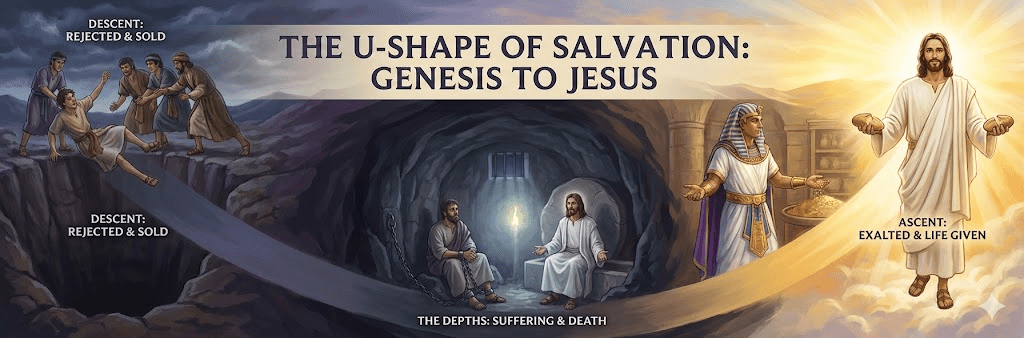
Because he is not only explaining how Israel got to Egypt. He is training you how to read the Bible. He is teaching you the shape of salvation before Jesus arrives. And that shape, when you see it clearly, pushes you toward the patristic way of understanding the cross. The victory, the rescue, the healing, the descent and rising. The whole story as liberation and new life.

Genesis wants you to learn this rhythm early, because it is the rhythm Christ will fulfill.

The story-pattern Genesis wants in your bones

Joseph is the beloved son.

He is rejected by his brothers, Israel. They envy him, hate him, strip him, throw him into a pit, and sell him for silver. They go home and live on top of the lie, while Joseph is carried away like a dead man who still breathes.

Then comes the downward path. Egypt is the land below, the place of exile, the place where you disappear. Joseph becomes a slave. Then he becomes a prisoner. He suffers as an innocent man. The story makes you sit there with him for a long time.

And then God raises him up.

Joseph is lifted to the right hand of the throne. He receives authority over the kingdom. He becomes lord over the storehouses. Bread is placed into his hands.

Then the world starts coming. Nations come to Egypt for life. And eventually his own brothers come too.

They arrive hungry, frightened, and guilty. They do not know who they are standing before. They are face to face with the one they betrayed, and he now has absolute power over their survival.

This is where the story could turn into vengeance.

Instead it turns into revelation, tears, mercy, and reconciliation. Joseph feeds them. He preserves them. He brings them near.

Genesis itself tells you what you are supposed to learn from it:

“You meant evil against me, but God meant it for good… to bring it about that many people should be kept alive.” (Genesis 50:20)

That sentence is the key to the whole mystery.

Real evil happened. The brothers are truly guilty. God does not pretend their sin is fine. And yet God takes the very evil they intended and bends it, without endorsing it, toward the saving of many.

That is the shape.

Why this shape matters when you get to the cross

By the time you reach the New Testament, you should already have categories for what God is doing in Christ. Joseph gives them to you.

Beloved son, rejected by his own. Handed over. Descended into the place below. Humiliated. Then exalted to the throne. Then he becomes life for the world. Then reconciliation.

This is why the Fathers read the cross the way they did.

They did not treat atonement as a puzzle about how God can finally be willing to forgive. They treated it as a rescue mission. Humanity is in bondage, corrupted, and dying. Death is not a metaphor in Scripture. It is an enemy. Sin is not only bad choices. It is a power. The devil is not a cute idea. He is a tyrant, a destroyer, an accuser.

So God comes down into our condition to break it.

Irenaeus talks about Christ recapitulating humanity, redoing the human story from the inside and healing it. Athanasius talks about the Word taking flesh so that, by dying, he might destroy death and restore humanity to life. The Fathers use ransom language at times, and they are not trying to diagram a literal payment to Satan. They are saying something simpler and stronger. The powers seized the innocent one, and that seizure became their downfall.

This is the basic proclamation: Christ entered death and shattered it.

Joseph is the Old Testament practice run for that proclamation.

Jesus as the true Joseph

Jesus is the beloved Son.

He is rejected by his own people. He is handed over. He is sold for silver. He is stripped and shamed. He is treated as cursed. He descends into death itself, the final exile, the real pit.

Then God raises him.

He is exalted as Lord. And what follows is not only a verdict on paper. What follows is life poured out into the world. Bread in his hands. A table set for the starving. Captives released. Sins forgiven. Death losing its claim.

And then comes the part that Joseph trained you for.

Those who betrayed him can still come near.

The risen Christ does not meet his disciples with revenge. He meets them with peace. He restores them. He feeds them. He sends them.

The one wronged becomes the one who saves.

That is Joseph. That is Jesus. Only Jesus is the final version.

The grid this gives you

If you take Joseph seriously, you stop making the cross a narrow mechanism.

You begin to see the cross and resurrection as one act of salvation. The cross is the descent into the enemy’s territory. The resurrection is the victory and the liberation. The ascension is the enthronement. Pentecost is the distribution of life. The church is the rescued people learning to live as a new humanity.

Forgiveness is inside that, and it is precious. Guilt is real. Repentance is real. Judgment is real. But the central drama is bigger than a courtroom scene. It is the defeat of death and the healing of the human race by union with Christ.

That is why the patristic model is not an optional angle. It is the interpretive grid that fits the whole Bible, including Joseph.

Genesis was already teaching you that God saves by turning evil back on itself. God does not become evil to defeat evil. God overrules it, absorbs it, and breaks it.

The brothers meant evil. God meant it for good, so that many would live.

Israel hands over the beloved Son. Evil means it for destruction. God means it for salvation.

The payoff

So the reason Joseph occupies a huge chunk of Genesis is not only because it is a great story.

It is because God wanted to lodge a pattern into you.

Descent. Exile. Suffering. Silence. Then exaltation. Then bread for the world. Then reconciliation.

Once you see that, the gospels stop feeling like a new religion dropped out of the sky. They feel like the climax of a story you have already been reading.

And the right response is not to walk away impressed with a clever connection.

It is to look at Christ and adore him.

Because the God who wrote Joseph’s story has done it in history, for real, for the whole world.

He went down to bring us up.

He entered the grave to make the grave a passage.

He took what was meant for evil and made it the place where life is stored.

That is the mystery Genesis sets up.

And Joseph is how it pays it off, before you ever reach Bethlehem.

The Great Cancer of American Protestantism

The greatest error I needed to resolve in my thinking over the past few years was the mistake of seeing the cross of Christ as a transaction. This is common teaching in American Christianity, and removing it was like surgically removing cancer. I can’t overstate the damage this does to the soul.

If all Christ did was pay a legal debt, all kinds of evil ideas will start to oxidize downstream. It twists the image of the Father into a vengeful despot, cheapens the cross to be a sort of a bank you can swipe the sin credit card on, and misunderstands what problem God is dealing with on a cosmic scale. It’s easy to become embittered by this vision. I empathize with any atheists who have been pitched this vision and have walked away in anger.

It took me many years to recover the historical tradition of the fathers, the ancient teaching of the church. Once you see it, you will never return to a transactional cross again.

God came to unite himself to his creation, so that he could suffer with it, and thereby transfigure it. Transfiguration is what he does. When Jesus was transfigured atop the mountain, it wasn’t a random show off to his three best disciples. It was a hermeneutical key to explain his modus operandi.

The problem with evil is that God cannot touch it. By its definition, evil is not a thing, but the absence of a thing, the privation of God. If he cannot touch evil, he cannot get rid of it. How does he solve this dilemma? He becomes man, and joins himself to his creation. By suffering and dying on the cross, he transfigures, in his flesh, the very suffering introduced by evil itself. What the devil intended for evil God meant for good. The very symbol of death became the tree of life.

A suffering God is the God I long to worship. I can now suffer with joy, because in my suffering I can partake in union with God, who suffers alongside me and has blessed suffering as a means of his grace. There he joins us on the cross, and there we fill up what still remain in the suffering of Christ.

Apart From Me, You Can Do Nothing: Christ as Real Metaphysical Vine

Echoes of the Mountain

In a previous post, I wrote about Moses and the elders of Israel climbing Mt. Sinai and seeing the God of Israel standing above a sapphire sea. I said that what they saw wasn’t some vague, symbolic presence of God. They saw the Lord Jesus Christ, resurrected, enthroned, and whole.

That might sound strange to some. Isn’t Jesus born in Bethlehem long after Sinai? Yes. But that is only if you are still thinking inside the frame of time. I tried to lay it out there. God doesn’t dwell in time. He isn’t watching the story unfold like we are. From His view, everything is present. The birth in Bethlehem, the cross on Golgotha, the empty tomb in the garden. All of it stands before Him as one living reality. That is why Moses sees a man on the mountain with a body. That is why I said if Moses had looked closely, he might have seen the nail scars already there.

And so, if that is true, if Jesus is not just in time but over it and beyond it, then I want to press a step further. What does that mean for the world we live in? What does it say about your life, your choices, your suffering, your joy?

John records Jesus saying, “I am the vine, you are the branches. Whoever abides in Me and I in him, he it is that bears much fruit. For apart from Me, you can do nothing.”

We usually read that as a spiritual principle. But what if it is deeper than that?

What if it is not just spiritual, but also the nature of reality itself? What if “apart from Me you can do nothing” is not only about salvation or morality, but about existence itself?

What if the universe, not just Israel and not just the Church but the entire cosmos, is rooted in Him like branches from a vine?

Christ Before All Things: The Gospel as the Shape of Creation

We tend to imagine that Jesus enters into a world already in motion, as if God builds a stage, writes the rules of physics and history, and then, at some point, Jesus steps into the play. But that is not quite right. It is actually the reverse. The play exists because of Jesus; the stage was designed to hold Him, and the story bends around Him like light through a prism. We have to learn to think backward, or better yet, eternally. Christ is not a product of creation; creation is the product of Christ. And this isn’t Christ in the abstract, not just the eternal Logos as some disembodied force of reason. I mean Jesus of Nazareth – the one who preached the Beatitudes, who wept at Lazarus’s tomb, who bled on the cross, who walked out of the grave, the one with rough hands, a body of wounds, and eyes that have seen both death and glory. His life is the original pattern after which creation was fashioned. This means the Gospels are the blueprint of reality, not merely a response to reality. Yet, even within the church, we are often not formed to carefully consider this truth in how we approach our lives and decisions.

If Christ’s life is the original pattern, the source code of creation, then choosing a path contrary to His isn’t merely “sinful” in a religious sense. It’s choosing anti-reality, like trying to breathe water or build a house on quicksand. The structures you build will fail, not because God is punishing you, but because they defy the fundamental physics of existence as designed by Christ. Consider the operating system the world often runs on: a focus on self-preservation, prioritizing personal needs and comfort, hoarding resources, and seeking advancement above all. Relationships become transactional exchanges where love is conditional and forgiveness is granted only when personally beneficial. There’s a drive for control over circumstances, people, and image, meticulously managing perceptions. Life becomes a chase for instant gratification – the fleeting high of a purchase, praise, or pleasure, ignoring the long-term cost. Underlying much of this is fear: fear of lack, pain, insignificance, or missing out, allowing these fears to dictate boundaries and choices.

This worldly operating system feels pragmatic, even necessary for survival, but it runs directly contrary to the blueprint. Christ’s pattern is one of self-emptying (kenosis), sacrificial love, forgiveness extended before repentance, vulnerability, patient endurance, and trusting the Father even unto death. Therefore, when you choose the world’s way, the consequences are baked into the structure of reality itself. That relationship built on transaction will become hollow because reality is patterned on the self-giving love reflected in the Trinity and the Cross. That career climbed through ruthless ambition will feel empty because reality is patterned on service and fruitfulness for others, like the Vine and Branches. That carefully constructed image will inevitably shatter because reality is patterned on the vulnerability and truth revealed in Christ. That pursuit of fleeting pleasure will leave you barren because reality is patterned on the enduring joy found through, not around, suffering and sacrifice, as seen in the Passion and Resurrection. You see people desperately trying to patch these crumbling structures with more therapy, another self-help book, a new relationship, or a bigger purchase. But they are merely treating symptoms. The disease is living against the grain of reality itself. Jesus wasn’t exaggerating: “Apart from Me, you can do nothing” – not just nothing spiritual, but nothing lasting, nothing real, nothing that ultimately works according to the design.

So, what does it mean to live aligned with this blueprint today? It requires a conscious shift in your operating system. It’s not about adding “Jesus things” to your existing life; it’s about letting the logic of the Vine reshape every aspect of it. When making decisions, instead of asking “What’s best for me?”, the question becomes “What aligns with the pattern of Christ?” Does this choice lead toward self-giving, service, forgiveness, truth, and dependence on the Father, even if it looks like ‘losing’ by worldly standards? When suffering arrives, the temptation is to see it as meaningless or purely negative, but the blueprint reframes it as a potential opportunity to participate in the Cross, to be pruned, to depend more deeply on the Vine, or to discover resurrection life on the other side, infusing pain with meaning rooted in reality’s deepest pattern. Your work and creativity transform from mere paychecks into participation in Christ’s ordering and creative work; you begin building things – products, services, systems, families, meals – that reflect His goodness, truth, and beauty, stewarding resources according to abundance and generosity, not scarcity and hoarding. In relationships, you move beyond transaction to practice sacrificial love, preemptive forgiveness, burden-bearing, and speaking truth in love, aligning with the relational reality of the Trinity and the Church as Christ’s body – perhaps inefficient by worldly standards, but the only way to build connections that resonate with the design. Finally, the antidote to the world’s pervasive fear, especially the fear of missing out, is recognizing that abiding in the Vine is the reality you were made for. Anything else is the illusion, the shadowland. Choosing humility, mercy, and patience isn’t ‘missing out’ on fleeting thrills; it’s opting into the only way of life that is durable, fruitful, and deeply joyful because it aligns with the way things fundamentally are.

The Only Path That Is

This isn’t about striving harder to be “good.” It’s about recognition and alignment. Recognize the blueprint. See how the world’s frantic, self-defeating patterns clash with it. Then, choose moment by moment to align yourself with the Vine.

To abide in Him is to stop swimming against the fundamental current of the cosmos. It’s planting your feet on the bedrock reality of the resurrected Christ, the pattern through whom and for whom all things were made. It’s not a way to live, but the only way that leads to genuine, lasting life, because it’s the only way that is tuned to reality itself. The Christian life isn’t escaping the world; it’s engaging with the world as it truly is, beneath the noise and illusions, patterned after the Man on the mountain, the Lamb upon the throne.

A Sunlit World: Colored and Warmed by Resurrection

The claim that a man has risen from the dead with an imperishable body, no longer bound by the laws of physics, ought to be considered ridiculous without strong evidence.

And good evidence today must be strong. We should expect evidence across history that the same man who supposedly rose continues to act upon the earth, doing the same kinds of things he did when he first rose:

  • Recruiting his enemies through dreams and visions
  • Appearing humbly and hiding his appearance, teaching in ways that make hearts burn
  • Knitting together unlikely communities, so certain of his presence that they would rather die than fail to testify to what they encounter
  • Quietly moving through the world, breaking bread with the outcast, healing the brokenhearted, and resisting the proud and the powerful

We might go further and expect that a direct, sincere call to him would summon a response, though in his usual unexpected form.

Yes, only then does it make sense to believe such an outrageous claim.
The sunrise is proven not by the sight of the sun but by the warmth and rays of first light.
And if a man has truly risen and ascended, we should expect a sunlit world, warmed and colored by resurrection.

The Figure Above the Sapphire Sea

It’s about 2am, and I must write down the journey I had through Exodus tonight.

The long office reading in Liturgy of the Hours today is Exodus 24 where Moses and the elders “see” the one who brought them out of Egypt. It makes note of the clear sapphire floor beneath the figure’s feet, a detail I always found odd. It drove me into a tailspin of parallel research in Revelation and other books to double check some things.

And it got me wondering: who exactly, and I mean very precisely, was sitting atop the sapphire sea? God is ambiguous. John clearly tells us that no one has seen God. Is this another preincarnate Theophany, whatever that is? That feels a bit hand-wavey and vague. Is it a symbolic vision, a type of visual storytelling, as I’ve always understood it? Also hand-wavey, as it doesn’t answer the question precisely.

We know that God resides in the Eternal Present, the “static” reality of eternity (by static, I mean in the programmer’s sense: unchanging and uncreated). Time is an artifact, a creature. The realm of eternity exists above it. This is the biggest mental hurdle to jump for creatures of time like us. It’s easy to say God is not bound by time, and another to stop yourself from thinking God waits for anything. From God’s vantage point, all things are present and at once. He is present at all moments in time and therefore does not wait for anything to happen.

So what about events in time that supposedly happen to God? We say, for example, the Word was incarnate of the Virgin Mary and became man. Did God have to wait for Mary to be born? Before Jesus was conceived, was the Logos in a kind of preincarnate state? If so, what is that state, and how does he, say, walk with Adam, or wrestle with Jacob, or stand with Daniel in the Babylonian furnace?

And that’s when I realized that from God’s vantage point, the incarnation, death, resurrection, and ascension of Jesus are simultaneous. They are already written. In a sense, they are already true and have already happened. God has decreed that he would become man. So from an eternal perspective, God is in some sense always incarnate of the Virgin Mary, and has always been united to man’s nature in the God-man, Jesus.

If Jesus is God in the eternal act, this gives weight behind Paul’s statement that all things were created by Jesus (Col. 1:16). Jesus is the invisible God’s visible image not simply after he was born, but in eternity. That is, when God penned creation by eternal decree, he had fully intended the life of Christ as the representation of himself. God cannot be fully visible by any other image. From our vantage point in time, we are merely awakening to what is already true in the eyes of God.

If we should conceive of Jesus as the eternal image of the Son as we say in the Nicene Creed, are we to believe that, prior to the birth of Jesus, God fashioned a human body for himself to inhabit that is not Jesus? This seems to open more questions. What sort of body or form did he create? What does God do with that body after he’s inhabited it? Was it actually a human body or something else? In what sense did he inhabit it, if he inhabited it at all? This is no way to answer who Moses saw atop Sinai.

Since we know the visible icon of God is Jesus, we should assume, like Paul, this is true throughout time. But isn’t the birth of Jesus in the future from Moses’s vantage point? Yes, but again, Jesus is united to the Logos in the eternal decree of God (the Now). Therefore, in the Now, Jesus is already the lamb slain before the foundation of the world, since those time-bound events are already true in the Now. And therefore, in the Now, Jesus, the carpenter from Nazareth, is God.

So who did Moses see atop Sinai? He saw Jesus. He did not see an ephemeral vision of the Godhead, an impossibility for man, but the image of God, the risen Lord Jesus. The resurrection of Jesus happens in the future time of the Romans, yes, but, once resurrected, the glorified body of Jesus is no longer constrained by time in the same way we are. We know that he is no longer bound by physics because he is able to walk through a locked door, transform his appearance, and appear in multiple places at once. He is also no longer bound by time. We have a very well-known example of a future reality inbreaking into the present: the Transfiguration. It occurs prior to his resurrection, but is the display of his glorified body post-resurrection. This is a Chekov Gun that is dropped midway in the Gospels to demonstrate the mechanism of Jesus’s forward-and-backward ministry. He is now not simply the Lord of heaven and earth, but of time itself. We might call this bilocation or sacramental presence. By virtue of the Hypostatic Union and his resurrected body now ascended, he can miraculously participate in history retroactively.

To put it another way, the one who said, “Let there be light” is rightly identified as the resurrected Jesus. The one who walked with Adam and Eve in the garden was the glorified Jesus. And if Moses had been able to look at the true form of God and had asked to see his hands and side, I speculate that he may have seen nail-pierced hands and a wounded side. The God-man has been and always will be the image of the Creator. And hence, Jesus can rightly tell Phillip that anyone who has seen him has seen the Father, as if it should’ve been obvious by now.

That Christ occupies a preeminent position in time explains the patterns of the universe better: nature’s cycles conform to the Passion rather than the Passion being conformed to nature’s cycles. The author of creation is in fact Jesus. It should therefore be no surprise that everything in creation is a kind of emanation of the Gospel story rather than the Gospel story being one emanation of life. For example, the “circle of life” is patterned after the birth, death, and resurrection of Christ, the concept of “other” and family/friends is patterned from the Trinity, the suffering of life is designed from the cross, and so on. These are emanation of the eternal decree of God from the mind of the author, Christ. It is confusing to us in time because we see the life of Christ happen after creation, but in eternity, the life of Christ logically precedes creation!

One implication of this is that we should see the cosmos as a series of hieroglyphs encoded and revealed only by its Rosetta Stone, the life of Christ. This is why Christ is rightly called the Archetype. The marriage of the eternal (God) and matter (man) is eternally decreed because Christ wills to draw creation into the wedding chambers of divinity. This is in fact why we have creation at all. As Paul says, from him and through him and for him are all things.

I want to describe the implications this has on the Mass, especially the Eucharist, where we find the resurrected body of Christ hiding in the same way he hid from the disciples in the garden of Emmaus and where he consecrates a better Mt. Sinai and meeting place of heaven and earth. But that’s for another night.

Don’t Reinvent the Liturgical Wheel

The Mass is the Pinnacle of Western Christian Worship

For 2,000 years, Christians have worked tirelessly to perfect their public worship. Through councils, theological writings, and centuries of refinement, the Catholic Mass has emerged as the summit of that long, collective journey. It is the distilled essence of worship—a refined gemstone that balances theological depth with simplicity.

While the Orthodox Divine Liturgy is undeniably beautiful and rich, the Mass offers something uniquely suited to the West. It is less elaborate but no less profound. It’s a structure that holds within it the wisdom of the early Church, the influence of the Church Fathers, and the contributions of theologians who sought to reflect the glory of God as fully as possible in public worship. And it’s this structure, perfected over millennia, that I believe all Western Christians—Protestants included—should adopt.

The Search for the Perfect Liturgy

Protestants have long struggled with how to structure their public worship. Some traditions opted for simplicity, rejecting formal liturgy altogether, while others sought to create their own forms, borrowing from the past but often doing so inconsistently.

In this search, Protestant churches have wrestled with the question of how to balance spontaneity with structure, emotion with theology. Some communities have embraced a free-flowing style of worship, focused on preaching or praise music, but lacking the rhythm and depth that liturgical forms offer. Others have clung to pieces of liturgy but without the theological grounding and consistency that make it feel complete.

But there is no need to reinvent the wheel. The Mass provides a solution, offering a perfected form of worship that has been shaped by centuries of Christian thought. It addresses every aspect of public worship, from confession to the reading of Scripture to the sacrament of the Eucharist, drawing the congregation into a deeper encounter with the divine.

The Mass as the Pinnacle of Christian Wisdom

What makes the Mass so powerful is that it is not merely a tradition; it is the embodiment of Christian wisdom, distilled and purified over time. Every element, every word, and every action in the Mass has been considered and shaped by the early Church and generations of Christian leaders. It is theologically rich yet accessible, focused on Christ’s sacrifice yet inviting to all believers.

At its core, the Mass centers around the Eucharist, the memorial of Christ’s death and resurrection. It reflects the biblical foundations of Christian worship, particularly the Last Supper, and integrates them into a structure that has endured throughout Christian history. The Mass, in this sense, isn’t just a service; it is a living tradition, a sacred rhythm that draws the worshipper into the heart of God’s redemptive plan.

Over centuries, councils have debated and shaped the Mass into what it is today. It’s not the product of any one person or period but a collaborative refinement that has survived the tests of time, persecution, and cultural shifts. That’s why, for Catholics, the Mass is non-negotiable. It is the weekly, even daily, gathering point of the faithful—an act of worship that is mandated not by custom but by divine inspiration.

Protestantism and the Struggle with Liturgy

In contrast, Protestantism has often been fragmented in its approach to public worship. The Reformation rightly brought many vital theological corrections, but in its break from Catholic tradition, much of the structure that had formed the backbone of Christian worship was lost.

Many Protestant churches, especially in their early days, abandoned liturgy entirely, opting for an unstructured, spontaneous approach. While this can lead to passionate and heartfelt worship, it often lacks the theological grounding that ensures the entire community is drawn into the fullness of Christian teaching and experience.

Other Protestant communities have sought to reintroduce liturgical elements, often borrowing from Anglican, Lutheran, or even Catholic traditions. However, without the centuries of theological and spiritual refinement behind them, these attempts can feel incomplete. The structure might be there, but the depth and meaning that the Mass offers often remain elusive.

A Surprising Discovery: Protestant Hymns in the Mass

When I first went to Mass, I was shocked to hear evangelical hymns—songs I knew from my teenage years, Bible college days, and even my time in Baptist ministry. I didn’t expect that. I thought Catholic music was totally different from what I knew growing up.

But there we were, singing the same songs I’d heard for years. The big difference? The Mass took what I was used to and made it more complete. The prayers were thoughtful, the structure was solid, and everything was deeply rooted in scripture. It felt more intentional than the extemporaneous way we’d do things in evangelical services. There was a depth to it that went beyond anything I had experienced before.

A Path Forward: Adopting the Mass

For Protestants, the Mass offers an ideal model for worship. Not only does it provide a consistent and deeply theological structure, but it also unites the congregation in a common purpose: to worship God through Christ’s sacrifice. Adopting the Mass, or at least its core elements, would not mean forsaking Protestant theology but rather embracing a form of worship that has already stood the test of time.

In many ways, the Mass is a gift that Protestants have overlooked. It is a perfect aggregation of centuries of thought, prayer, and theological development, all aimed at drawing believers closer to God. It provides a framework that ensures the essentials of the faith are present in every service: confession, Scripture, prayer, and the sacrament.

This doesn’t mean every Protestant church must adopt the Catholic Mass in its entirety, but incorporating its rhythm and structure could bring about a richer, more theologically grounded worship experience. The Mass offers a way to ensure that public worship is not just an expression of personal faith but a communal participation in the great story of salvation.

Conclusion: Unity Through Worship

By adopting the Mass or its essential elements, Protestants can rediscover the beauty and depth of liturgical worship. It offers the best of Christian tradition, refined through centuries of wisdom and forged in the fires of theological debate.

The Mass is a reminder that worship is not merely a personal act but a communal one, rooted in the story of Christ’s sacrifice and resurrection. And in embracing the Mass, we find a form of worship that not only honors God but also unites believers across time and space in the grand narrative of redemption.

Liturgy of the Hours is Better Than the Rosary

Why You Should Pray the Liturgy of the Hours (and Why It Might Be the Best Prayer Rhythm Ever)

When we became Catholic, we were blown away by the beauty of the Church’s traditions. One of the greatest surprises for us has been the Liturgy of the Hours. It’s structured, deeply rooted in Scripture, and totally connected to the life of the Church. Once we found it, it felt like everything else, including the spiritual practices we grew up with, paled in comparison.

And while the Rosary gets a lot of attention in Catholic circles, we’ve found that it just doesn’t come close to what the Liturgy of the Hours offers. We don’t pray the Rosary in our home. Not because we’re against Mary or dislike repetition, but because we’ve discovered something richer, deeper, and more Christ-centered. We believe more Catholics should seriously consider giving the Liturgy of the Hours pride of place in their daily life.

Our Story

Before Catholicism, we were in the evangelical world. I was a pastor in various churches, and prayer there was usually spontaneous, shaped by whatever the devotional reading or sermon theme was that day. It wasn’t bad, it just lacked consistency. There was no rhythm that tied it all together.

When we entered the Church, we immediately fell in love with the Mass. It was obvious this was the center of everything. But we started to wonder, what does the Church offer to anchor the rest of the day? That’s when we stumbled on the Liturgy of the Hours, and it changed everything.

No more random devotionals or freeform prayers that drifted from day to day. Now, we had a prayer rhythm that followed the seasons of the Church, rooted us in Scripture, and tied us to the prayers of Christians all over the world. And it wasn’t just nice. It was powerful.

What Is the Liturgy of the Hours?

The Liturgy of the Hours (also called the Divine Office) has ancient roots. It started in the Jewish practice of praying the Psalms at set times during the day. The early Church adopted that rhythm, and over time it became a complete daily cycle of prayer that includes Psalms, Scripture readings, and writings from the saints.

It’s not something buried in history books. It’s alive. Priests and religious pray it every day. More and more lay Catholics are discovering it too. When you pray it, you’re joining a living, global rhythm of worship. It brings God into your morning, midday, evening, and night, not just on Sundays, but every day.

Why We Prefer the Liturgy of the Hours Over the Rosary

This isn’t about knocking the Rosary. But the truth is, we don’t find it as helpful or meaningful. The Liturgy of the Hours offers more. Here’s why we think it deserves a bigger role in the spiritual lives of everyday Catholics:

1. It’s All Scripture

When you pray the Liturgy of the Hours, you’re immersed in the Bible. You’re praying the Psalms, reading from the Gospels, the epistles, the Old Testament, every day. It’s not a summary or reflection about Scripture. It is Scripture.

2. It Keeps Christ at the Center

The Rosary is centered on Mary’s experience of Jesus. That’s good, but the Liturgy of the Hours puts Christ Himself right in the middle. It aligns your day with His story, His words, and His mission.

3. It’s Liturgical

Each time you pray the Hours, you’re syncing with the Church’s liturgical calendar. You’re not just praying randomly. You’re entering into a pattern that the Church has kept for centuries. one that flows out from the Mass and sanctifies your whole day.

4. It’s Shared by the Whole Church

Unlike the Rosary, which is a private devotion, the Liturgy of the Hours is the official public prayer of the Church. When you pray it, you’re praying with priests, monks, nuns, and laypeople all over the world. And not just Catholics. Orthodox and some Anglicans pray it too. It’s a prayer of unity.

5. It’s Less About Preference, More About Formation

The Rosary tends to be more individual and preference-driven. Some people love it, some don’t. But the Liturgy of the Hours isn’t about personal preference. It’s about being formed by the rhythm of the Church, day in and day out.

How to Start

It can feel a little intimidating at first, but getting started is easier than you think:

1. Start Small

Begin with Morning Prayer (Lauds) and Evening Prayer (Vespers). Those are the “hinge hours” and they cover most of the spiritual ground.

2. Use a Good App or Website

We use the Divine Office app, and we love it. It’s simple, user-friendly, and even has audio so you can pray along on your commute or while folding laundry.

3. Make It a Real Habit

Set a time each day for prayer. Or flip it: structure your day around prayer. The Church calls this “sanctifying the hours.” It’s not about squeezing God in. It’s about putting Him first.

4. Pray with Others When You Can

If you can find a parish or group that prays the Hours together, jump in. It adds a whole new layer to the experience. But even when you pray alone, you’re never really alone.

Final Thoughts

If you’ve never prayed the Liturgy of the Hours, you’re missing out on one of the richest treasures the Church has to offer. It’s shaped our days, deepened our faith, and brought us into closer communion with the Body of Christ.

We believe more Catholics should lean into this form of prayer. It’s not just for monks and nuns. It’s for you. And in our experience, it’s far more nourishing than the Rosary or any other devotional out there.

If the Mass is the source and summit of our faith, the Liturgy of the Hours is the rhythm that carries you from one to the next. Give it a shot. You won’t regret it.