
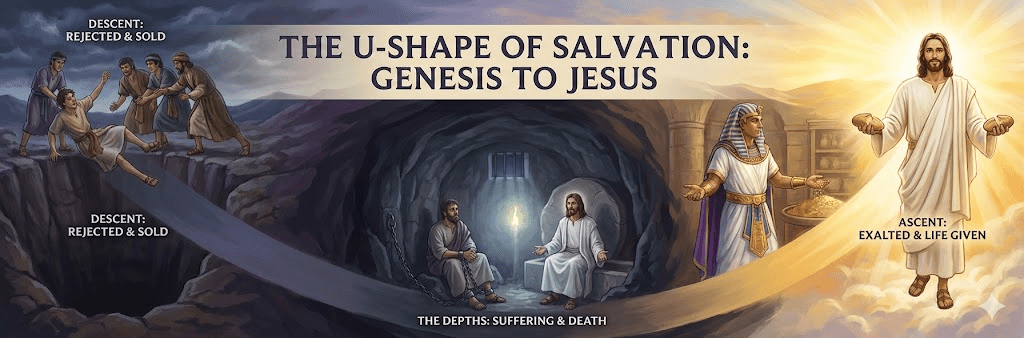
Genesis moves quickly through creation, fall, flood, Babel, Abraham, Isaac, and Jacob. Then the book slows down and stays with Joseph for chapters. The family crisis explains how Israel ends up in Egypt, but the space given to Joseph suggests that Genesis is doing more than moving the family into position for Exodus.
Joseph trains us to recognize the shape of salvation before Jesus arrives. His story moves through descent and rising, guilt and mercy, death and restored life. Genesis puts this rhythm in us early because Christ will fulfill it.
The story-pattern Genesis wants in your bones
Joseph is the beloved son. His brothers envy him, strip him, throw him into a pit, and sell him for silver. They return home with a lie while Joseph is carried into exile.
The path keeps descending. Joseph becomes a slave and then a prisoner, suffering as an innocent man. The story does not rush past his humiliation. It makes us sit with him there before God raises him.
Joseph is lifted to Pharaoh’s right hand and given authority over the kingdom and its storehouses. Bread is placed into his hands, and people come to Egypt for life. Eventually his brothers arrive hungry and guilty, unaware that the man who holds power over their survival is the brother they betrayed.
This is where the story could turn into vengeance. Instead it turns toward revelation, tears, mercy, and reconciliation. Joseph feeds his brothers, preserves their lives, and brings them near.
Genesis tells us how to interpret the whole movement:
“You meant evil against me, but God meant it for good… to bring it about that many people should be kept alive.” (Genesis 50:20)
Real evil happened, and the brothers remain guilty. God does not pretend their sin is harmless or secretly good. He takes the evil they intended and bends it, without endorsing it, toward the saving of many. The one they rejected becomes the one who keeps them alive.
Joseph and the cross
By the time we reach the New Testament, Joseph has given us categories for what God is doing in Christ. This is why his story fits the Fathers’ reading of the cross so well.
They did not treat atonement as a puzzle about making God willing to forgive. They proclaimed a rescue. Humanity is in bondage, corrupted, and dying. Death is an enemy; sin is more than a collection of bad choices; the devil is an accuser and destroyer. God comes down into our condition to break their hold.
Irenaeus speaks of Christ recapitulating humanity, taking up the human story from within and healing it. Athanasius speaks of the Word taking flesh so that by dying he might destroy death and restore humanity to life. When the Fathers use ransom language, they are not all diagramming a literal payment to Satan. The powers seize the innocent one, and that seizure becomes their downfall.
Joseph prepares us for that proclamation. Jesus is the beloved Son, rejected by his own and handed over for silver. He is stripped, shamed, and sent down into death, the final exile and the real pit. God raises him and exalts him as Lord. Life then pours into the world through him: bread for the starving, freedom for captives, forgiveness for sinners, and defeat for death. The disciples who abandoned him are invited near. The risen Christ meets them not with revenge but peace; he restores, feeds, and sends them. Joseph is the type, and Jesus is the fulfillment.
This pattern keeps us from making the cross a narrow mechanism. The cross and resurrection form one saving movement: Christ descends into the enemy’s territory, breaks its power, rises in victory, and gives life to a rescued people. The ascension is his enthronement, and Pentecost shares his life with the Church.
Forgiveness remains precious. Guilt, repentance, sacrifice, and judgment remain real. But the drama is larger than a courtroom scene. It is the defeat of death and the healing of the human race through union with Christ. That is why the patristic model is not an optional angle for me. It fits the larger biblical pattern, including Joseph.
Genesis teaches that God saves by turning evil back on itself. God does not become evil in order to defeat it. He overrules it and breaks it. The brothers mean evil against Joseph, but God means their act for good so that many will live. Christ is handed over for destruction, but God makes the cross the place of salvation.
The payoff
Joseph occupies so much of Genesis because his story lodges this pattern in us before we reach Bethlehem. Once we see it, the Gospels no longer feel like a new religion dropped into history. They read as the climax of a story already underway.
The right response is not admiration for a clever connection. It is to look at Christ and adore him. The God who wrote Joseph’s story has accomplished its pattern in history for the world.
He went down to bring us up. He entered the grave and made it a passage. He took what was meant for evil and made it a place of life.

