Why Does the Joseph Story Occupy So Much of Genesis?

Genesis is supposed to be moving. Creation, fall, flood, Babel, Abraham, Isaac, Jacob. The promise line is in motion.

Then the book almost stops.

It parks on Joseph. Chapters and chapters. Detailed scenes. Slow turns. A long family crisis that becomes the backbone of how Israel ends up in Egypt.

So why does Joseph take up so much space?

Because he is not only explaining how Israel got to Egypt. He is training you how to read the Bible. He is teaching you the shape of salvation before Jesus arrives. And that shape, when you see it clearly, pushes you toward the patristic way of understanding the cross. The victory, the rescue, the healing, the descent and rising. The whole story as liberation and new life.

Genesis wants you to learn this rhythm early, because it is the rhythm Christ will fulfill.

The story-pattern Genesis wants in your bones

Joseph is the beloved son.

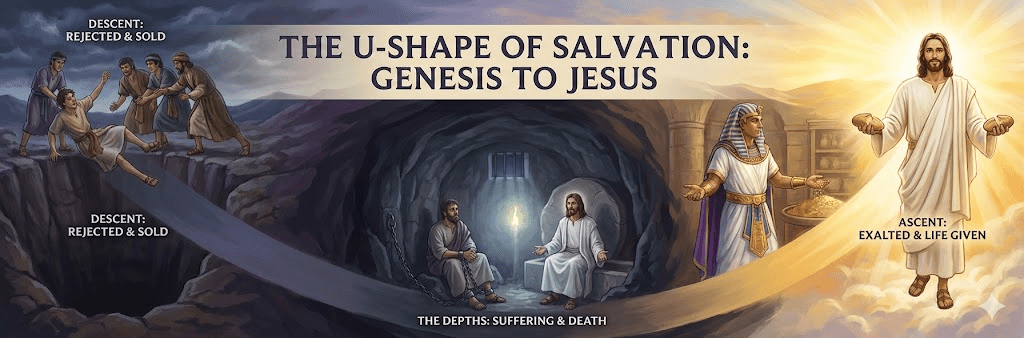
He is rejected by his brothers, Israel. They envy him, hate him, strip him, throw him into a pit, and sell him for silver. They go home and live on top of the lie, while Joseph is carried away like a dead man who still breathes.

Then comes the downward path. Egypt is the land below, the place of exile, the place where you disappear. Joseph becomes a slave. Then he becomes a prisoner. He suffers as an innocent man. The story makes you sit there with him for a long time.

And then God raises him up.

Joseph is lifted to the right hand of the throne. He receives authority over the kingdom. He becomes lord over the storehouses. Bread is placed into his hands.

Then the world starts coming. Nations come to Egypt for life. And eventually his own brothers come too.

They arrive hungry, frightened, and guilty. They do not know who they are standing before. They are face to face with the one they betrayed, and he now has absolute power over their survival.

This is where the story could turn into vengeance.

Instead it turns into revelation, tears, mercy, and reconciliation. Joseph feeds them. He preserves them. He brings them near.

Genesis itself tells you what you are supposed to learn from it:

“You meant evil against me, but God meant it for good… to bring it about that many people should be kept alive.” (Genesis 50:20)

That sentence is the key to the whole mystery.

Real evil happened. The brothers are truly guilty. God does not pretend their sin is fine. And yet God takes the very evil they intended and bends it, without endorsing it, toward the saving of many.

That is the shape.

Why this shape matters when you get to the cross

By the time you reach the New Testament, you should already have categories for what God is doing in Christ. Joseph gives them to you.

Beloved son, rejected by his own. Handed over. Descended into the place below. Humiliated. Then exalted to the throne. Then he becomes life for the world. Then reconciliation.

This is why the Fathers read the cross the way they did.

They did not treat atonement as a puzzle about how God can finally be willing to forgive. They treated it as a rescue mission. Humanity is in bondage, corrupted, and dying. Death is not a metaphor in Scripture. It is an enemy. Sin is not only bad choices. It is a power. The devil is not a cute idea. He is a tyrant, a destroyer, an accuser.

So God comes down into our condition to break it.

Irenaeus talks about Christ recapitulating humanity, redoing the human story from the inside and healing it. Athanasius talks about the Word taking flesh so that, by dying, he might destroy death and restore humanity to life. The Fathers use ransom language at times, and they are not trying to diagram a literal payment to Satan. They are saying something simpler and stronger. The powers seized the innocent one, and that seizure became their downfall.

This is the basic proclamation: Christ entered death and shattered it.

Joseph is the Old Testament practice run for that proclamation.

Jesus as the true Joseph

Jesus is the beloved Son.

He is rejected by his own people. He is handed over. He is sold for silver. He is stripped and shamed. He is treated as cursed. He descends into death itself, the final exile, the real pit.

Then God raises him.

He is exalted as Lord. And what follows is not only a verdict on paper. What follows is life poured out into the world. Bread in his hands. A table set for the starving. Captives released. Sins forgiven. Death losing its claim.

And then comes the part that Joseph trained you for.

Those who betrayed him can still come near.

The risen Christ does not meet his disciples with revenge. He meets them with peace. He restores them. He feeds them. He sends them.

The one wronged becomes the one who saves.

That is Joseph. That is Jesus. Only Jesus is the final version.

The grid this gives you

If you take Joseph seriously, you stop making the cross a narrow mechanism.

You begin to see the cross and resurrection as one act of salvation. The cross is the descent into the enemy’s territory. The resurrection is the victory and the liberation. The ascension is the enthronement. Pentecost is the distribution of life. The church is the rescued people learning to live as a new humanity.

Forgiveness is inside that, and it is precious. Guilt is real. Repentance is real. Judgment is real. But the central drama is bigger than a courtroom scene. It is the defeat of death and the healing of the human race by union with Christ.

That is why the patristic model is not an optional angle. It is the interpretive grid that fits the whole Bible, including Joseph.

Genesis was already teaching you that God saves by turning evil back on itself. God does not become evil to defeat evil. God overrules it, absorbs it, and breaks it.

The brothers meant evil. God meant it for good, so that many would live.

Israel hands over the beloved Son. Evil means it for destruction. God means it for salvation.

The payoff

So the reason Joseph occupies a huge chunk of Genesis is not only because it is a great story.

It is because God wanted to lodge a pattern into you.

Descent. Exile. Suffering. Silence. Then exaltation. Then bread for the world. Then reconciliation.

Once you see that, the gospels stop feeling like a new religion dropped out of the sky. They feel like the climax of a story you have already been reading.

And the right response is not to walk away impressed with a clever connection.

It is to look at Christ and adore him.

Because the God who wrote Joseph’s story has done it in history, for real, for the whole world.

He went down to bring us up.

He entered the grave to make the grave a passage.

He took what was meant for evil and made it the place where life is stored.

That is the mystery Genesis sets up.

And Joseph is how it pays it off, before you ever reach Bethlehem.

Bethlehem as the Beginning of Time

What if the Incarnation did not just enter time, but created it?

The tiny hands that gripped Mary’s finger are the same hands that said, “Let there be light.”

We usually tell the story in a line. First, God creates the world. Then history unfolds. Then, much later, Jesus is born.

That is the order we experience as creatures inside time. It is the right order for us. But it might not be the order for God.

The mystery of Advent is not only that God enters time. It is that time itself may flow from His entry.

I. Bethlehem as the Center

A newborn child lies in a manger. He is wrapped in cloth. He is dependent on his mother. He is a creature of flesh and blood.

But he is also called the Word who was in the beginning. John tells us that all things were made through him. Paul says that in him all things hold together. Colossians calls him the firstborn of all creation. Revelation calls him the Lamb slain before the foundation of the world.

Something deeper is happening here. Maybe the child is not simply entering into history. Maybe history itself is radiating out from him.

II. The Spiral: A New Shape of Time

What if the Incarnation is not the result of Creation, but its cause?

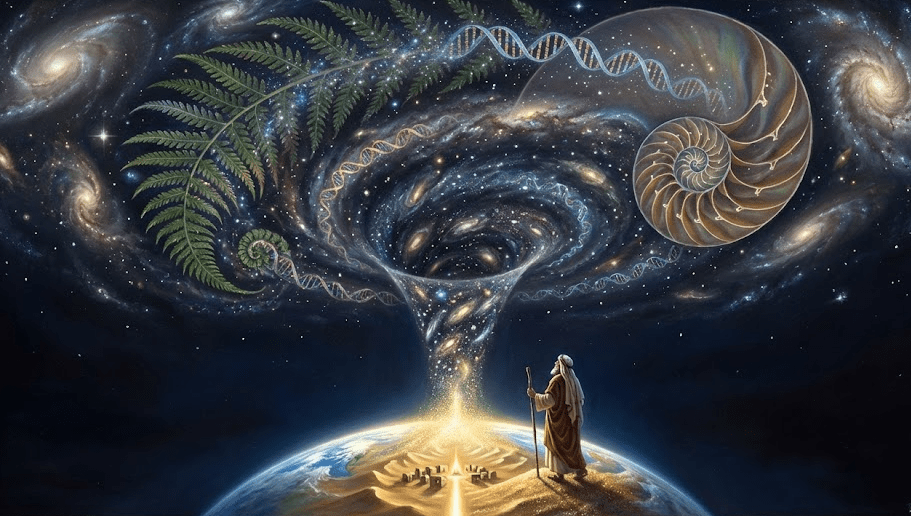
This turns the timeline inside out. Instead of a straight line (Creation, then Incarnation, then Resurrection), the shape becomes a spiral, a closed loop.

The Risen Christ is the eternal image in the mind of God. God creates the world through the Risen Christ. The world produces Mary. Mary gives birth to Christ. Christ suffers, dies, rises, and becomes the Risen Christ. The loop closes. The cause becomes the result, and the result becomes the cause.

In this shape, Bethlehem stands at the beginning of the story, not the middle. The stars were not already burning when Christ appeared. They were lit for the sake of his appearing. The house in Bethlehem is the center of the spiral.

This is an ontological claim, not a poetic flourish.

Genesis happens because of Bethlehem.

III. The Transfiguration as the Interpretive Key

To believe this, we need to explain how something in the middle of time could be the origin of time.

The answer is found on Mount Tabor.

At the Transfiguration, Jesus appears in glory. His face shines like the sun. His clothes become radiant. Moses and Elijah appear. A cloud surrounds him. A voice from heaven declares, This is my beloved Son.

This takes place before the crucifixion and resurrection. The disciples are seeing the risen Christ before he has died.

The Transfiguration is a revelation, not a preview. The veil drops for a moment, and they see what has always been true.

If the glorified Christ can appear before the resurrection, then his glorified body is not bound by temporal sequence. The risen Christ does not only act after Easter. He can act in any moment: before Genesis, during Exodus, at the end of the age.

And if he can act before Genesis, then he can be the one speaking Genesis.

The hands that formed Adam from the dust were already marked by the nails.

IV. Retroactive Causality

Once the human nature is created in Bethlehem and glorified in the Resurrection, it participates in the Eternal Now. It can act upon the past.

The humanity of Christ is not eternal in its own right. It is created from Mary. It is born in time. But once it is united to the divine person and glorified, it begins to share in divine operations.

That is the mystery of the Ascension. To sit at the right hand of the Father is a status of authority and presence, not a location. The glorified humanity of Jesus becomes the instrument through which the Logos acts throughout time.

We already believe this about the Eucharist.

At every Mass, the glorified body of Christ is truly present. Every Mass is a participation in the one sacrifice of Calvary. The glorified body reaches forward two thousand years.

Why should it not also reach backward?

If it can, then we begin to glimpse the full spiral. The risen Lord creates the world in order to enter it. Bethlehem is the reason the timeline exists.

V. The Objections (And Whether They Hold)

A claim like this must be tested. It must withstand pressure from the Church’s dogma. It will be challenged on three fronts.

1. The Ex Nihilo Problem

The objection: Creation from nothing is a divine act. The human nature of Christ is created. It cannot be the agent of an uncreated act.

The response: Creation belongs to God alone. But the human nature of Christ is the instrument of the Divine Person. As the saints and doctors have said, it is the conjunct instrument. It is wielded by the Logos, but not confused with Him.

So when we say the risen Christ created the world, we mean the Divine Person acted through His human nature, just as He later would through the sacraments.

The humanity is not the cause. It is the tool of the cause.

And tools can be wielded anywhere if the hand that uses them is not bound by time.

2. The Action-Before-Existence Problem

The objection: A creature must exist before it can act. A created human nature cannot act before its own creation.

The response: This would be true for any ordinary creature. But the human nature of Christ exists within a person who is eternal. The Transfiguration shows us that His glorified humanity can appear before the resurrection. The Ascension tells us that His body now reigns outside time.

It does not exist eternally. But it can be wielded eternally.

In God’s economy, time is not a string. It is a spiral. From our perspective, the humanity comes later. From God’s perspective, it is present wherever He wills.

3. The Blueprint vs. Architect Problem

The objection: Christ is the blueprint of creation, not its builder. The Logos created the world. The Incarnate Christ came later.

The response: Scripture does not only say the world was made for Christ. It says all things were made through Him. Not only through the Logos Asarkos (Word without flesh), but through the Christos—Jesus the Messiah. Mount Tabor shows us that He is not only the goal. He is the one doing the work.

Why must we insist that the Incarnate One came only afterward? Why can we not say the very body that lay in a manger, the very hands that were pierced, those were the hands that lit the stars?

To say otherwise is to separate the Logos from His human nature more than Chalcedon permits.

VI. The Spiral Holds

Before Abraham was, “I Am.”
In Him, all things hold together.
He is the Alpha and the Omega.

He is not the result of the story.
He is the one who wrote it.
And He wrote Himself into its center.
In Bethlehem.

The Bible Is Not Enough, and to Follow Saints, not Simply Preachers

If I could go back and tell my 18-year-old self one thing, it would be this: the Bible is not enough.

I do not say that because I lost my love for Scripture. I say it because I misunderstood what it was for.

2 Timothy 3:16 was quoted to me as proof that the Bible is sufficient for the Christian life. The text does not say that. It says Scripture is inspired and useful. Useful for teaching, correcting, and training. A tool. But tools do not build by themselves. They need the hands of a craftsman. The Bible needs the Church.

When we tried to make the Bible stand alone, the results spoke for themselves. Endless arguments. Endless church splits. Each man became his own teacher. Preachers could explain Greek grammar but could not govern their own lives. Movements could fill stadiums but could not form disciples.

I followed preachers. John MacArthur. R.C. Sproul. Voddie Baucham. Paul Washer. They were strong voices, but they were not enough. Many of the most famous names in our day ended in scandal. Tullian Tchividjian. Carl Lentz. Bill Hybels. Brian Houston. The Bible in their hands did not stop their collapse.

The solution is not better preachers. The solution is the Church. The Church is the place where God shapes His people. The Bible belongs inside the life of the Church. It is one of the main tools by which the Spirit trains us, but it works rightly only in the household of God.

This is why the saints matter. They are not replacements for Scripture. They are the fruit of the Church. They are proof of what happens when Scripture is read, prayed, and lived within the body of Christ. Augustine confessing his sins. Monica persevering in prayer. Anthony leaving everything for God. Francis choosing poverty. Perpetua walking toward death without fear. These are the lives formed by the Church around the Word.

If you read the Bible in isolation, you will invent a Christianity in your own image. If you follow celebrity preachers, you will invent a Christianity in theirs. If you want a life shaped by Christ, you need the Church. The Bible in her hands. The Spirit at work in her worship. The saints as her fruit.

At eighteen, I thought I needed more knowledge and more preachers. What I really needed was the Church.

The Great Cancer of American Protestantism

The greatest error I needed to resolve in my thinking over the past few years was the mistake of seeing the cross of Christ as a transaction. This is common teaching in American Christianity, and removing it was like surgically removing cancer. I can’t overstate the damage this does to the soul.

If all Christ did was pay a legal debt, all kinds of evil ideas will start to oxidize downstream. It twists the image of the Father into a vengeful despot, cheapens the cross to be a sort of a bank you can swipe the sin credit card on, and misunderstands what problem God is dealing with on a cosmic scale. It’s easy to become embittered by this vision. I empathize with any atheists who have been pitched this vision and have walked away in anger.

It took me many years to recover the historical tradition of the fathers, the ancient teaching of the church. Once you see it, you will never return to a transactional cross again.

God came to unite himself to his creation, so that he could suffer with it, and thereby transfigure it. Transfiguration is what he does. When Jesus was transfigured atop the mountain, it wasn’t a random show off to his three best disciples. It was a hermeneutical key to explain his modus operandi.

The problem with evil is that God cannot touch it. By its definition, evil is not a thing, but the absence of a thing, the privation of God. If he cannot touch evil, he cannot get rid of it. How does he solve this dilemma? He becomes man, and joins himself to his creation. By suffering and dying on the cross, he transfigures, in his flesh, the very suffering introduced by evil itself. What the devil intended for evil God meant for good. The very symbol of death became the tree of life.

A suffering God is the God I long to worship. I can now suffer with joy, because in my suffering I can partake in union with God, who suffers alongside me and has blessed suffering as a means of his grace. There he joins us on the cross, and there we fill up what still remain in the suffering of Christ.

Your Mother Never Knew You: Michael the Archangel, Limbo, and Gene Wolfe’s Wizard Knight

I tore into The Wizard Knight right after finishing Gene Wolfe’s celebrated Book of the New Sun. I expected another dark alien world with Wolfe’s usual cloaked narrative. Instead I found bright meadows, talking cats, honorable knights, and overall a much more straightforward surface read.

Then I reached the final paragraph, closed the cover, and wept. The novel has not left my mind since.

If you have never read Wolfe, this is the easiest book to start with. Knights, dragons, giants, elf queens, princesses… everything sits right on the surface as you’d expect it in a fantasy adventure novel. Yet beneath that bright surface runs the same ocean‑depth you find in his denser books.

Read it once for the adventure. Let it baffle you. Then come back and try to uncover the deeper meanings of the book.

My thesis (spoilers below)

What finally clicked for me is a simple, if startling, idea that I took in a slightly different form from a writeup from Marc Aramini, a writer who knew Wolfe personally:

Able is a child in the womb who is dying, and his adventure in Mythgarthr is a mystical kind of limbo where he gets to live a full lifetime to become a knight.

Everything literal in the book still holds: he is truly fighting giants, time really does run at different speeds on each plane, and he is really experiencing a “world” for himself while literally in the womb of his mother. But the location of that world shifts. Mythgarthr is less a dimension the boy stumbles into and more a limbo where a life too brief for earth can stretch out and ripen.

A few puzzle pieces that lock into place

Puzzle on first readHow it looks through the womb lens
Able’s memories are “mixed up with a little girl’s.”An unborn son sharing the conscious overflow of his mother.
Parka’s silver bow‑string never breaks and whispers like heartbeats.It is the umbilical cord: bright, unbroken, carrying breath and memory from mother to child.
The sea heals Able, and Garsecg calls blood “the sea inside you.”Amniotic water and maternal blood nurturing a child who must fight for life.
Able sees the real Able in an ambulance in America.The “real Able” (the baby on earth) glimpsed from inside the suspended moment via a vision.
Michael the Archangel pauses Able and says, “Your mother never knew you.”Literal for a baby who will never be born alive; Michael prepares the soul to meet Christ.

Suddenly the “two-dimensional” side characters make sense. They are archetypes in a myth crafted for one child’s formation. The dragon, Setr, far from being an external villain, becomes the ego, formidable but capable of being directed toward selfless courage. Every quest trains Able to choose self‑gift over self‑preservation, so that when the moment of earthly death finally arrives he answers it like a knight.

Michael’s Message in the Last Paragraphs

At the very end of The Wizard, we read the following:

“We live in Aelfrice, and for whole days we are children again, as we were the first time I came. Children, we run and shout among the groves and grottoes of an endless wood more beautiful than any you will ever see. Children, we go to the sea I love, to splash in the shallows and play with kelpies. She has given me a new dog, a white puppy with red ears. I call him Farvan; and at night we speak to him of the play now past and the play to come and he tells us puppy things.

But we are not always children, and sometimes we lie upon our backs in fine green grass to watch the world above where time runs swift. There we saw Marder knight Wistan and Bold Berthold slay Schildstarr. Soon time will ripen, and we will come again.

Michael has found me at last, and that is why I have written this for you, Ben. He tells us of a great lord in need of a knight. I have told Michael that I will be this lord’s champion if I may bring my lady. He says it will be permitted.

We go soon. You will see this, Ben, for Michael has found a way. Do not worry about me. I am fine.

All best, Art
(Arthur Ormsby)”

I suspect that this is exactly where Wolfe wanted to land the plane. A “great lord” is likely the closest thing we’ll get to a tip from Wolfe, a strong Catholic. This is none other than Michael the Archangel being sent by Christ to call Able, the baby-turned-knight, into the beatific vision.

My wife and I miscarried three times. I suspect Wolfe wanted to speculate what it would be like for our children to enter limbo. What does Christ do with infants who won’t be able to live a full life? Here, my theory is that Wolfe wanted to do some imaginative theology: he allows them to experience an earth-like fantastical adventure where their souls can truly grow up and be formed into noble souls.

So while the book reads on the surface like a colorful fantasy novel, it seems more like a meditation on what it means for a baby to grow up and become an ideal. And I absolutely adore the idea. I trust that the great Lord cares for all the unborn children who won’t make it, and that he’s going to fully form them into grown knights fit for his service. This is an ending I can consider just, one that I can accept with great peace.

The Engine of the Eschaton: Jesus, Time, and the Power of the Future

Throughout the Gospels, we encounter moments when Jesus heals the sick, restores the blind, raises the dead, and calms the storm. These events feel like cracks in the fabric of reality where the rules of the world give way to something more profound. But beneath these miracles lies a process—one that stretches across time and space, where the future breaks into the present, where the life of the new creation seeps into a world still marred by decay and death.

What if these moments weren’t just divine actions within the here and now but were tied to a much larger unfolding of God’s future kingdom? A process where Jesus was drawing power from the future—the same future the prophets glimpsed in their visions of the enthroned Lord and the restored creation.

In the visions of Isaiah, Ezekiel, and Daniel, we see God revealed in his glory, reigning over a reality where all things have been made new. These prophets were given a glimpse of the future Christ, seated in glory, reigning over the completed new creation. It was not just a symbolic vision—it was a window into the future, a reality already secured in Christ, stretching across time to reveal itself to them.

The Prophets’ Vision of the Future

Isaiah saw the Lord seated on a throne, his robe filling the temple, surrounded by seraphim who cried, “Holy, holy, holy.” Ezekiel witnessed the throne of God carried by living creatures, with wheels full of eyes, a vision so overwhelming that he fell facedown. Daniel, too, saw a vision of the Son of Man coming with the clouds of heaven, brought before the Ancient of Days to be given an everlasting dominion.

What if these prophets, separated by time and circumstance, were all granted visions of the same reality? What they saw was not a vision of their present but of the glorified Christ, reigning in the future. Their vantage points were different, but their vision was unified—they saw the same Lord, the same throne, the same kingdom, already established.

This future reality wasn’t some distant hope for them. It existed beyond time, and they were given access to it through their visions. In those moments, they weren’t just predicting what was to come; they were gazing into a future that was fully present in God. The power they witnessed is the same power that would later work through Jesus during his ministry. The new creation they saw was already alive, waiting to be revealed, waiting to break through into the world.

Jesus Drawing from the Future

In his ministry, Jesus wasn’t just working miracles within the boundaries of the present world. He was reaching into that same future the prophets had seen—the perfected creation, the resurrection life—and bringing it forward into the present. When Jesus healed the blind, restored life to the dead, and multiplied loaves, he was pulling from the fullness of the new creation, allowing it to touch the brokenness of the current world.

Jesus didn’t merely heal bodies; he was bringing the life of the resurrection into those bodies. The blind man’s restored sight wasn’t just a repair—it was a foretaste of the future reality where blindness no longer exists. When Jesus called Lazarus from the tomb, it was more than a resuscitation—it was an echo of the resurrection power that would one day make all things new. Every miracle was part of a larger process, where the future reality of the new creation began to leak into the present, showing glimpses of what was to come.

And this wasn’t just a temporary phenomenon. The future kingdom was always alive in Jesus. As the God-man, he was fully connected to both the present world and the future new creation. The power he drew upon wasn’t a display of isolated divinity; it was the power of the future world, flowing through him. The prophets had seen it in their visions, and Jesus carried it in his very being, channeling it into the present through his actions.

The Spirit and the Flow of New Creation

The presence of the Holy Spirit was key to this process. The Spirit, who descended upon Jesus at his baptism, wasn’t simply there to mark him as the Messiah—it was through the Spirit that the life of the future flowed into him. The Spirit is the active agent connecting the future reality of the new creation to the present, making it possible for Jesus to draw from that future life and manifest it in the here and now.

The miracles of Jesus were not momentary disruptions in the natural order; they were moments where the natural order was touched by the new creation. The Spirit facilitated this connection, allowing the future to break through into the present. The power that the prophets saw in their visions of the future kingdom—the life and glory of the throne room—was the same power the Spirit made available to Jesus in his ministry. Through the Spirit, the life of the future became a present reality, even if only in glimpses.

Jesus’ Resurrected Body: A Glimpse of the Future Creation

After his resurrection, Jesus’ body took on a new nature. It wasn’t bound by the same limitations as before. He could appear in rooms behind locked doors, vanish from sight, and yet he was still physical—he could be touched, and he ate with his disciples. His body was not merely spiritual, nor was it purely physical as we understand it now. It was something more—a new creation body, fully integrated with the life of the future kingdom.

This resurrected body was a glimpse of what is to come. It operated within a different framework, where the laws of time and space no longer applied in the same way. Jesus’ resurrected body was not subject to decay or death. It was a body fully alive in the new creation, and through it, we see the future leaking into the present. This is the future that the prophets had seen, the future that Jesus carried with him and revealed through his life, death, and resurrection.

The New Creation and the Church

This process of the future breaking into the present didn’t end with Jesus. Through the Spirit, the Church is now connected to that same future reality. Paul speaks of the Spirit as a “deposit,” a guarantee of what is to come. The new creation is already alive in us because the Spirit is alive in us. We are fragile vessels, but the treasure we carry is the life of the future, the life of the resurrection that will one day transform the entire cosmos.

The Church is not just waiting for the kingdom to come; we are part of the process by which the kingdom is already breaking into the present. Through the Spirit, we are mediators of this future life, bearing the fruit of the new creation even in a world still marred by sin and death. As Jesus drew from the future to heal and restore, so too does the Spirit work in us to bring the life of the new creation into the world around us.

Speculation: The Process of New Creation Breaking Through

If we venture deeper into theological speculation, we might ask, what is the mechanism behind this process? How does the new creation “leak” into the present? The prophets saw visions of a reality beyond time, a future where God’s glory was fully revealed. Jesus, in his ministry, was already connected to that future, drawing from its life and power.

Could it be that the Spirit serves as the conduit through which this future life flows? The Spirit connects us to the reality of the new creation, allowing its life to touch the present world. The miracles of Jesus were not isolated events—they were part of a larger, ongoing process, a process that continues today through the Spirit. The new creation is leaking into the present, and we, through the Spirit, are participants in that process.

Through the Spirit, the life of the future kingdom is breaking through, one moment at a time, giving us glimpses of the world to come. The process that began with the prophets’ visions, that was embodied in Jesus, and that continues through the Church, is the unfolding of the new creation. It is a reality that is already established, already alive, and it is drawing the present world toward its ultimate renewal.