Why Does the Joseph Story Occupy So Much of Genesis?

Genesis is supposed to be moving. Creation, fall, flood, Babel, Abraham, Isaac, Jacob. The promise line is in motion.

Then the book almost stops.

It parks on Joseph. Chapters and chapters. Detailed scenes. Slow turns. A long family crisis that becomes the backbone of how Israel ends up in Egypt.

So why does Joseph take up so much space?

Because he is not only explaining how Israel got to Egypt. He is training you how to read the Bible. He is teaching you the shape of salvation before Jesus arrives. And that shape, when you see it clearly, pushes you toward the patristic way of understanding the cross. The victory, the rescue, the healing, the descent and rising. The whole story as liberation and new life.

Genesis wants you to learn this rhythm early, because it is the rhythm Christ will fulfill.

The story-pattern Genesis wants in your bones

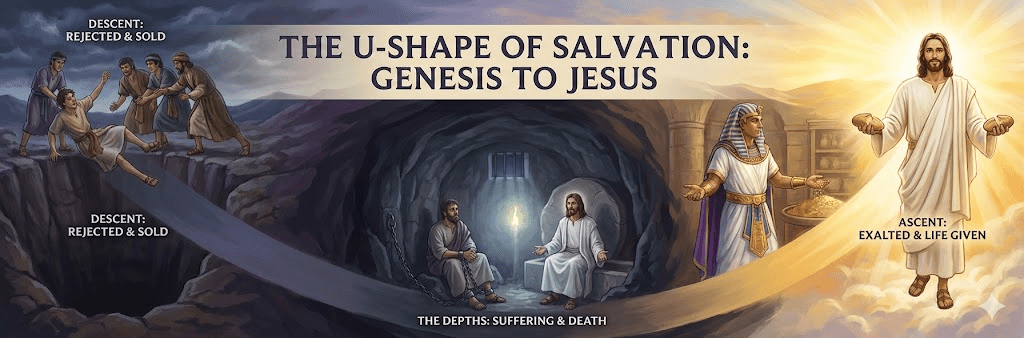
Joseph is the beloved son.

He is rejected by his brothers, Israel. They envy him, hate him, strip him, throw him into a pit, and sell him for silver. They go home and live on top of the lie, while Joseph is carried away like a dead man who still breathes.

Then comes the downward path. Egypt is the land below, the place of exile, the place where you disappear. Joseph becomes a slave. Then he becomes a prisoner. He suffers as an innocent man. The story makes you sit there with him for a long time.

And then God raises him up.

Joseph is lifted to the right hand of the throne. He receives authority over the kingdom. He becomes lord over the storehouses. Bread is placed into his hands.

Then the world starts coming. Nations come to Egypt for life. And eventually his own brothers come too.

They arrive hungry, frightened, and guilty. They do not know who they are standing before. They are face to face with the one they betrayed, and he now has absolute power over their survival.

This is where the story could turn into vengeance.

Instead it turns into revelation, tears, mercy, and reconciliation. Joseph feeds them. He preserves them. He brings them near.

Genesis itself tells you what you are supposed to learn from it:

“You meant evil against me, but God meant it for good… to bring it about that many people should be kept alive.” (Genesis 50:20)

That sentence is the key to the whole mystery.

Real evil happened. The brothers are truly guilty. God does not pretend their sin is fine. And yet God takes the very evil they intended and bends it, without endorsing it, toward the saving of many.

That is the shape.

Why this shape matters when you get to the cross

By the time you reach the New Testament, you should already have categories for what God is doing in Christ. Joseph gives them to you.

Beloved son, rejected by his own. Handed over. Descended into the place below. Humiliated. Then exalted to the throne. Then he becomes life for the world. Then reconciliation.

This is why the Fathers read the cross the way they did.

They did not treat atonement as a puzzle about how God can finally be willing to forgive. They treated it as a rescue mission. Humanity is in bondage, corrupted, and dying. Death is not a metaphor in Scripture. It is an enemy. Sin is not only bad choices. It is a power. The devil is not a cute idea. He is a tyrant, a destroyer, an accuser.

So God comes down into our condition to break it.

Irenaeus talks about Christ recapitulating humanity, redoing the human story from the inside and healing it. Athanasius talks about the Word taking flesh so that, by dying, he might destroy death and restore humanity to life. The Fathers use ransom language at times, and they are not trying to diagram a literal payment to Satan. They are saying something simpler and stronger. The powers seized the innocent one, and that seizure became their downfall.

This is the basic proclamation: Christ entered death and shattered it.

Joseph is the Old Testament practice run for that proclamation.

Jesus as the true Joseph

Jesus is the beloved Son.

He is rejected by his own people. He is handed over. He is sold for silver. He is stripped and shamed. He is treated as cursed. He descends into death itself, the final exile, the real pit.

Then God raises him.

He is exalted as Lord. And what follows is not only a verdict on paper. What follows is life poured out into the world. Bread in his hands. A table set for the starving. Captives released. Sins forgiven. Death losing its claim.

And then comes the part that Joseph trained you for.

Those who betrayed him can still come near.

The risen Christ does not meet his disciples with revenge. He meets them with peace. He restores them. He feeds them. He sends them.

The one wronged becomes the one who saves.

That is Joseph. That is Jesus. Only Jesus is the final version.

The grid this gives you

If you take Joseph seriously, you stop making the cross a narrow mechanism.

You begin to see the cross and resurrection as one act of salvation. The cross is the descent into the enemy’s territory. The resurrection is the victory and the liberation. The ascension is the enthronement. Pentecost is the distribution of life. The church is the rescued people learning to live as a new humanity.

Forgiveness is inside that, and it is precious. Guilt is real. Repentance is real. Judgment is real. But the central drama is bigger than a courtroom scene. It is the defeat of death and the healing of the human race by union with Christ.

That is why the patristic model is not an optional angle. It is the interpretive grid that fits the whole Bible, including Joseph.

Genesis was already teaching you that God saves by turning evil back on itself. God does not become evil to defeat evil. God overrules it, absorbs it, and breaks it.

The brothers meant evil. God meant it for good, so that many would live.

Israel hands over the beloved Son. Evil means it for destruction. God means it for salvation.

The payoff

So the reason Joseph occupies a huge chunk of Genesis is not only because it is a great story.

It is because God wanted to lodge a pattern into you.

Descent. Exile. Suffering. Silence. Then exaltation. Then bread for the world. Then reconciliation.

Once you see that, the gospels stop feeling like a new religion dropped out of the sky. They feel like the climax of a story you have already been reading.

And the right response is not to walk away impressed with a clever connection.

It is to look at Christ and adore him.

Because the God who wrote Joseph’s story has done it in history, for real, for the whole world.

He went down to bring us up.

He entered the grave to make the grave a passage.

He took what was meant for evil and made it the place where life is stored.

That is the mystery Genesis sets up.

And Joseph is how it pays it off, before you ever reach Bethlehem.

Bethlehem as the Beginning of Time

What if the Incarnation did not just enter time, but created it?

The tiny hands that gripped Mary’s finger are the same hands that said, “Let there be light.”

We usually tell the story in a line. First, God creates the world. Then history unfolds. Then, much later, Jesus is born.

That is the order we experience as creatures inside time. It is the right order for us. But it might not be the order for God.

The mystery of Advent is not only that God enters time. It is that time itself may flow from His entry.

I. Bethlehem as the Center

A newborn child lies in a manger. He is wrapped in cloth. He is dependent on his mother. He is a creature of flesh and blood.

But he is also called the Word who was in the beginning. John tells us that all things were made through him. Paul says that in him all things hold together. Colossians calls him the firstborn of all creation. Revelation calls him the Lamb slain before the foundation of the world.

Something deeper is happening here. Maybe the child is not simply entering into history. Maybe history itself is radiating out from him.

II. The Spiral: A New Shape of Time

What if the Incarnation is not the result of Creation, but its cause?

This turns the timeline inside out. Instead of a straight line (Creation, then Incarnation, then Resurrection), the shape becomes a spiral, a closed loop.

The Risen Christ is the eternal image in the mind of God. God creates the world through the Risen Christ. The world produces Mary. Mary gives birth to Christ. Christ suffers, dies, rises, and becomes the Risen Christ. The loop closes. The cause becomes the result, and the result becomes the cause.

In this shape, Bethlehem stands at the beginning of the story, not the middle. The stars were not already burning when Christ appeared. They were lit for the sake of his appearing. The house in Bethlehem is the center of the spiral.

This is an ontological claim, not a poetic flourish.

Genesis happens because of Bethlehem.

III. The Transfiguration as the Interpretive Key

To believe this, we need to explain how something in the middle of time could be the origin of time.

The answer is found on Mount Tabor.

At the Transfiguration, Jesus appears in glory. His face shines like the sun. His clothes become radiant. Moses and Elijah appear. A cloud surrounds him. A voice from heaven declares, This is my beloved Son.

This takes place before the crucifixion and resurrection. The disciples are seeing the risen Christ before he has died.

The Transfiguration is a revelation, not a preview. The veil drops for a moment, and they see what has always been true.

If the glorified Christ can appear before the resurrection, then his glorified body is not bound by temporal sequence. The risen Christ does not only act after Easter. He can act in any moment: before Genesis, during Exodus, at the end of the age.

And if he can act before Genesis, then he can be the one speaking Genesis.

The hands that formed Adam from the dust were already marked by the nails.

IV. Retroactive Causality

Once the human nature is created in Bethlehem and glorified in the Resurrection, it participates in the Eternal Now. It can act upon the past.

The humanity of Christ is not eternal in its own right. It is created from Mary. It is born in time. But once it is united to the divine person and glorified, it begins to share in divine operations.

That is the mystery of the Ascension. To sit at the right hand of the Father is a status of authority and presence, not a location. The glorified humanity of Jesus becomes the instrument through which the Logos acts throughout time.

We already believe this about the Eucharist.

At every Mass, the glorified body of Christ is truly present. Every Mass is a participation in the one sacrifice of Calvary. The glorified body reaches forward two thousand years.

Why should it not also reach backward?

If it can, then we begin to glimpse the full spiral. The risen Lord creates the world in order to enter it. Bethlehem is the reason the timeline exists.

V. The Objections (And Whether They Hold)

A claim like this must be tested. It must withstand pressure from the Church’s dogma. It will be challenged on three fronts.

1. The Ex Nihilo Problem

The objection: Creation from nothing is a divine act. The human nature of Christ is created. It cannot be the agent of an uncreated act.

The response: Creation belongs to God alone. But the human nature of Christ is the instrument of the Divine Person. As the saints and doctors have said, it is the conjunct instrument. It is wielded by the Logos, but not confused with Him.

So when we say the risen Christ created the world, we mean the Divine Person acted through His human nature, just as He later would through the sacraments.

The humanity is not the cause. It is the tool of the cause.

And tools can be wielded anywhere if the hand that uses them is not bound by time.

2. The Action-Before-Existence Problem

The objection: A creature must exist before it can act. A created human nature cannot act before its own creation.

The response: This would be true for any ordinary creature. But the human nature of Christ exists within a person who is eternal. The Transfiguration shows us that His glorified humanity can appear before the resurrection. The Ascension tells us that His body now reigns outside time.

It does not exist eternally. But it can be wielded eternally.

In God’s economy, time is not a string. It is a spiral. From our perspective, the humanity comes later. From God’s perspective, it is present wherever He wills.

3. The Blueprint vs. Architect Problem

The objection: Christ is the blueprint of creation, not its builder. The Logos created the world. The Incarnate Christ came later.

The response: Scripture does not only say the world was made for Christ. It says all things were made through Him. Not only through the Logos Asarkos (Word without flesh), but through the Christos—Jesus the Messiah. Mount Tabor shows us that He is not only the goal. He is the one doing the work.

Why must we insist that the Incarnate One came only afterward? Why can we not say the very body that lay in a manger, the very hands that were pierced, those were the hands that lit the stars?

To say otherwise is to separate the Logos from His human nature more than Chalcedon permits.

VI. The Spiral Holds

Before Abraham was, “I Am.”
In Him, all things hold together.
He is the Alpha and the Omega.

He is not the result of the story.
He is the one who wrote it.
And He wrote Himself into its center.
In Bethlehem.

A Sunlit World: Colored and Warmed by Resurrection

The claim that a man has risen from the dead with an imperishable body, no longer bound by the laws of physics, ought to be considered ridiculous without strong evidence.

And good evidence today must be strong. We should expect evidence across history that the same man who supposedly rose continues to act upon the earth, doing the same kinds of things he did when he first rose:

  • Recruiting his enemies through dreams and visions
  • Appearing humbly and hiding his appearance, teaching in ways that make hearts burn
  • Knitting together unlikely communities, so certain of his presence that they would rather die than fail to testify to what they encounter
  • Quietly moving through the world, breaking bread with the outcast, healing the brokenhearted, and resisting the proud and the powerful

We might go further and expect that a direct, sincere call to him would summon a response, though in his usual unexpected form.

Yes, only then does it make sense to believe such an outrageous claim.
The sunrise is proven not by the sight of the sun but by the warmth and rays of first light.
And if a man has truly risen and ascended, we should expect a sunlit world, warmed and colored by resurrection.

The Donkey as Archetype

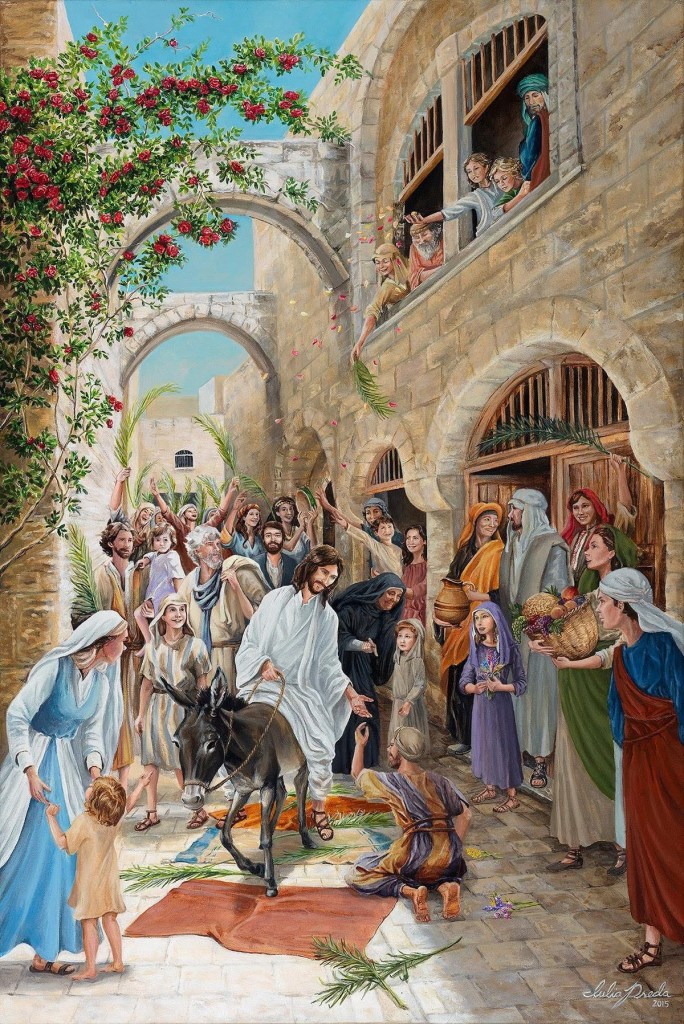
I used to think of Palm Sunday as a classic moral reversal tale: you expect a king to come on a warhorse, but Jesus purposefully downgrades his vehicle to be humble, so that’s why we need to be humble, etc.

But now I see it more deeply as metaphysical. As I said the other week, the Passion logically precedes the universe and helps us decode what is real. That means the triumphal entry is where we should expect to find a definitive truth about the universe. The key axiom appears to be: Godhood is humble, power is lowly, and glory broods like a mother hen.

This means that the warhorse is a representation of evil, a counterfeit. A conquering king upon his steed is a falsehood. There is no such thing as power that doesn’t come as upon a donkey. In fact, that Jesus chose the donkey is a restatement of his rejection of archetypes like the warrior-brute Esau or the chariots of Egypt. These are illusions that claim power but have only succeeded at twisting its definition.

The donkey isn’t the less glorious animal, but the only vehicle that could possibly seat God and reveal what power and glory really are. Our tendencies to want to ride the warhorse are the real inversion, a disorder born of our sickness.

So of course Jesus says the stones will cry out if the people don’t. The palm branches yearn to clap their hands when they glimpse the humility of the scene. It’s only an ironic picture to us because we’ve forgotten the humility and peace of our Father.

The Figure Above the Sapphire Sea

It’s about 2am, and I must write down the journey I had through Exodus tonight.

The long office reading in Liturgy of the Hours today is Exodus 24 where Moses and the elders “see” the one who brought them out of Egypt. It makes note of the clear sapphire floor beneath the figure’s feet, a detail I always found odd. It drove me into a tailspin of parallel research in Revelation and other books to double check some things.

And it got me wondering: who exactly, and I mean very precisely, was sitting atop the sapphire sea? God is ambiguous. John clearly tells us that no one has seen God. Is this another preincarnate Theophany, whatever that is? That feels a bit hand-wavey and vague. Is it a symbolic vision, a type of visual storytelling, as I’ve always understood it? Also hand-wavey, as it doesn’t answer the question precisely.

We know that God resides in the Eternal Present, the “static” reality of eternity (by static, I mean in the programmer’s sense: unchanging and uncreated). Time is an artifact, a creature. The realm of eternity exists above it. This is the biggest mental hurdle to jump for creatures of time like us. It’s easy to say God is not bound by time, and another to stop yourself from thinking God waits for anything. From God’s vantage point, all things are present and at once. He is present at all moments in time and therefore does not wait for anything to happen.

So what about events in time that supposedly happen to God? We say, for example, the Word was incarnate of the Virgin Mary and became man. Did God have to wait for Mary to be born? Before Jesus was conceived, was the Logos in a kind of preincarnate state? If so, what is that state, and how does he, say, walk with Adam, or wrestle with Jacob, or stand with Daniel in the Babylonian furnace?

And that’s when I realized that from God’s vantage point, the incarnation, death, resurrection, and ascension of Jesus are simultaneous. They are already written. In a sense, they are already true and have already happened. God has decreed that he would become man. So from an eternal perspective, God is in some sense always incarnate of the Virgin Mary, and has always been united to man’s nature in the God-man, Jesus.

If Jesus is God in the eternal act, this gives weight behind Paul’s statement that all things were created by Jesus (Col. 1:16). Jesus is the invisible God’s visible image not simply after he was born, but in eternity. That is, when God penned creation by eternal decree, he had fully intended the life of Christ as the representation of himself. God cannot be fully visible by any other image. From our vantage point in time, we are merely awakening to what is already true in the eyes of God.

If we should conceive of Jesus as the eternal image of the Son as we say in the Nicene Creed, are we to believe that, prior to the birth of Jesus, God fashioned a human body for himself to inhabit that is not Jesus? This seems to open more questions. What sort of body or form did he create? What does God do with that body after he’s inhabited it? Was it actually a human body or something else? In what sense did he inhabit it, if he inhabited it at all? This is no way to answer who Moses saw atop Sinai.

Since we know the visible icon of God is Jesus, we should assume, like Paul, this is true throughout time. But isn’t the birth of Jesus in the future from Moses’s vantage point? Yes, but again, Jesus is united to the Logos in the eternal decree of God (the Now). Therefore, in the Now, Jesus is already the lamb slain before the foundation of the world, since those time-bound events are already true in the Now. And therefore, in the Now, Jesus, the carpenter from Nazareth, is God.

So who did Moses see atop Sinai? He saw Jesus. He did not see an ephemeral vision of the Godhead, an impossibility for man, but the image of God, the risen Lord Jesus. The resurrection of Jesus happens in the future time of the Romans, yes, but, once resurrected, the glorified body of Jesus is no longer constrained by time in the same way we are. We know that he is no longer bound by physics because he is able to walk through a locked door, transform his appearance, and appear in multiple places at once. He is also no longer bound by time. We have a very well-known example of a future reality inbreaking into the present: the Transfiguration. It occurs prior to his resurrection, but is the display of his glorified body post-resurrection. This is a Chekov Gun that is dropped midway in the Gospels to demonstrate the mechanism of Jesus’s forward-and-backward ministry. He is now not simply the Lord of heaven and earth, but of time itself. We might call this bilocation or sacramental presence. By virtue of the Hypostatic Union and his resurrected body now ascended, he can miraculously participate in history retroactively.

To put it another way, the one who said, “Let there be light” is rightly identified as the resurrected Jesus. The one who walked with Adam and Eve in the garden was the glorified Jesus. And if Moses had been able to look at the true form of God and had asked to see his hands and side, I speculate that he may have seen nail-pierced hands and a wounded side. The God-man has been and always will be the image of the Creator. And hence, Jesus can rightly tell Phillip that anyone who has seen him has seen the Father, as if it should’ve been obvious by now.

That Christ occupies a preeminent position in time explains the patterns of the universe better: nature’s cycles conform to the Passion rather than the Passion being conformed to nature’s cycles. The author of creation is in fact Jesus. It should therefore be no surprise that everything in creation is a kind of emanation of the Gospel story rather than the Gospel story being one emanation of life. For example, the “circle of life” is patterned after the birth, death, and resurrection of Christ, the concept of “other” and family/friends is patterned from the Trinity, the suffering of life is designed from the cross, and so on. These are emanation of the eternal decree of God from the mind of the author, Christ. It is confusing to us in time because we see the life of Christ happen after creation, but in eternity, the life of Christ logically precedes creation!

One implication of this is that we should see the cosmos as a series of hieroglyphs encoded and revealed only by its Rosetta Stone, the life of Christ. This is why Christ is rightly called the Archetype. The marriage of the eternal (God) and matter (man) is eternally decreed because Christ wills to draw creation into the wedding chambers of divinity. This is in fact why we have creation at all. As Paul says, from him and through him and for him are all things.

I want to describe the implications this has on the Mass, especially the Eucharist, where we find the resurrected body of Christ hiding in the same way he hid from the disciples in the garden of Emmaus and where he consecrates a better Mt. Sinai and meeting place of heaven and earth. But that’s for another night.

The Pure Love of God

Love, But Not Quite

Love is a word we use often, but its true depth is something many of us never fully grasp. We experience love in various forms—toward a partner, a friend, a child, or a cause we’re passionate about. Despite its beauty, however, human love often feels incomplete. There’s always something holding us back, a sense that we’re not able to fully give ourselves to the people we care about. This isn’t necessarily because we lack the desire to love completely, but rather because our very nature, shaped by past experiences and deep-seated fears, often prevents us from fully opening our hearts.

Why Can’t We Love Like We Mean It?

Our ability to love is often compromised by our own psychological limitations. The fear of vulnerability can be paralyzing. To love deeply is to expose ourselves, to risk being hurt or rejected. This fear leads us to build walls around our hearts, holding back parts of ourselves to avoid the pain that might come with true openness.

Instead of embracing love with open arms, we approach it cautiously, protecting ourselves from the very thing we most desire. Our instinct for self-preservation, hardwired into us by years of emotional conditioning, makes us wary of giving too much, lest we lose ourselves or get hurt in the process. The traumas of our past, whether they involve betrayal, loss, or abandonment, leave lasting scars that create emotional blockages. These wounds linger in our psyches, silently shaping how we engage in relationships, often making it difficult to trust or to love without fear. Even when we want to love fully, these unresolved pains keep us tethered to old wounds, limiting our ability to give ourselves completely.

And then there’s the issue of ego. We want to be loved, but often on our own terms. We cling to control, wanting to protect our sense of self and maintain our own interests. This pride can make it difficult to truly surrender to love, as we hold back, giving conditionally rather than fully. These psychological barriers—fear, self-preservation, past traumas, and ego—are deeply rooted, and they make it nearly impossible for us to love with the selflessness and purity that we might aspire to.

A Love That Knows No Limits

But there is a love that knows no such limitations—a love that is completely untainted by the flaws that hold us back. God’s love stands in stark contrast to our own. Where we are afraid, God’s love is bold and unreserved. Where we hold back out of self-preservation, God gives of Himself fully and without hesitation. Unlike our love, which is often shaped by past hurts, God’s love is pure and unchanging, not swayed by fear or the need to protect Himself. It is a love that pours out endlessly, without expectation or condition, without even a hint of self-interest. In God, there are no walls, no barriers, no ego—just a fierce, passionate love that seeks only to give, to heal, and to embrace.

To imagine what it would be like to love as God loves is to step into a realm of love that is beyond our human understanding. It is a love that is entirely selfless, a love that does not waver or withdraw, even when faced with rejection or pain. To love like God is to love with a heart that is wide open, unguarded, and unafraid—a heart that seeks only the good of the other, without any thought of self. This is a love that we, as humans, can only strive to imitate in small ways, as we work to transcend the limitations that hold us back. Yet, even in our imperfect attempts, we can catch glimpses of this divine love, and these glimpses can be transformative, guiding us toward a greater capacity to love others more selflessly.

The Kind of Love That Changes Everything

But perhaps more important than our attempts to imitate this love is the recognition of how deeply we are loved by God. Reflecting on this love should leave us in awe—it’s a love that is so different from our own experiences that it can be difficult to fully comprehend. Romans 8 reminds us of the unbreakable, unyielding nature of this love, a love that is life-changing and edifying. Yet, despite its constancy, we often need to refresh our minds and hearts to truly grasp the magnitude of God’s love for us. We need to continually remind ourselves that God’s love is not like human love, with its flaws and limitations. It is a love that showers us with grace, that pursues us relentlessly, and that remains steadfast even when we falter.

A Love Worth Dwelling On

Contemplating on this divine love will allow it to renew our spirits and transform the way we love others. Let us strive to love more selflessly, to break free from the chains of fear, ego, and past pain. And let us dwell on the truth that we are already loved beyond measure by a God whose love knows no bounds—a love that is worth reflecting on, worth striving for, and worth celebrating every day.

Liturgy of the Hours is Better Than the Rosary

Why You Should Pray the Liturgy of the Hours (and Why It Might Be the Best Prayer Rhythm Ever)

When we became Catholic, we were blown away by the beauty of the Church’s traditions. One of the greatest surprises for us has been the Liturgy of the Hours. It’s structured, deeply rooted in Scripture, and totally connected to the life of the Church. Once we found it, it felt like everything else, including the spiritual practices we grew up with, paled in comparison.

And while the Rosary gets a lot of attention in Catholic circles, we’ve found that it just doesn’t come close to what the Liturgy of the Hours offers. We don’t pray the Rosary in our home. Not because we’re against Mary or dislike repetition, but because we’ve discovered something richer, deeper, and more Christ-centered. We believe more Catholics should seriously consider giving the Liturgy of the Hours pride of place in their daily life.

Our Story

Before Catholicism, we were in the evangelical world. I was a pastor in various churches, and prayer there was usually spontaneous, shaped by whatever the devotional reading or sermon theme was that day. It wasn’t bad, it just lacked consistency. There was no rhythm that tied it all together.

When we entered the Church, we immediately fell in love with the Mass. It was obvious this was the center of everything. But we started to wonder, what does the Church offer to anchor the rest of the day? That’s when we stumbled on the Liturgy of the Hours, and it changed everything.

No more random devotionals or freeform prayers that drifted from day to day. Now, we had a prayer rhythm that followed the seasons of the Church, rooted us in Scripture, and tied us to the prayers of Christians all over the world. And it wasn’t just nice. It was powerful.

What Is the Liturgy of the Hours?

The Liturgy of the Hours (also called the Divine Office) has ancient roots. It started in the Jewish practice of praying the Psalms at set times during the day. The early Church adopted that rhythm, and over time it became a complete daily cycle of prayer that includes Psalms, Scripture readings, and writings from the saints.

It’s not something buried in history books. It’s alive. Priests and religious pray it every day. More and more lay Catholics are discovering it too. When you pray it, you’re joining a living, global rhythm of worship. It brings God into your morning, midday, evening, and night, not just on Sundays, but every day.

Why We Prefer the Liturgy of the Hours Over the Rosary

This isn’t about knocking the Rosary. But the truth is, we don’t find it as helpful or meaningful. The Liturgy of the Hours offers more. Here’s why we think it deserves a bigger role in the spiritual lives of everyday Catholics:

1. It’s All Scripture

When you pray the Liturgy of the Hours, you’re immersed in the Bible. You’re praying the Psalms, reading from the Gospels, the epistles, the Old Testament, every day. It’s not a summary or reflection about Scripture. It is Scripture.

2. It Keeps Christ at the Center

The Rosary is centered on Mary’s experience of Jesus. That’s good, but the Liturgy of the Hours puts Christ Himself right in the middle. It aligns your day with His story, His words, and His mission.

3. It’s Liturgical

Each time you pray the Hours, you’re syncing with the Church’s liturgical calendar. You’re not just praying randomly. You’re entering into a pattern that the Church has kept for centuries. one that flows out from the Mass and sanctifies your whole day.

4. It’s Shared by the Whole Church

Unlike the Rosary, which is a private devotion, the Liturgy of the Hours is the official public prayer of the Church. When you pray it, you’re praying with priests, monks, nuns, and laypeople all over the world. And not just Catholics. Orthodox and some Anglicans pray it too. It’s a prayer of unity.

5. It’s Less About Preference, More About Formation

The Rosary tends to be more individual and preference-driven. Some people love it, some don’t. But the Liturgy of the Hours isn’t about personal preference. It’s about being formed by the rhythm of the Church, day in and day out.

How to Start

It can feel a little intimidating at first, but getting started is easier than you think:

1. Start Small

Begin with Morning Prayer (Lauds) and Evening Prayer (Vespers). Those are the “hinge hours” and they cover most of the spiritual ground.

2. Use a Good App or Website

We use the Divine Office app, and we love it. It’s simple, user-friendly, and even has audio so you can pray along on your commute or while folding laundry.

3. Make It a Real Habit

Set a time each day for prayer. Or flip it: structure your day around prayer. The Church calls this “sanctifying the hours.” It’s not about squeezing God in. It’s about putting Him first.

4. Pray with Others When You Can

If you can find a parish or group that prays the Hours together, jump in. It adds a whole new layer to the experience. But even when you pray alone, you’re never really alone.

Final Thoughts

If you’ve never prayed the Liturgy of the Hours, you’re missing out on one of the richest treasures the Church has to offer. It’s shaped our days, deepened our faith, and brought us into closer communion with the Body of Christ.

We believe more Catholics should lean into this form of prayer. It’s not just for monks and nuns. It’s for you. And in our experience, it’s far more nourishing than the Rosary or any other devotional out there.

If the Mass is the source and summit of our faith, the Liturgy of the Hours is the rhythm that carries you from one to the next. Give it a shot. You won’t regret it.