The Double Cleansing: Why You Should Expect Corruption in Religion

The Gospels record Jesus cleansing the temple in two places, once in John 2, near the beginning of His ministry, and again in the Synoptic Gospels (Matthew 21, Mark 11, Luke 19) during His final week.

Most of us probably remember this as one event. Some read John as placing the same cleansing thematically; others read the accounts as two events. I think the second reading makes the most sense. Jesus went up to Jerusalem regularly, and two cleansings would bookend his public ministry. If he began and ended his ministry this way, we should take notice.

The temple was where people came to worship. But trade and money-changing had taken over its outer courts. The poor bore the cost, and the place called a house of prayer had become entangled with money and power.

Jesus does not ignore it. He drives them out. If the accounts describe two events, then he begins and ends his ministry by confronting the use of religion to take advantage of people, especially the poor.

There will always be cunning minds ready to use religion for profit. That was true then and it is still true now. The Church is holy because she belongs to Christ, but her members remain sinners. Corruption by Christians should grieve us, but it should not surprise us. Refusing surprise does not mean accepting the corruption.

When we see financial scandal or religion used to squeeze the weak, we should name it, protect those harmed, and demand truthful accounting. Jesus’ cleansing of the temple shows where religion is vulnerable and what fidelity requires of us.

We were never promised that every member or leader would be clean. We were called to be faithful within the Church, which includes confronting corruption rather than excusing it. If you follow Jesus, you will face this same fight. Some tables may need to be flipped again.

Jesus cleanses the temple because it belongs to his Father and must be a house of prayer. The lesson is not that we should appoint ourselves reckless table-flippers. It is that we must neither abandon the Church at the first scandal nor make peace with corruption inside her. If the Lord took up this work twice, we should take double notice.
Apart From Me, You Can Do Nothing: Christ the Metaphysical Vine

Echoes of the Mountain

In a previous post, I wrote about Moses and the elders of Israel climbing Mt. Sinai and seeing the God of Israel standing above a sapphire sea. I said that what they saw wasn’t some vague, symbolic presence of God. They saw the Lord Jesus Christ, resurrected, enthroned, and whole.

That sounds strange because Jesus is born in Bethlehem long after Sinai. But God does not watch the story unfold as we do. Bethlehem, Golgotha, and the empty tomb stand present to him. That is why I believe Moses sees not a vague symbol but the risen Christ. Had Moses looked closely, he might have seen the nail scars already there.

If the risen Jesus is not confined to temporal sequence, what does that mean for the world we live in: for our choices, suffering, and joy?

John records Jesus saying, “I am the vine, you are the branches. Whoever abides in Me and I in him, he it is that bears much fruit. For apart from Me, you can do nothing.”

We usually read that as a spiritual principle. I think it reaches deeper.

“Apart from Me you can do nothing” concerns salvation, morality, and existence itself.

Israel and the Church belong to a cosmos rooted in him like branches in a vine.

Christ Before All Things: The Gospel as the Shape of Creation

We tend to imagine that Jesus entered a world already in motion. But the world exists through him and for him. I do not mean Christ as an abstraction. I mean Jesus of Nazareth: the man who preached the Beatitudes, wept at Lazarus’s tomb, bled on the cross, and walked out of the grave. His life is the original pattern of creation. The Gospels show us reality’s grain.

If Christ’s life is the pattern, then sin is a refusal of reality itself. The world trains us in self-preservation, control, transaction, and instant gratification. Fear of lack, pain, or insignificance begins to govern our choices. We may prosper for a time, but we cannot build durable lives against the one through whom all things were made.

Christ’s pattern is self-emptying love, forgiveness, patient endurance, and trust in the Father even unto death. A relationship built only on exchange becomes hollow. A career climbed through ruthless ambition cannot satisfy. An image built on concealment eventually cracks. These are not arbitrary punishments attached to a list of rules. They are the consequences of living against the grain of a creation patterned on Christ. “Apart from Me, you can do nothing”: nothing lasting or fruitful.

To live by this pattern is not to add a few “Jesus things” to an otherwise unchanged life. It is to ask, in work and relationships, “Does this choice resemble Christ?” Does it move toward service, forgiveness, truth, and dependence on the Father? Suffering remains evil and painful, but in Christ it need not be meaningless; it can become participation in the Cross and deeper dependence on the Vine. Work can become service. Possessions can become gifts. Relationships can move beyond transaction into burden-bearing love.

The Only Path That Is

Good behavior alone is too small. We must recognize the pattern and choose, moment by moment, to abide in the Vine.

To abide in him is to stand on the reality of the resurrected Christ, through whom and for whom all things were made. The Christian life is not an escape from the world. It is life in the world as it truly is, patterned after the Man on the mountain and the Lamb upon the throne.

A Sunlit World: Colored and Warmed by Resurrection

The claim that a man has risen from the dead with an imperishable, glorified body ought to be considered ridiculous without strong evidence.

We should expect evidence across history that the same man who rose continues to act upon the earth in recognizable ways:

  • Recruiting his enemies through dreams and visions
  • Appearing humbly and hiding his appearance, teaching in ways that make hearts burn
  • Knitting together unlikely communities, so certain of his presence that they would rather die than deny what they encountered
  • Moving quietly through the world, breaking bread with the outcast, healing the brokenhearted, and resisting the proud and powerful

We might go further and call to Him directly. But prayer is not a laboratory test, and silence does not prove that the person praying was insincere. The claim must stand on more than a promised private response.

The sunrise is proven not only by the sight of the sun but by the warmth and rays of first light. If a man has truly risen and ascended, we should expect a sunlit world, warmed and colored by resurrection.

The Donkey as Archetype

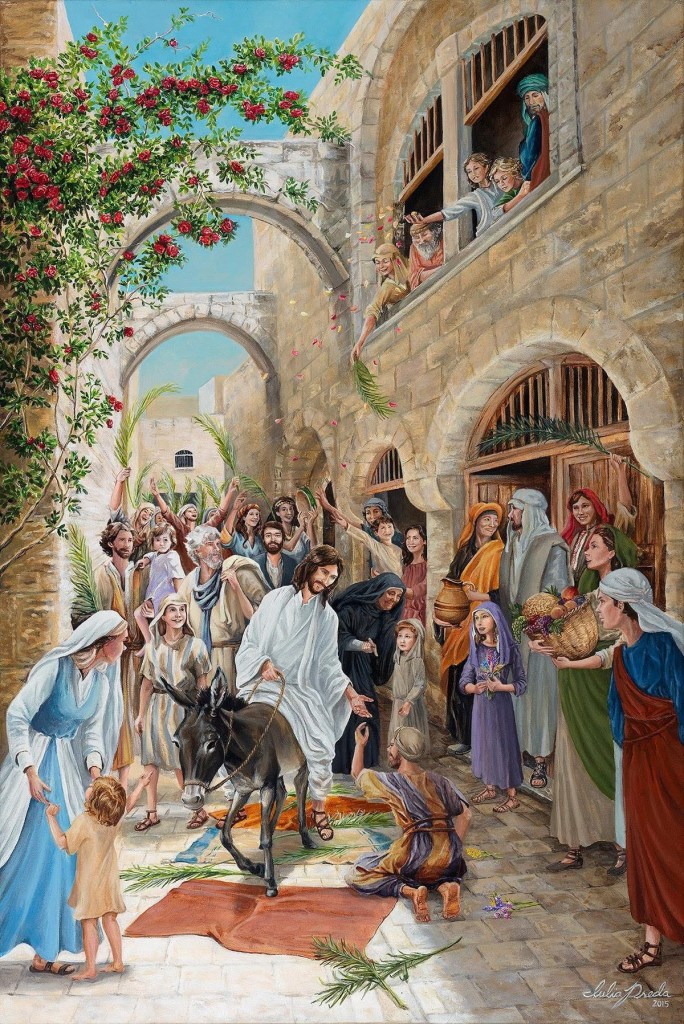
I used to think of Palm Sunday as a simple moral reversal. You expect a king on a warhorse, but Jesus chooses a donkey to teach us humility.

Now I see something metaphysical in it. In God’s eternal purpose, creation is ordered toward Christ and His Passion helps us decode what is real. The triumphal entry reveals how God exercises power in Jesus: lowly, peaceful, and brooding over Jerusalem like a mother hen.

Zechariah had already joined this donkey-riding king to the end of chariots, warhorses, and the battle bow. The warhorse in this scene represents a counterfeit power: domination mistaken for kingship. The animal itself is not evil, and martial authority is not the whole target.

The donkey is not the less glorious animal. It is the only mount that could reveal this King. Our desire for the warhorse is the inversion.

Of course Jesus says the stones will cry out if the people do not. The scene looks ironic only because we have forgotten the humility and peace of our Father.

The Figure Above the Sapphire Sea

It’s about 2am, and I must write down the journey I had through Exodus tonight.

The long office reading in Liturgy of the Hours today is Exodus 24, where Moses and the elders “see” the one who brought them out of Egypt. The text notices the clear sapphire floor beneath the figure’s feet. That odd detail sent me into Revelation and the other throne visions.

Who, precisely, sat above that sapphire sea? John tells us that no one has seen God. Calling this a preincarnate theophany names the event without telling me what Moses saw.

God lives in the Eternal Present, the unchanging and uncreated reality of eternity. Time is a creature. God is present to every moment and does not wait for Mary, the Incarnation, or the Resurrection as we wait for tomorrow.

From our place in time, the Word becomes incarnate, dies, rises, and ascends in sequence. From God’s vantage point, the whole life of Jesus stands within one eternal decree. God always wills the Incarnation. In that sense, His union with human nature in the God-man is never an afterthought.

That eternal decree does not make Christ’s humanity eternal. The Son is eternal according to His divinity; His human nature begins in Mary. Any speculation about the risen Christ acting within earlier history has to preserve that boundary.

Colossians 1 names the Son as the image of the invisible God and says that all things were created through Him. The eternal Son through whom creation comes is the same divine person who takes flesh from Mary. We awaken in time to what God eternally wills without making Christ’s humanity eternal.

That still leaves the body Moses saw. Did God fashion a temporary human form for the occasion, something like Jesus but not Jesus? What was it, and what became of it after the vision?

There is another possibility. The risen body of Jesus passes beyond the ordinary conditions of earthly life without ceasing to be a true human body. He appears behind locked doors and makes Himself present where He wills. The Transfiguration occurs before the Resurrection but displays the glory we associate with the risen Christ. None of those texts directly says that His humanity travels backward in time.

By virtue of the Hypostatic Union and His risen body now ascended, could Jesus participate in history retroactively? Could the figure above the sapphire sea be the glorified Jesus rather than a temporary form?

If so, the one who said, “Let there be light” is rightly identified as Jesus. On this Christological reading, the one who walked with Adam and Eve was Jesus. And if Moses had been able to see His hands and side, perhaps he would have seen the wounds. Exodus does not say this; it is the speculative edge of the argument. The God-man is the image of the Creator. Jesus can tell Philip that anyone who has seen Him has seen the Father.

This also changes how we read creation. Nature’s cycles conform to the Passion rather than the Passion conforming to nature. Birth, death, and new life are patterned after Christ. The distinction between the “other” and the beloved reflects the life of the Trinity. Suffering takes its final shape from the cross. From our place in time, Christ arrives after creation. In the eternal decree, His life logically precedes it.

The cosmos becomes a field of hieroglyphs, and the life of Christ is its Rosetta Stone. This is why Christ is rightly called the Archetype. Creation exists because Christ wills to draw it into the wedding chamber of divinity. As Paul says, from Him and through Him and for Him are all things.

I want to follow this into the Mass, especially the Eucharist, where the risen body of Christ hides as He hid from the disciples on the road to Emmaus and where He consecrates a better Sinai, a meeting place of heaven and earth. But that is for another night.

Five Wellness Practices After the Basics

Sleep, food, exercise, and avoiding smoking and excess alcohol carry most of the weight in a healthy life. Once those are in place, a few smaller practices may help.

1. Get Morning Sun Exposure

Light early in the day can help set the circadian rhythm that governs sleep and wakefulness. Dr. Andrew Huberman recommends getting outside within the first 30 minutes after waking. I treat that as a practical cue, not a medical cutoff or a guarantee of better sleep.

Spending some time outside after waking is an easy experiment. Do not stare at the sun, and keep whatever eye protection you need. The useful habit is morning outdoor light, not perfect compliance with a complicated protocol.

2. Practice Grounding

Grounding, or earthing, means walking barefoot on grass or sand. I like it because it gets me outside and puts my feet on something other than a floor or a shoe.

Claims about electrical charge, inflammation, sleep, and chronic pain run ahead of the evidence. Going barefoot outside costs nothing, but I treat it as a pleasant habit, not a treatment.

3. Use a Sauna Regularly

A long-running Finnish study found an association between frequent sauna use and lower cardiovascular and all-cause mortality. That observation is interesting, but it does not establish a longevity treatment or a dose that applies to everyone.

The study does not prove that sauna use caused longer life, and sweating is not a substitute for the body’s normal detoxification systems. Sauna can also create risks for some people. Follow the facility’s safety guidance, stop if you feel unwell, and seek medical advice when pregnancy, a health condition, or medication makes heat exposure a real clinical question.

4. Eat Fermented Foods for Gut Health

Kimchi, kefir, sauerkraut, and yogurt contain live microbes or the products of fermentation. They can add variety to the diet and may support the gut microbiome, which plays a role in digestion and immune function.

The evidence does not make every fermented food a treatment for every gut problem. Including foods you tolerate can be a simple dietary habit, especially when they replace a more processed option. It is not a dosage or a probiotic prescription.

5. Reduce Avoidable Exposures

Modern life includes chemicals we do not need to seek out. Small changes can reduce exposure without turning the house into a laboratory.

Pesticides in Produce: Wash fruits and vegetables thoroughly. A baking soda and water soak may remove some surface pesticide residue, although it cannot remove everything absorbed into the food.

Household Cleaners and Artificial Fragrances: Use the simplest product that does the job, ventilate the room, and be skeptical of both “natural” and heavily fragranced marketing. The label matters more than the aesthetic.

Glyphosate (Roundup): Glyphosate remains controversial. If you are managing weeds at home and a lower-risk method will work, there is no need to use it.

None of these practices outranks sleep, diet, exercise, or medical care. They are support pillars. Pick one that fits your life, watch whether it helps, and do not confuse a wellness habit with a miracle.

Saint Jean de Brébeuf and the Missionary Power of Love

Today’s Office of Readings gave me a better picture of what drives missionary work.

Saint Jean de Brebeuf left France in the seventeenth century and spent nearly two decades among the Huron people in what is now Canada. He learned their language, lived through brutal winters, disease, and hunger, and remained when the mission put his life at risk.

In 1649, Iroquois warriors captured and tortured him. They cut his body, placed burning coals on his skin, and poured boiling water over him in mockery of baptism. Brebeuf endured it without cursing his captors.

Fear of hell is often offered as the engine of evangelism: without eternal stakes, why cross an ocean or risk death? Brebeuf’s own words give another answer. He loved Christ and wanted to share in His Passion for the good of his neighbor.

From his diary entry shared in today’s Office of Readings:

“For two days now I have experienced a great desire to be a martyr and to endure all the torments the martyrs suffered.

Jesus, my Lord and Savior, what can I give you in return for all the favors you have first conferred on me? I will take from your hand the cup of your sufferings and call on your name. I vow before your eternal Father and the Holy Spirit, before your most holy Mother and her most chaste spouse, before the angels, apostles and martyrs, before my blessed fathers Saint Ignatius and Saint Francis Xavier—in truth I vow to you, Jesus my Savior, that as far as I have the strength I will never fail to accept the grace of martyrdom, if some day you in your infinite mercy would offer it to me, your most unworthy servant.

I bind myself in this way so that for the rest of my life I will have neither permission nor freedom to refuse opportunities of dying and shedding my blood for you, unless at a particular juncture I should consider it more suitable for your glory to act otherwise at that time. Further, I bind myself to this so that, on receiving the blow of death, I shall accept it from your hands with the fullest delight and joy of spirit. For this reason, my beloved Jesus, and because of the surging joy which moves me, here and now I offer my blood and body and life. May I die only for you, if you will grant me this grace, since you willingly died for me. Let me so live that you may grant me the gift of such a happy death. In this way, my God and Savior, I will take from your hand the cup of your sufferings and call on your name: Jesus, Jesus, Jesus!

My God, it grieves me greatly that you are not known, that in this savage wilderness all have not been converted to you, that sin has not been driven from it. My God, even if all the brutal tortures which prisoners in this region must endure should fall on me, I offer myself most willingly to them and I alone shall suffer them all.”

Here is a man moved by the Passion of Christ and a desire to bear that love to his neighbor. His urgency is unmistakable. So is its source.

Martyrs at Large

Brebeuf was not alone. Ignatius of Antioch longed to be united with Christ in martyrdom. Perpetua faced death in the arena with confidence that she would see Christ. The martyrs did not treat suffering as meaningless pain. They received it as witness, union with Christ, and hope of resurrection.

This does not make judgment unreal or conversion unnecessary. Brebeuf grieved that God was not known and that sin had not been driven from the land. But his words do show that missionary courage does not need fear as its deepest motive.

Love can carry a person across the ocean, into another people’s life, and finally to the cross. The Church’s mission is strongest when that love is plain: Christ is worth knowing, and our neighbor is worth the cost of telling.

The Engine of the Eschaton: Jesus, Time, and the Power of the Future

Jesus heals the sick, restores the blind, raises the dead, and calms the storm. These miracles are more than divine acts within the present world. They are moments when the life of God’s future kingdom enters a world still marked by decay and death.

What if Jesus was drawing the power of that future into the present, the same restored creation the prophets glimpsed in their visions of the enthroned Lord? I do not mean that the future is an independent energy source or that the Son lacks divine power. I mean that His signs make the promised end operative in a world still under death.

The Prophets’ Vision of the Future

Isaiah saw the Lord seated on a throne, His robe filling the temple while seraphim cried, “Holy, holy, holy.” Ezekiel saw living creatures carrying the throne of God over wheels full of eyes. Daniel saw the Son of Man come with the clouds and receive everlasting dominion from the Ancient of Days.

These men were separated by time and circumstance, but their visions converge on one reality: the Lord reigning in glory over His kingdom.

They were not only predicting a distant event. For a moment they saw a future already secure in God. Their visions help name the kingdom Jesus would announce and reveal in His ministry.

Jesus and the Future Kingdom

When Jesus restored sight, multiplied loaves, and called Lazarus from the tomb, the perfected creation touched the broken one. Each miracle showed in miniature what His kingdom would do to hunger, blindness, decay, and death.

The blind man’s sight was a foretaste of a world without blindness. Lazarus walking from the tomb echoed the resurrection that will one day make all things new. The future was not replacing the present all at once. It was breaking through in signs.

Jesus did not borrow power from a future source. As the divine Son made man, He acted with the Father and the Spirit. “Drawing from the future” names the direction of the sign: the broken present receives the shape of its promised end because the kingdom is already present in its King.

The Spirit and the New Creation

The Spirit descended upon Jesus at His baptism and revealed Him as the Messiah. The Spirit did not supply a power the eternal Son lacked. Father, Son, and Spirit act together as the signs of the kingdom become visible in His ministry.

His miracles did not violate the natural order for spectacle. They showed the natural order healed. The life and glory seen by the prophets became present in a blind man’s eyes, a hungry crowd’s bread, and a dead man walking from his grave.

Jesus’ Resurrected Body: A Glimpse of the Future Creation

After the resurrection, Jesus’ body entered a new mode of life. He appeared behind locked doors and vanished from sight, yet He could be touched and ate with His disciples. He was physical, but no longer subject to decay and death.

His risen body is the clearest glimpse of the future creation. The world to come is not an escape from matter. It is matter made incorruptible.

The New Creation and the Church

This movement did not end with Jesus’ earthly ministry. Paul calls the Spirit a “deposit,” the guarantee of what is to come. The Church carries the firstfruits of resurrection life while remaining fragile and mortal.

We do not merely wait for the kingdom. Through the Spirit, we bear its fruit in the present. The kingdom the prophets glimpsed, Jesus announced, and the resurrection unveiled continues to make its claim through His body, the Church.

The new creation is already established in Christ. Through the Spirit it breaks into the world one life at a time, drawing the present toward its renewal.

Creativity as the Calling of Christians

God’s Poetry and the Call to Create

N.T. Wright once pointed out the word Paul uses in Ephesians 2:10: we are God’s handiwork, His poetry or artwork. We are not afterthoughts or assembly-line products. God made us deliberately, and He made us for good works.

That means Christians cannot spend life waiting for God to “come back and fix it all.” We are His work, made to take part in His work.

A Creative God, A Creative People

Creation bears the care of its Maker, from the stars to the smallest atom. Human beings bear His image and receive the task of cultivation and stewardship.

Christ does more than patch a broken system. He makes us new creations. Paul tells us in Philippians 2 to have the mind of Christ, and that mind turns power into service.

Our work, relationships, and care for the world should therefore show the craftsmanship of the God who made us. Christian life is active. We receive what God has made and bring our own gifts to it.

Creativity Is a Christian Calling

Genesis joins creation to cultivation. God makes the world, then gives human beings work within it. The New Testament uses the same living image: life in the Spirit bears fruit.

A line attributed to C.S. Lewis says that being in God’s image means we are made to “create in the same sense that He creates.” The wording needs a source, and the distinction matters: God creates from nothing; we receive a world and work with what He gives. We make, tend, repair, and restore because we are creatures of the Maker.

This does not require a grand artistic vocation. It can happen in code, soil, wood, meals, classrooms, families, and neighborhoods. The point is faithful attention to the part of creation placed in our hands.

Rejecting Fatalism

Christians sometimes speak as if God will destroy everything and start over, so work in the present world barely matters. That is not the New Testament hope. The kingdom has already broken into the world through Christ, and we are called to participate in it now.

We still await the fullness of that kingdom. But waiting does not mean idleness. It means bringing beauty, order, justice, and care into the places God has given us.

Our efforts do not build the kingdom by their own power. They answer the God who is making all things new. Even small acts of making and repair can bear witness to His future.

A Life of Creative Engagement

We are God’s handiwork, made in Christ for good works. So make something. Tend something. Repair what has been neglected. Use the gift instead of burying it.

As God’s handiwork, we have the privilege of becoming faithful makers under Him. Our work is not in vain.

Set Your Ambition on Becoming a Saint

When I was a pastor, I used to run the mile from my house to the gym instead of driving. I wanted to keep my heart healthy and push my body.

One day my wife mentioned the routine to another pastor’s wife. Her response was immediate: “What, is that a pride thing?”

That suspicion followed ambition through much of the Christian culture I knew. If you wanted to excel, test your limits, or build something difficult, someone was ready to call it pride.

Then I encountered a line attributed to Pope Gregory the Great: “Do not fear to set your ambition to become a saint.” It gave me a better question. I did not need to bury my drive. I needed to decide what it served.

Ambition and Pride

Ambition can be selfish. It can seek recognition, rank, and control. But drive can also be consecrated. It can build up the weak, serve the poor, strengthen the Church, and glorify God.

Gregory’s challenge aims ambition at the highest goal: sainthood. Holiness requires more than passivity. It requires discipline, endurance, and the willingness to give your strength away.

The Example of Judas in The Chosen

The latest season of The Chosen puts this tension into Judas. He comes to Jesus’ ministry with plans for collections, rewards, and expansion. The other disciples push back and tell him to “just do the work you’re told.”

His problem is not that he thinks boldly. It is that his ambition bends toward control instead of love. I wish the writers had made that distinction more clearly. The Judas on screen did not need less strength. He needed strength ordered by the Beatitudes.

Ambition Ordered by Love

St. Paul writes in Philippians 2:3, “Do nothing from selfish ambition or conceit, but in humility count others more significant than yourselves.” He names the corrupt form: selfish ambition. Christian greatness spends itself for another.

A second line attributed to Gregory says, “Where love exists, it works great things.” Love decides whether strength becomes service or self-worship. Ambition grounded in love builds, protects, and gives.

The world does not need Christians who are afraid to be strong. It needs Christians who know what their strength is for.

So set your ambition on becoming a saint. Consecrate your passion and your dreams of higher things to serve the lower things. Lift up the Lord Jesus and, with Him, your neighbor.