O My Son Absalom

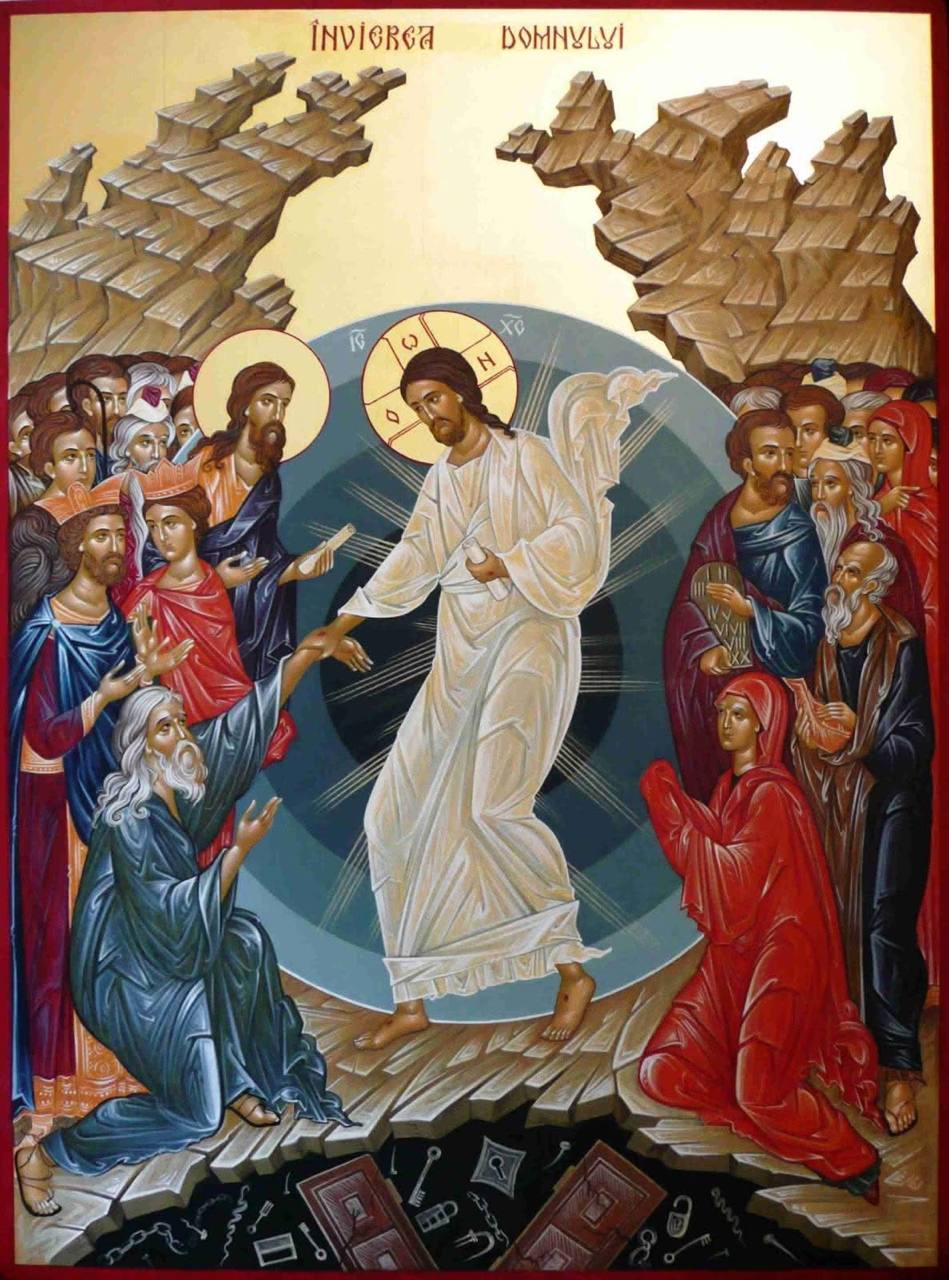
Învierea Domnului — Anastasis icon

The king was deeply moved, and went up to the chamber over the gate, and wept; and as he went, he said, ‘O my son Absalom, my son, my son Absalom! Would that I had died instead of you, O Absalom, my son, my son!’

— 2 Samuel 18

Absalom, the guilty son, hangs in the tree and dies a rebel. Joab and his men pierce him, and his death ends the rebellion of a false kingdom.

Christ, the innocent Son, hangs on the tree and dies the true King. After his death, a Roman spear pierces his side. His death opens the true kingdom.

David’s weeping over Absalom is an icon of God’s compassion for Adam. His wish to die in his son’s place becomes a type that Christ fulfills in his Passion, rescuing his brothers and bringing the fallen children of Adam into the kingdom of his Father.

(Icon pictured: Easter and the rescue of Adam and Eve. I believe that’s David in the background.)

We Do Not Have His Eyes

When Jesus says “Do not judge,” he’s warning us about blindness, hypocrisy, and the measure we use against other people.

We see fragments. God sees the whole person. We see the public act. He sees the childhood, the wounds, the lies absorbed, the habits formed, the long road of choices that ended at that moment. None of that excuses evil. But it explains why our judgments so often miss the mark.

Discernment isn’t condemnation. Christians still have to name sin. Parents correct, courts sentence, and churches discipline. Discernment tells the truth, protects people, and looks for repair. Condemnation shrinks a person down to their worst moment.

Christ alone judges perfectly. He sees intention and ignorance, wounds and freedom, grace resisted and grace received. And he judges with pierced hands. His judgment is merciful truth, without blindness or malice. Final judgment belongs to him.

In God, mercy doesn’t cancel justice. It brings justice to its proper end. His judgment within history calls us to repentance, healing, and restoration, and his final judgment tells the whole truth about our response. God doesn’t call darkness light. He drags it into the light.

“Do not judge” is a call to humility. Name evil without turning it into a performance. Protect victims without stripping offenders of their humanity. Refuse gossip dressed up as righteousness. Pray for the people you’re tempted to hate. Leave final verdicts to Christ.

We don’t have his eyes. We’re working with half-sight at best. So we don’t get to play God.

Tell the truth. Do justice. Love mercy. Walk humbly.

Israel as the Icon of Earth

The Pattern

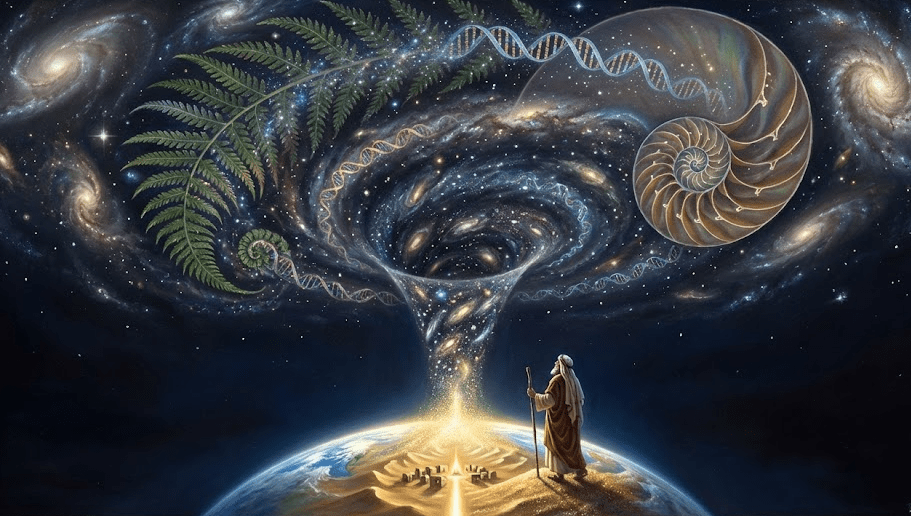
Consider the spiral: a fern uncurling, a fingerprint, a hurricane, a galaxy. The image repeats at radically different scales. It gives us a way to picture a movement Scripture makes again and again: outward toward the whole world, but inward toward a small and hidden center.

The Small and the Chosen

Israel was not selected because it was mighty among nations. Deuteronomy says the Lord set his love on Israel though it was the fewest. David was the youngest son, overlooked when Samuel came calling. Mary lived in Nazareth, the village behind Nathanael’s question: can anything good come from there? Christ says the Kingdom belongs to the little ones and its mysteries are revealed to infants.

The center of gravity in salvation history is rarely the obvious seat of power. Again and again, God chooses the hidden, the overlooked, and the least.

The Hidden Village of the Cosmos

Now lift your eyes. Our sun is one star in the Milky Way, and the Milky Way is one galaxy in a universe whose visible extent is almost impossible to grasp. Earth is very small within it.

And the Word became flesh here. The Creator became a particular man in a particular place and time: a Jew in Roman-occupied Palestine, born among animals, raised in obscurity, and executed as a criminal. If Israel was chosen among the nations, Earth has been chosen within the cosmos. Our planet is the hidden village from which salvation came.

The Icon

Here is the mystery worth pondering: God’s selection of Israel is the icon of his selection of Earth.

I mean icon in the Christian sense: a visible particular that opens onto a larger reality. The God who chose Israel also chose this small planet as the place of the Incarnation. He hides his glory in dust and ashes, bread and wine, water and oil. He counts hairs and marks the fall of sparrows. The scandal of particularity is not a problem to solve but a revelation to receive. The particular opens onto the universal; the local becomes the gate to the cosmic.

The Kingdom Within

The movement does not stop at the planetary or national. It continues inward. Christ says the Kingdom is in our midst, and the Christian contemplative tradition also traces its work within the soul. There is a hidden center in you, overlooked perhaps even by yourself, where God wishes to dwell.

The Carmelite tradition speaks of the interior castle, the deepest chamber of the soul where the King takes up residence. Meister Eckhart spoke of the Seelenfünklein, the spark of the soul; Augustine said God was more inward to him than his own inwardness. You are your own Nazareth, small and easily overlooked. That is where the weight falls: where God has chosen to dwell.

Blessed are the poor in spirit, for theirs is the kingdom of heaven.

Your Mother Never Knew You: Michael the Archangel, Limbo, and Gene Wolfe’s Wizard Knight

I tore into The Wizard Knight right after finishing Gene Wolfe’s celebrated Book of the New Sun. I expected another dark alien world wrapped in Wolfe’s usual obscurity. Instead I found bright meadows, talking cats, honorable knights, and a much clearer adventure.

Then I reached the final paragraph, closed the cover, and wept. The novel has not left my mind since.

If you have never read Wolfe, this is the easiest book to start with. Knights, dragons, giants, elf queens, princesses… it has everything you would expect from a fantasy adventure, with the depth of his denser books underneath.

Read it once for the adventure. Let it baffle you. Then come back and try to uncover the deeper meanings of the book.

My thesis (spoilers below)

What finally clicked for me is a simple, if startling, idea that I took in a slightly different form from a writeup from Marc Aramini, a writer who knew Wolfe personally:

Able is a child in the womb who is dying, and his adventure in Mythgarthr is a mystical kind of limbo where he gets to live a full lifetime to become a knight.

On this reading, Able still fights giants and time still runs at different speeds on each plane. But Mythgarthr is less a dimension the boy stumbles into than a limbo where a life too brief for earth can stretch out and ripen while he lies in his mother’s womb.

A few puzzle pieces that lock into place

Puzzle on first read How it looks through the womb lens
Able’s memories are “mixed up with a little girl’s.” An unborn son sharing the conscious overflow of his mother.
Parka’s silver bow‑string never breaks and whispers like heartbeats. It is the umbilical cord: bright, unbroken, carrying breath and memory from mother to child.
The sea heals Able, and Garsecg calls blood “the sea inside you.” Amniotic water and maternal blood nurturing a child who must fight for life.
Able sees the real Able in an ambulance in America. The “real Able” (the baby on earth) glimpsed from inside the suspended moment via a vision.
Michael the Archangel pauses Able and says, “Your mother never knew you.” Literal for a baby who will never be born alive; Michael prepares the soul to meet Christ.

The side characters now read as archetypes in a myth crafted for one child’s formation. Even the dragon Setr can be read as Able’s ego: formidable, but capable of being turned toward courage. Every quest trains Able to choose self‑gift over self‑preservation, so that when earthly death arrives he answers it like a knight.

Michael’s Message in the Last Paragraphs

At the very end of The Wizard, we read the following:

“We live in Aelfrice, and for whole days we are children again, as we were the first time I came. Children, we run and shout among the groves and grottoes of an endless wood more beautiful than any you will ever see. Children, we go to the sea I love, to splash in the shallows and play with kelpies. She has given me a new dog, a white puppy with red ears. I call him Farvan; and at night we speak to him of the play now past and the play to come and he tells us puppy things.

But we are not always children, and sometimes we lie upon our backs in fine green grass to watch the world above where time runs swift. There we saw Marder knight Wistan and Bold Berthold slay Schildstarr. Soon time will ripen, and we will come again.

Michael has found me at last, and that is why I have written this for you, Ben. He tells us of a great lord in need of a knight. I have told Michael that I will be this lord’s champion if I may bring my lady. He says it will be permitted.

We go soon. You will see this, Ben, for Michael has found a way. Do not worry about me. I am fine.

All best, Art
(Arthur Ormsby)”

I suspect this is where Wolfe meant to lead us. The “great lord” is the closest thing we get to a direct clue. I read Michael as the archangel sent by Christ to call Able, the baby-turned-knight, into the beatific vision.

My wife and I miscarried three times. I suspect Wolfe wanted to imagine what it might be like for children like ours to enter limbo. What does Christ do with infants who won’t live a full life on earth? Wolfe gives one possible answer: an earth-like adventure in which a child can grow up and be formed into a noble soul.

The book is a colorful fantasy adventure, but it also reads as a meditation on a child growing into the person he never had time to become on earth. I adore the idea. I trust the great Lord with the children we lost, and I trust that no life is too brief for him to bring it to fullness. This is an ending I can consider just, one that I can accept with great peace.

The Engine of the Eschaton: Jesus, Time, and the Power of the Future

Jesus heals the sick, restores the blind, raises the dead, and calms the storm. These miracles are more than divine acts within the present world. They are moments when the life of God’s future kingdom enters a world still marked by decay and death.

What if Jesus was drawing the power of that future into the present, the same restored creation the prophets glimpsed in their visions of the enthroned Lord? I do not mean that the future is an independent energy source or that the Son lacks divine power. I mean that His signs make the promised end operative in a world still under death.

The Prophets’ Vision of the Future

Isaiah saw the Lord seated on a throne, His robe filling the temple while seraphim cried, “Holy, holy, holy.” Ezekiel saw living creatures carrying the throne of God over wheels full of eyes. Daniel saw the Son of Man come with the clouds and receive everlasting dominion from the Ancient of Days.

These men were separated by time and circumstance, but their visions converge on one reality: the Lord reigning in glory over His kingdom.

They were not only predicting a distant event. For a moment they saw a future already secure in God. Their visions help name the kingdom Jesus would announce and reveal in His ministry.

Jesus and the Future Kingdom

When Jesus restored sight, multiplied loaves, and called Lazarus from the tomb, the perfected creation touched the broken one. Each miracle showed in miniature what His kingdom would do to hunger, blindness, decay, and death.

The blind man’s sight was a foretaste of a world without blindness. Lazarus walking from the tomb echoed the resurrection that will one day make all things new. The future was not replacing the present all at once. It was breaking through in signs.

Jesus did not borrow power from a future source. As the divine Son made man, He acted with the Father and the Spirit. “Drawing from the future” names the direction of the sign: the broken present receives the shape of its promised end because the kingdom is already present in its King.

The Spirit and the New Creation

The Spirit descended upon Jesus at His baptism and revealed Him as the Messiah. The Spirit did not supply a power the eternal Son lacked. Father, Son, and Spirit act together as the signs of the kingdom become visible in His ministry.

His miracles did not violate the natural order for spectacle. They showed the natural order healed. The life and glory seen by the prophets became present in a blind man’s eyes, a hungry crowd’s bread, and a dead man walking from his grave.

Jesus’ Resurrected Body: A Glimpse of the Future Creation

After the resurrection, Jesus’ body entered a new mode of life. He appeared behind locked doors and vanished from sight, yet He could be touched and ate with His disciples. He was physical, but no longer subject to decay and death.

His risen body is the clearest glimpse of the future creation. The world to come is not an escape from matter. It is matter made incorruptible.

The New Creation and the Church

This movement did not end with Jesus’ earthly ministry. Paul calls the Spirit a “deposit,” the guarantee of what is to come. The Church carries the firstfruits of resurrection life while remaining fragile and mortal.

We do not merely wait for the kingdom. Through the Spirit, we bear its fruit in the present. The kingdom the prophets glimpsed, Jesus announced, and the resurrection unveiled continues to make its claim through His body, the Church.

The new creation is already established in Christ. Through the Spirit it breaks into the world one life at a time, drawing the present toward its renewal.

Tribute to My Father, Paul Kern (1972-2024)

Rest in peace, Paul Alan Kern (1972-2024).

There’s a lot in this story. It will be difficult to capture the whole portrait of who he was, but I will do my best:

Audacious, proud, fiercely passionate, deeply emotional, reserved but charismatic. A rebel without a cause.

He drops out of school around junior high and gets involved in the gangs of LA in the 1980’s.

He falls in love, gets married in his teens, and fathers two sons. Things do not go well. Devastated by a divorce, he retreats back to his parents’ house with his two young boys.

Life as a single dad is unconventional. He gets the crazy idea to unschool the boys—he doesn’t like the system but doesn’t have an alternative. He can’t do beyond elementary math, so he does his best to print worksheets, collect books, and share his love of reading.

While on a walk, he discovers a kendo dojo and a Japanese community in the late 90’s and signs his boys up. It becomes an incubator, deeply forming the three. He paints helicopters, works on cars, and does manual labor on the side to scrape by.

Having had a good experience in the Japanese community, he signs his sons up to a Japanese baseball team, and somehow winds up as the head coach. He leads a ragtag team named the Samurais through a few leagues and across several years and is celebrated as a beloved coach.

He decides one day the boys need to at least attend middle school. So he finds a small private Lutheran school to enroll them in despite being strapped for cash. It’s hard to keep them out of trouble, especially the oldest.

The family has all sorts of adventures together. Life is good living in LA with the grandparents and the boys tucked into one small and cozy house.

Things slow down a bit as the boys get into public high school. Their grades are terrible, and sometimes it seems they might slide into his old ways.

But he was unaware of one thing. He left an old worn Bible on the shelf of the room they shared, the one his father recommended, the one he used to try to turn his life around. He didn’t know that one of his sons was wrestling with existential questions and finding his way into it, looking for answers. This son has a life-altering spiritual experience while reading the letters of St. Paul and commits himself to Christ. The two boys, transformed significantly, set out to forge their own path.

They scrap their way into community college, then into a small Christian college further out of the city, and then into jobs. It was time for them to leave home on their own adventures away from dad, bringing the glory days with his sons to an end. What was left for him to do?

He meanders for a bit, but finally musters up the will at 50 years old to get his GED and enroll in community college courses.

He’s brilliant and loved by students and professors. He excels at his studies and gets accepted into UCLA. He attends and has the time of his life studying his favorite subject, history, in the kind of environment he always longed for. He TA’s for a tenured professor and begins envisioning plans to teach abroad.

He studies in the day and spends his afternoons helping his mother caretake for his father, who passes away at a ripe old age. He dreams of new lands, a fresh start, and another chapter.

Sadly, he will never go on to finish his degree. Suddenly and quickly, he is overtaken by heart failure. He fights and rebels even in his last moments. He breathes his last in the company of his family and friends, the blazing path of a maverick at last snuffed out.

And so ends the earthly tale of Paul Kern.

There’s no way I can get to everything: the brotherhood he found in the gangs, the days spent speeding down California highways in our 70’s pickup truck, his acting career in Hollywood, his Jiu Jitsu training with the Gracie’s, his first drafts at an adventure novel, his struggle with being something of a Jon Snow (let the reader understand).

He nursed many wounds and traumas privately by himself. Yes, he was full of flaws, but it’s easy to say that. It’s much harder to understand the whole man, what he overcame, and ultimately what he accomplished, not only by himself but through the sons he staked everything on.

His life is a lesson that it’s never too late to write the second half of your tale, that God can slowly mend the pieces that shattered in you long ago, and that the love you pour into your children and those you influence will sprout like olive shoots, leafing and branching out across the flow of time, bearing good fruit for the earth and blessing descendants for thousands of years to come.

But I’ve waxed eloquent long enough. I really have a simple message to deliver: I loved my dad, and I’m forever grateful I got to be his son.

I look forward to the resurrection of the dead and the life of the world to come. Amen.