Why Does the Joseph Story Occupy So Much of Genesis?

Genesis is supposed to be moving. Creation, fall, flood, Babel, Abraham, Isaac, Jacob. The promise line is in motion.

Then the book almost stops.

It parks on Joseph. Chapters and chapters. Detailed scenes. Slow turns. A long family crisis that becomes the backbone of how Israel ends up in Egypt.

So why does Joseph take up so much space?

Because he is not only explaining how Israel got to Egypt. He is training you how to read the Bible. He is teaching you the shape of salvation before Jesus arrives. And that shape, when you see it clearly, pushes you toward the patristic way of understanding the cross. The victory, the rescue, the healing, the descent and rising. The whole story as liberation and new life.

Genesis wants you to learn this rhythm early, because it is the rhythm Christ will fulfill.

The story-pattern Genesis wants in your bones

Joseph is the beloved son.

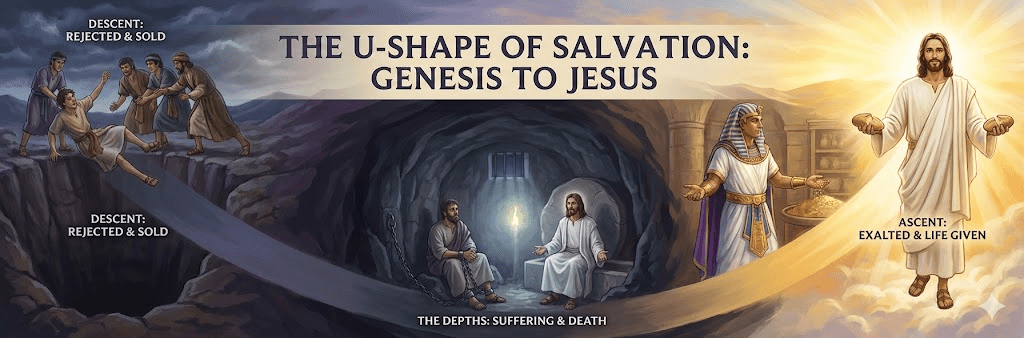
He is rejected by his brothers, Israel. They envy him, hate him, strip him, throw him into a pit, and sell him for silver. They go home and live on top of the lie, while Joseph is carried away like a dead man who still breathes.

Then comes the downward path. Egypt is the land below, the place of exile, the place where you disappear. Joseph becomes a slave. Then he becomes a prisoner. He suffers as an innocent man. The story makes you sit there with him for a long time.

And then God raises him up.

Joseph is lifted to the right hand of the throne. He receives authority over the kingdom. He becomes lord over the storehouses. Bread is placed into his hands.

Then the world starts coming. Nations come to Egypt for life. And eventually his own brothers come too.

They arrive hungry, frightened, and guilty. They do not know who they are standing before. They are face to face with the one they betrayed, and he now has absolute power over their survival.

This is where the story could turn into vengeance.

Instead it turns into revelation, tears, mercy, and reconciliation. Joseph feeds them. He preserves them. He brings them near.

Genesis itself tells you what you are supposed to learn from it:

“You meant evil against me, but God meant it for good… to bring it about that many people should be kept alive.” (Genesis 50:20)

That sentence is the key to the whole mystery.

Real evil happened. The brothers are truly guilty. God does not pretend their sin is fine. And yet God takes the very evil they intended and bends it, without endorsing it, toward the saving of many.

That is the shape.

Why this shape matters when you get to the cross

By the time you reach the New Testament, you should already have categories for what God is doing in Christ. Joseph gives them to you.

Beloved son, rejected by his own. Handed over. Descended into the place below. Humiliated. Then exalted to the throne. Then he becomes life for the world. Then reconciliation.

This is why the Fathers read the cross the way they did.

They did not treat atonement as a puzzle about how God can finally be willing to forgive. They treated it as a rescue mission. Humanity is in bondage, corrupted, and dying. Death is not a metaphor in Scripture. It is an enemy. Sin is not only bad choices. It is a power. The devil is not a cute idea. He is a tyrant, a destroyer, an accuser.

So God comes down into our condition to break it.

Irenaeus talks about Christ recapitulating humanity, redoing the human story from the inside and healing it. Athanasius talks about the Word taking flesh so that, by dying, he might destroy death and restore humanity to life. The Fathers use ransom language at times, and they are not trying to diagram a literal payment to Satan. They are saying something simpler and stronger. The powers seized the innocent one, and that seizure became their downfall.

This is the basic proclamation: Christ entered death and shattered it.

Joseph is the Old Testament practice run for that proclamation.

Jesus as the true Joseph

Jesus is the beloved Son.

He is rejected by his own people. He is handed over. He is sold for silver. He is stripped and shamed. He is treated as cursed. He descends into death itself, the final exile, the real pit.

Then God raises him.

He is exalted as Lord. And what follows is not only a verdict on paper. What follows is life poured out into the world. Bread in his hands. A table set for the starving. Captives released. Sins forgiven. Death losing its claim.

And then comes the part that Joseph trained you for.

Those who betrayed him can still come near.

The risen Christ does not meet his disciples with revenge. He meets them with peace. He restores them. He feeds them. He sends them.

The one wronged becomes the one who saves.

That is Joseph. That is Jesus. Only Jesus is the final version.

The grid this gives you

If you take Joseph seriously, you stop making the cross a narrow mechanism.

You begin to see the cross and resurrection as one act of salvation. The cross is the descent into the enemy’s territory. The resurrection is the victory and the liberation. The ascension is the enthronement. Pentecost is the distribution of life. The church is the rescued people learning to live as a new humanity.

Forgiveness is inside that, and it is precious. Guilt is real. Repentance is real. Judgment is real. But the central drama is bigger than a courtroom scene. It is the defeat of death and the healing of the human race by union with Christ.

That is why the patristic model is not an optional angle. It is the interpretive grid that fits the whole Bible, including Joseph.

Genesis was already teaching you that God saves by turning evil back on itself. God does not become evil to defeat evil. God overrules it, absorbs it, and breaks it.

The brothers meant evil. God meant it for good, so that many would live.

Israel hands over the beloved Son. Evil means it for destruction. God means it for salvation.

The payoff

So the reason Joseph occupies a huge chunk of Genesis is not only because it is a great story.

It is because God wanted to lodge a pattern into you.

Descent. Exile. Suffering. Silence. Then exaltation. Then bread for the world. Then reconciliation.

Once you see that, the gospels stop feeling like a new religion dropped out of the sky. They feel like the climax of a story you have already been reading.

And the right response is not to walk away impressed with a clever connection.

It is to look at Christ and adore him.

Because the God who wrote Joseph’s story has done it in history, for real, for the whole world.

He went down to bring us up.

He entered the grave to make the grave a passage.

He took what was meant for evil and made it the place where life is stored.

That is the mystery Genesis sets up.

And Joseph is how it pays it off, before you ever reach Bethlehem.

Bethlehem as the Beginning of Time

What if the Incarnation did not just enter time, but created it?

The tiny hands that gripped Mary’s finger are the same hands that said, “Let there be light.”

We usually tell the story in a line. First, God creates the world. Then history unfolds. Then, much later, Jesus is born.

That is the order we experience as creatures inside time. It is the right order for us. But it might not be the order for God.

The mystery of Advent is not only that God enters time. It is that time itself may flow from His entry.

I. Bethlehem as the Center

A newborn child lies in a manger. He is wrapped in cloth. He is dependent on his mother. He is a creature of flesh and blood.

But he is also called the Word who was in the beginning. John tells us that all things were made through him. Paul says that in him all things hold together. Colossians calls him the firstborn of all creation. Revelation calls him the Lamb slain before the foundation of the world.

Something deeper is happening here. Maybe the child is not simply entering into history. Maybe history itself is radiating out from him.

II. The Spiral: A New Shape of Time

What if the Incarnation is not the result of Creation, but its cause?

This turns the timeline inside out. Instead of a straight line (Creation, then Incarnation, then Resurrection), the shape becomes a spiral, a closed loop.

The Risen Christ is the eternal image in the mind of God. God creates the world through the Risen Christ. The world produces Mary. Mary gives birth to Christ. Christ suffers, dies, rises, and becomes the Risen Christ. The loop closes. The cause becomes the result, and the result becomes the cause.

In this shape, Bethlehem stands at the beginning of the story, not the middle. The stars were not already burning when Christ appeared. They were lit for the sake of his appearing. The house in Bethlehem is the center of the spiral.

This is an ontological claim, not a poetic flourish.

Genesis happens because of Bethlehem.

III. The Transfiguration as the Interpretive Key

To believe this, we need to explain how something in the middle of time could be the origin of time.

The answer is found on Mount Tabor.

At the Transfiguration, Jesus appears in glory. His face shines like the sun. His clothes become radiant. Moses and Elijah appear. A cloud surrounds him. A voice from heaven declares, This is my beloved Son.

This takes place before the crucifixion and resurrection. The disciples are seeing the risen Christ before he has died.

The Transfiguration is a revelation, not a preview. The veil drops for a moment, and they see what has always been true.

If the glorified Christ can appear before the resurrection, then his glorified body is not bound by temporal sequence. The risen Christ does not only act after Easter. He can act in any moment: before Genesis, during Exodus, at the end of the age.

And if he can act before Genesis, then he can be the one speaking Genesis.

The hands that formed Adam from the dust were already marked by the nails.

IV. Retroactive Causality

Once the human nature is created in Bethlehem and glorified in the Resurrection, it participates in the Eternal Now. It can act upon the past.

The humanity of Christ is not eternal in its own right. It is created from Mary. It is born in time. But once it is united to the divine person and glorified, it begins to share in divine operations.

That is the mystery of the Ascension. To sit at the right hand of the Father is a status of authority and presence, not a location. The glorified humanity of Jesus becomes the instrument through which the Logos acts throughout time.

We already believe this about the Eucharist.

At every Mass, the glorified body of Christ is truly present. Every Mass is a participation in the one sacrifice of Calvary. The glorified body reaches forward two thousand years.

Why should it not also reach backward?

If it can, then we begin to glimpse the full spiral. The risen Lord creates the world in order to enter it. Bethlehem is the reason the timeline exists.

V. The Objections (And Whether They Hold)

A claim like this must be tested. It must withstand pressure from the Church’s dogma. It will be challenged on three fronts.

1. The Ex Nihilo Problem

The objection: Creation from nothing is a divine act. The human nature of Christ is created. It cannot be the agent of an uncreated act.

The response: Creation belongs to God alone. But the human nature of Christ is the instrument of the Divine Person. As the saints and doctors have said, it is the conjunct instrument. It is wielded by the Logos, but not confused with Him.

So when we say the risen Christ created the world, we mean the Divine Person acted through His human nature, just as He later would through the sacraments.

The humanity is not the cause. It is the tool of the cause.

And tools can be wielded anywhere if the hand that uses them is not bound by time.

2. The Action-Before-Existence Problem

The objection: A creature must exist before it can act. A created human nature cannot act before its own creation.

The response: This would be true for any ordinary creature. But the human nature of Christ exists within a person who is eternal. The Transfiguration shows us that His glorified humanity can appear before the resurrection. The Ascension tells us that His body now reigns outside time.

It does not exist eternally. But it can be wielded eternally.

In God’s economy, time is not a string. It is a spiral. From our perspective, the humanity comes later. From God’s perspective, it is present wherever He wills.

3. The Blueprint vs. Architect Problem

The objection: Christ is the blueprint of creation, not its builder. The Logos created the world. The Incarnate Christ came later.

The response: Scripture does not only say the world was made for Christ. It says all things were made through Him. Not only through the Logos Asarkos (Word without flesh), but through the Christos—Jesus the Messiah. Mount Tabor shows us that He is not only the goal. He is the one doing the work.

Why must we insist that the Incarnate One came only afterward? Why can we not say the very body that lay in a manger, the very hands that were pierced, those were the hands that lit the stars?

To say otherwise is to separate the Logos from His human nature more than Chalcedon permits.

VI. The Spiral Holds

Before Abraham was, “I Am.”
In Him, all things hold together.
He is the Alpha and the Omega.

He is not the result of the story.
He is the one who wrote it.
And He wrote Himself into its center.
In Bethlehem.

The Bible Is Not Enough, and to Follow Saints, not Simply Preachers

If I could go back and tell my 18-year-old self one thing, it would be this: the Bible is not enough.

I do not say that because I lost my love for Scripture. I say it because I misunderstood what it was for.

2 Timothy 3:16 was quoted to me as proof that the Bible is sufficient for the Christian life. The text does not say that. It says Scripture is inspired and useful. Useful for teaching, correcting, and training. A tool. But tools do not build by themselves. They need the hands of a craftsman. The Bible needs the Church.

When we tried to make the Bible stand alone, the results spoke for themselves. Endless arguments. Endless church splits. Each man became his own teacher. Preachers could explain Greek grammar but could not govern their own lives. Movements could fill stadiums but could not form disciples.

I followed preachers. John MacArthur. R.C. Sproul. Voddie Baucham. Paul Washer. They were strong voices, but they were not enough. Many of the most famous names in our day ended in scandal. Tullian Tchividjian. Carl Lentz. Bill Hybels. Brian Houston. The Bible in their hands did not stop their collapse.

The solution is not better preachers. The solution is the Church. The Church is the place where God shapes His people. The Bible belongs inside the life of the Church. It is one of the main tools by which the Spirit trains us, but it works rightly only in the household of God.

This is why the saints matter. They are not replacements for Scripture. They are the fruit of the Church. They are proof of what happens when Scripture is read, prayed, and lived within the body of Christ. Augustine confessing his sins. Monica persevering in prayer. Anthony leaving everything for God. Francis choosing poverty. Perpetua walking toward death without fear. These are the lives formed by the Church around the Word.

If you read the Bible in isolation, you will invent a Christianity in your own image. If you follow celebrity preachers, you will invent a Christianity in theirs. If you want a life shaped by Christ, you need the Church. The Bible in her hands. The Spirit at work in her worship. The saints as her fruit.

At eighteen, I thought I needed more knowledge and more preachers. What I really needed was the Church.

The Great Cancer of American Protestantism

The greatest error I needed to resolve in my thinking over the past few years was the mistake of seeing the cross of Christ as a transaction. This is common teaching in American Christianity, and removing it was like surgically removing cancer. I can’t overstate the damage this does to the soul.

If all Christ did was pay a legal debt, all kinds of evil ideas will start to oxidize downstream. It twists the image of the Father into a vengeful despot, cheapens the cross to be a sort of a bank you can swipe the sin credit card on, and misunderstands what problem God is dealing with on a cosmic scale. It’s easy to become embittered by this vision. I empathize with any atheists who have been pitched this vision and have walked away in anger.

It took me many years to recover the historical tradition of the fathers, the ancient teaching of the church. Once you see it, you will never return to a transactional cross again.

God came to unite himself to his creation, so that he could suffer with it, and thereby transfigure it. Transfiguration is what he does. When Jesus was transfigured atop the mountain, it wasn’t a random show off to his three best disciples. It was a hermeneutical key to explain his modus operandi.

The problem with evil is that God cannot touch it. By its definition, evil is not a thing, but the absence of a thing, the privation of God. If he cannot touch evil, he cannot get rid of it. How does he solve this dilemma? He becomes man, and joins himself to his creation. By suffering and dying on the cross, he transfigures, in his flesh, the very suffering introduced by evil itself. What the devil intended for evil God meant for good. The very symbol of death became the tree of life.

A suffering God is the God I long to worship. I can now suffer with joy, because in my suffering I can partake in union with God, who suffers alongside me and has blessed suffering as a means of his grace. There he joins us on the cross, and there we fill up what still remain in the suffering of Christ.

The Double Cleansing: Why You Should Expect Corruption in Religion

The Gospels record Jesus cleansing the temple in two places, once in John 2, near the beginning of His ministry, and again in the Synoptic Gospels (Matthew 21, Mark 11, Luke 19) during His final week.

Most of us probably remember this as one event. Some say it was one event remembered in different ways, or John organizing his Gospel thematically. But most of the Church Fathers took the accounts as separate. That reading makes the most sense. Jesus went up to Jerusalem each year. If he began and ended his public ministry by cleansing the temple, we should see that as deliberate. It bookends his ministry and indicates a very important message.

The temple was where people came to worship. But over time, it had become a place to make money. The traders and moneychangers set up shop in the outer courts. The poor had to pay extra. The outsiders were pushed aside. It was still called a house of prayer, but that name no longer matched what was happening inside.

Jesus does not ignore it. He drives them out. He flips the table not once, but twice. What was he confronting? He was confronting the way religion can be used to take advantage of people, especially the poor.

There will always be cunning minds ready to use religion for profit. That was true then and it is still true now. What I’m suggesting is that this is normal. We shouldn’t be scandalized by a greedy and corrupt church. The Gospels are not just stories. They show us the patterns we should expect throughout our life journeys.

So when we see corruption in our churches, or financial scandal, or religion used to squeeze the weak, we should not act surprised. This is what Jesus took pains to clean up twice deliberately, as if to underline the point: this is where religion is vulnerable, and this is where you need to join me in cleaning it up.

We were never promised clean institutions. We were called into them to take up this work. If you follow Jesus, you will face this same fight. Some tables may need to be flipped again.

It would be foolish to walk away from religion because of its corruptions, knowing full well that Jesus almost seemed more passionate about his religious system because of it. But it would also be ignorant to be scandalized by what you see. If the Lord took up a job twice, we should take double notice. Fully expect a corrupt religious system, and let the impurity be a fire in your belly to cleanse it so as to make way for a house of prayer.

Apart From Me, You Can Do Nothing: Christ as Real Metaphysical Vine

Echoes of the Mountain

In a previous post, I wrote about Moses and the elders of Israel climbing Mt. Sinai and seeing the God of Israel standing above a sapphire sea. I said that what they saw wasn’t some vague, symbolic presence of God. They saw the Lord Jesus Christ, resurrected, enthroned, and whole.

That might sound strange to some. Isn’t Jesus born in Bethlehem long after Sinai? Yes. But that is only if you are still thinking inside the frame of time. I tried to lay it out there. God doesn’t dwell in time. He isn’t watching the story unfold like we are. From His view, everything is present. The birth in Bethlehem, the cross on Golgotha, the empty tomb in the garden. All of it stands before Him as one living reality. That is why Moses sees a man on the mountain with a body. That is why I said if Moses had looked closely, he might have seen the nail scars already there.

And so, if that is true, if Jesus is not just in time but over it and beyond it, then I want to press a step further. What does that mean for the world we live in? What does it say about your life, your choices, your suffering, your joy?

John records Jesus saying, “I am the vine, you are the branches. Whoever abides in Me and I in him, he it is that bears much fruit. For apart from Me, you can do nothing.”

We usually read that as a spiritual principle. But what if it is deeper than that?

What if it is not just spiritual, but also the nature of reality itself? What if “apart from Me you can do nothing” is not only about salvation or morality, but about existence itself?

What if the universe, not just Israel and not just the Church but the entire cosmos, is rooted in Him like branches from a vine?

Christ Before All Things: The Gospel as the Shape of Creation

We tend to imagine that Jesus enters into a world already in motion, as if God builds a stage, writes the rules of physics and history, and then, at some point, Jesus steps into the play. But that is not quite right. It is actually the reverse. The play exists because of Jesus; the stage was designed to hold Him, and the story bends around Him like light through a prism. We have to learn to think backward, or better yet, eternally. Christ is not a product of creation; creation is the product of Christ. And this isn’t Christ in the abstract, not just the eternal Logos as some disembodied force of reason. I mean Jesus of Nazareth – the one who preached the Beatitudes, who wept at Lazarus’s tomb, who bled on the cross, who walked out of the grave, the one with rough hands, a body of wounds, and eyes that have seen both death and glory. His life is the original pattern after which creation was fashioned. This means the Gospels are the blueprint of reality, not merely a response to reality. Yet, even within the church, we are often not formed to carefully consider this truth in how we approach our lives and decisions.

If Christ’s life is the original pattern, the source code of creation, then choosing a path contrary to His isn’t merely “sinful” in a religious sense. It’s choosing anti-reality, like trying to breathe water or build a house on quicksand. The structures you build will fail, not because God is punishing you, but because they defy the fundamental physics of existence as designed by Christ. Consider the operating system the world often runs on: a focus on self-preservation, prioritizing personal needs and comfort, hoarding resources, and seeking advancement above all. Relationships become transactional exchanges where love is conditional and forgiveness is granted only when personally beneficial. There’s a drive for control over circumstances, people, and image, meticulously managing perceptions. Life becomes a chase for instant gratification – the fleeting high of a purchase, praise, or pleasure, ignoring the long-term cost. Underlying much of this is fear: fear of lack, pain, insignificance, or missing out, allowing these fears to dictate boundaries and choices.

This worldly operating system feels pragmatic, even necessary for survival, but it runs directly contrary to the blueprint. Christ’s pattern is one of self-emptying (kenosis), sacrificial love, forgiveness extended before repentance, vulnerability, patient endurance, and trusting the Father even unto death. Therefore, when you choose the world’s way, the consequences are baked into the structure of reality itself. That relationship built on transaction will become hollow because reality is patterned on the self-giving love reflected in the Trinity and the Cross. That career climbed through ruthless ambition will feel empty because reality is patterned on service and fruitfulness for others, like the Vine and Branches. That carefully constructed image will inevitably shatter because reality is patterned on the vulnerability and truth revealed in Christ. That pursuit of fleeting pleasure will leave you barren because reality is patterned on the enduring joy found through, not around, suffering and sacrifice, as seen in the Passion and Resurrection. You see people desperately trying to patch these crumbling structures with more therapy, another self-help book, a new relationship, or a bigger purchase. But they are merely treating symptoms. The disease is living against the grain of reality itself. Jesus wasn’t exaggerating: “Apart from Me, you can do nothing” – not just nothing spiritual, but nothing lasting, nothing real, nothing that ultimately works according to the design.

So, what does it mean to live aligned with this blueprint today? It requires a conscious shift in your operating system. It’s not about adding “Jesus things” to your existing life; it’s about letting the logic of the Vine reshape every aspect of it. When making decisions, instead of asking “What’s best for me?”, the question becomes “What aligns with the pattern of Christ?” Does this choice lead toward self-giving, service, forgiveness, truth, and dependence on the Father, even if it looks like ‘losing’ by worldly standards? When suffering arrives, the temptation is to see it as meaningless or purely negative, but the blueprint reframes it as a potential opportunity to participate in the Cross, to be pruned, to depend more deeply on the Vine, or to discover resurrection life on the other side, infusing pain with meaning rooted in reality’s deepest pattern. Your work and creativity transform from mere paychecks into participation in Christ’s ordering and creative work; you begin building things – products, services, systems, families, meals – that reflect His goodness, truth, and beauty, stewarding resources according to abundance and generosity, not scarcity and hoarding. In relationships, you move beyond transaction to practice sacrificial love, preemptive forgiveness, burden-bearing, and speaking truth in love, aligning with the relational reality of the Trinity and the Church as Christ’s body – perhaps inefficient by worldly standards, but the only way to build connections that resonate with the design. Finally, the antidote to the world’s pervasive fear, especially the fear of missing out, is recognizing that abiding in the Vine is the reality you were made for. Anything else is the illusion, the shadowland. Choosing humility, mercy, and patience isn’t ‘missing out’ on fleeting thrills; it’s opting into the only way of life that is durable, fruitful, and deeply joyful because it aligns with the way things fundamentally are.

The Only Path That Is

This isn’t about striving harder to be “good.” It’s about recognition and alignment. Recognize the blueprint. See how the world’s frantic, self-defeating patterns clash with it. Then, choose moment by moment to align yourself with the Vine.

To abide in Him is to stop swimming against the fundamental current of the cosmos. It’s planting your feet on the bedrock reality of the resurrected Christ, the pattern through whom and for whom all things were made. It’s not a way to live, but the only way that leads to genuine, lasting life, because it’s the only way that is tuned to reality itself. The Christian life isn’t escaping the world; it’s engaging with the world as it truly is, beneath the noise and illusions, patterned after the Man on the mountain, the Lamb upon the throne.

A Sunlit World: Colored and Warmed by Resurrection

The claim that a man has risen from the dead with an imperishable body, no longer bound by the laws of physics, ought to be considered ridiculous without strong evidence.

And good evidence today must be strong. We should expect evidence across history that the same man who supposedly rose continues to act upon the earth, doing the same kinds of things he did when he first rose:

  • Recruiting his enemies through dreams and visions
  • Appearing humbly and hiding his appearance, teaching in ways that make hearts burn
  • Knitting together unlikely communities, so certain of his presence that they would rather die than fail to testify to what they encounter
  • Quietly moving through the world, breaking bread with the outcast, healing the brokenhearted, and resisting the proud and the powerful

We might go further and expect that a direct, sincere call to him would summon a response, though in his usual unexpected form.

Yes, only then does it make sense to believe such an outrageous claim.
The sunrise is proven not by the sight of the sun but by the warmth and rays of first light.
And if a man has truly risen and ascended, we should expect a sunlit world, warmed and colored by resurrection.

The Donkey as Archetype

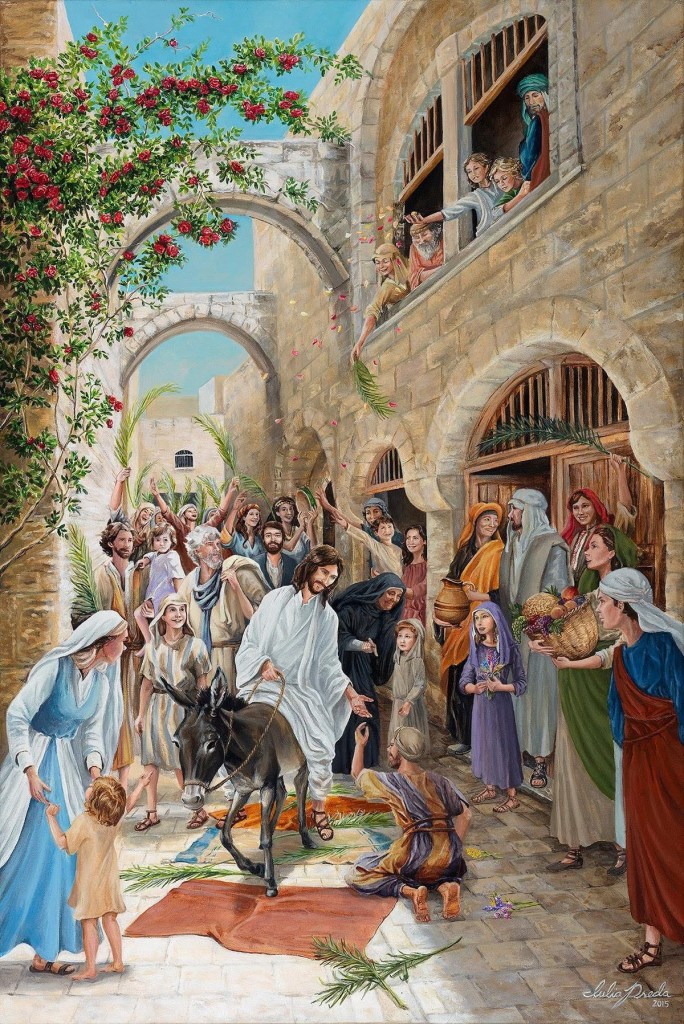
I used to think of Palm Sunday as a classic moral reversal tale: you expect a king to come on a warhorse, but Jesus purposefully downgrades his vehicle to be humble, so that’s why we need to be humble, etc.

But now I see it more deeply as metaphysical. As I said the other week, the Passion logically precedes the universe and helps us decode what is real. That means the triumphal entry is where we should expect to find a definitive truth about the universe. The key axiom appears to be: Godhood is humble, power is lowly, and glory broods like a mother hen.

This means that the warhorse is a representation of evil, a counterfeit. A conquering king upon his steed is a falsehood. There is no such thing as power that doesn’t come as upon a donkey. In fact, that Jesus chose the donkey is a restatement of his rejection of archetypes like the warrior-brute Esau or the chariots of Egypt. These are illusions that claim power but have only succeeded at twisting its definition.

The donkey isn’t the less glorious animal, but the only vehicle that could possibly seat God and reveal what power and glory really are. Our tendencies to want to ride the warhorse are the real inversion, a disorder born of our sickness.

So of course Jesus says the stones will cry out if the people don’t. The palm branches yearn to clap their hands when they glimpse the humility of the scene. It’s only an ironic picture to us because we’ve forgotten the humility and peace of our Father.

The Figure Above the Sapphire Sea

It’s about 2am, and I must write down the journey I had through Exodus tonight.

The long office reading in Liturgy of the Hours today is Exodus 24 where Moses and the elders “see” the one who brought them out of Egypt. It makes note of the clear sapphire floor beneath the figure’s feet, a detail I always found odd. It drove me into a tailspin of parallel research in Revelation and other books to double check some things.

And it got me wondering: who exactly, and I mean very precisely, was sitting atop the sapphire sea? God is ambiguous. John clearly tells us that no one has seen God. Is this another preincarnate Theophany, whatever that is? That feels a bit hand-wavey and vague. Is it a symbolic vision, a type of visual storytelling, as I’ve always understood it? Also hand-wavey, as it doesn’t answer the question precisely.

We know that God resides in the Eternal Present, the “static” reality of eternity (by static, I mean in the programmer’s sense: unchanging and uncreated). Time is an artifact, a creature. The realm of eternity exists above it. This is the biggest mental hurdle to jump for creatures of time like us. It’s easy to say God is not bound by time, and another to stop yourself from thinking God waits for anything. From God’s vantage point, all things are present and at once. He is present at all moments in time and therefore does not wait for anything to happen.

So what about events in time that supposedly happen to God? We say, for example, the Word was incarnate of the Virgin Mary and became man. Did God have to wait for Mary to be born? Before Jesus was conceived, was the Logos in a kind of preincarnate state? If so, what is that state, and how does he, say, walk with Adam, or wrestle with Jacob, or stand with Daniel in the Babylonian furnace?

And that’s when I realized that from God’s vantage point, the incarnation, death, resurrection, and ascension of Jesus are simultaneous. They are already written. In a sense, they are already true and have already happened. God has decreed that he would become man. So from an eternal perspective, God is in some sense always incarnate of the Virgin Mary, and has always been united to man’s nature in the God-man, Jesus.

If Jesus is God in the eternal act, this gives weight behind Paul’s statement that all things were created by Jesus (Col. 1:16). Jesus is the invisible God’s visible image not simply after he was born, but in eternity. That is, when God penned creation by eternal decree, he had fully intended the life of Christ as the representation of himself. God cannot be fully visible by any other image. From our vantage point in time, we are merely awakening to what is already true in the eyes of God.

If we should conceive of Jesus as the eternal image of the Son as we say in the Nicene Creed, are we to believe that, prior to the birth of Jesus, God fashioned a human body for himself to inhabit that is not Jesus? This seems to open more questions. What sort of body or form did he create? What does God do with that body after he’s inhabited it? Was it actually a human body or something else? In what sense did he inhabit it, if he inhabited it at all? This is no way to answer who Moses saw atop Sinai.

Since we know the visible icon of God is Jesus, we should assume, like Paul, this is true throughout time. But isn’t the birth of Jesus in the future from Moses’s vantage point? Yes, but again, Jesus is united to the Logos in the eternal decree of God (the Now). Therefore, in the Now, Jesus is already the lamb slain before the foundation of the world, since those time-bound events are already true in the Now. And therefore, in the Now, Jesus, the carpenter from Nazareth, is God.

So who did Moses see atop Sinai? He saw Jesus. He did not see an ephemeral vision of the Godhead, an impossibility for man, but the image of God, the risen Lord Jesus. The resurrection of Jesus happens in the future time of the Romans, yes, but, once resurrected, the glorified body of Jesus is no longer constrained by time in the same way we are. We know that he is no longer bound by physics because he is able to walk through a locked door, transform his appearance, and appear in multiple places at once. He is also no longer bound by time. We have a very well-known example of a future reality inbreaking into the present: the Transfiguration. It occurs prior to his resurrection, but is the display of his glorified body post-resurrection. This is a Chekov Gun that is dropped midway in the Gospels to demonstrate the mechanism of Jesus’s forward-and-backward ministry. He is now not simply the Lord of heaven and earth, but of time itself. We might call this bilocation or sacramental presence. By virtue of the Hypostatic Union and his resurrected body now ascended, he can miraculously participate in history retroactively.

To put it another way, the one who said, “Let there be light” is rightly identified as the resurrected Jesus. The one who walked with Adam and Eve in the garden was the glorified Jesus. And if Moses had been able to look at the true form of God and had asked to see his hands and side, I speculate that he may have seen nail-pierced hands and a wounded side. The God-man has been and always will be the image of the Creator. And hence, Jesus can rightly tell Phillip that anyone who has seen him has seen the Father, as if it should’ve been obvious by now.

That Christ occupies a preeminent position in time explains the patterns of the universe better: nature’s cycles conform to the Passion rather than the Passion being conformed to nature’s cycles. The author of creation is in fact Jesus. It should therefore be no surprise that everything in creation is a kind of emanation of the Gospel story rather than the Gospel story being one emanation of life. For example, the “circle of life” is patterned after the birth, death, and resurrection of Christ, the concept of “other” and family/friends is patterned from the Trinity, the suffering of life is designed from the cross, and so on. These are emanation of the eternal decree of God from the mind of the author, Christ. It is confusing to us in time because we see the life of Christ happen after creation, but in eternity, the life of Christ logically precedes creation!

One implication of this is that we should see the cosmos as a series of hieroglyphs encoded and revealed only by its Rosetta Stone, the life of Christ. This is why Christ is rightly called the Archetype. The marriage of the eternal (God) and matter (man) is eternally decreed because Christ wills to draw creation into the wedding chambers of divinity. This is in fact why we have creation at all. As Paul says, from him and through him and for him are all things.

I want to describe the implications this has on the Mass, especially the Eucharist, where we find the resurrected body of Christ hiding in the same way he hid from the disciples in the garden of Emmaus and where he consecrates a better Mt. Sinai and meeting place of heaven and earth. But that’s for another night.

Missionaries of Love, Not Fear: How Martyrs Like St. Jean de Brebeuf Prove Eternal Hell Isn’t Necessary for Mission

What drives true missionary work? Some argue that fear of eternal punishment—hell—fuels the urgency to bring the Gospel to the world. In evangelical circles, it’s often said that without the high stakes of hellfire, there wouldn’t be enough motivation for mission work. But the lives of the saints and martyrs tell a different story.

Saint Jean de Brebeuf, a French Jesuit missionary to the Huron people in the 17th century, stands as a powerful example of someone who gave his life to the Gospel, not out of fear of what awaited others in the afterlife, but from a deep love of Christ and a desire to suffer with Him. His story, along with countless others, shows us that the heart of true mission is not rooted in fear but in love—love for Christ, His passion, and for those who have yet to know Him.

Saint Jean de Brebeuf left behind the comforts of France to immerse himself in the lives of the Huron people in what is now Canada. For nearly two decades, he lived among them, learning their language, understanding their culture, and sharing the Gospel. Brebeuf didn’t see the Huron people as projects to be saved from hell, but as brothers and sisters whom Christ loved deeply.

He endured unimaginable hardships—extreme weather, disease, hunger, and threats from rival tribes. Despite these challenges, his mission was clear: to bring the love of Christ to the Huron people, not through coercion or fear, but through patience and compassion. His dedication was grounded in the belief that Christ’s suffering on the cross was the ultimate expression of love, and to share in that suffering was to be close to Christ Himself.

Brebeuf’s martyrdom in 1649 stands as the culmination of his lifelong commitment. When the Iroquois captured him and other missionaries, they subjected him to brutal torture. They sawed off pieces of his body, placed burning coals on his skin, and poured boiling water over him, mocking baptism. Yet even in the face of this agony, Brebeuf did not curse his captors or cry out in despair. Instead, he remained steadfast, offering his suffering as a testimony to the love of Christ, even praying for his torturers. His death was not about escaping punishment or ensuring the salvation of others through fear—it was about love, the kind of love Christ showed on the cross.

From his diary entry shared in today’s Office of Readings:

“For two days now I have experienced a great desire to be a martyr and to endure all the torments the martyrs suffered.

Jesus, my Lord and Savior, what can I give you in return for all the favors you have first conferred on me? I will take from your hand the cup of your sufferings and call on your name. I vow before your eternal Father and the Holy Spirit, before your most holy Mother and her most chaste spouse, before the angels, apostles and martyrs, before my blessed fathers Saint Ignatius and Saint Francis Xavier—in truth I vow to you, Jesus my Savior, that as far as I have the strength I will never fail to accept the grace of martyrdom, if some day you in your infinite mercy would offer it to me, your most unworthy servant.

I bind myself in this way so that for the rest of my life I will have neither permission nor freedom to refuse opportunities of dying and shedding my blood for you, unless at a particular juncture I should consider it more suitable for your glory to act otherwise at that time. Further, I bind myself to this so that, on receiving the blow of death, I shall accept it from your hands with the fullest delight and joy of spirit. For this reason, my beloved Jesus, and because of the surging joy which moves me, here and now I offer my blood and body and life. May I die only for you, if you will grant me this grace, since you willingly died for me. Let me so live that you may grant me the gift of such a happy death. In this way, my God and Savior, I will take from your hand the cup of your sufferings and call on your name: Jesus, Jesus, Jesus!

My God, it grieves me greatly that you are not known, that in this savage wilderness all have not been converted to you, that sin has not been driven from it. My God, even if all the brutal tortures which prisoners in this region must endure should fall on me, I offer myself most willingly to them and I alone shall suffer them all.”

Here is a man motivated by the passion of Christ and the spiritual yearning to partake in that passion for the benefit of his neighbor.

Martyrs at Large

Brebeuf’s story is not unique among the saints and martyrs. From the earliest days of Christianity, men and women have given their lives for the Gospel, not because they feared hell but because they were filled with a profound love for Christ and a desire to participate in His passion. Saints like Ignatius of Antioch, who eagerly embraced martyrdom, saw their deaths not as a way to escape damnation but as an opportunity to be united with Christ in His suffering.

Saint Perpetua, an early Christian martyr, faced death in the Roman Colosseum with the same resolve. She did not fear the punishment of her executioners; instead, she saw her suffering as a way to witness to the reality of Christ’s love. In her prison diary, Perpetua wrote of the joy she felt in knowing she would soon see Christ, even if it meant enduring the painful death of a martyr. Like Brebeuf, Perpetua’s motivation was not fear of punishment but love—a love so deep it could withstand any earthly trial.

These martyrs understood that Christ’s passion was the heart of the Gospel. They believed that to follow Christ was to embrace the cross, to share in His sufferings, and to bring the hope of resurrection to others. They saw their suffering not as something to be avoided, but as something that brought them closer to Christ and allowed them to witness to the power of His love.

In many evangelical circles today, the idea persists that eternal punishment—hell—is the necessary motivator for missionary work. The argument often goes that if we did not believe in eternal damnation, we would lose the urgency to evangelize. Without the threat of hell, some say, there would be no reason to risk comfort, safety, or life for the sake of the Gospel.

But the lives of the saints and martyrs tell a different story. Saint Jean de Brebeuf and others were not driven by fear of hell. Their missionary zeal came from a place of deep love for Christ and a desire to share His love with others. They were not motivated by the need to save others from punishment, but by the beauty of Christ’s passion and the opportunity to share in His sufferings.

The saints show us that the stakes of missionary work don’t have to be framed in terms of hellfire and eternal punishment. Instead, the greatest motivator can be love—the love of Christ that compels us to go to the ends of the earth, to suffer alongside others, and to bring them the joy of knowing Him. Missionary work grounded in love rather than fear has the power to transform not only the people being evangelized but also the missionaries themselves, as they come to experience Christ in a deeper, more intimate way.

Saint Jean de Brebeuf, along with countless other martyrs, reveals that true missionary work is not fueled by fear of punishment but by love—love for Christ and love for those who do not yet know Him. Their willingness to suffer and die was not about avoiding hell or ensuring others avoided it. Instead, it was about sharing in Christ’s passion and bringing the Gospel to others out of a deep and abiding love.

As we reflect on the lives of these saints, we are reminded that the Church’s mission is not about instilling fear but about sharing the love of Christ. When love is at the center of our missionary work, the need for punishment and fear fades away, and what remains is the joy of sharing in the sufferings of Christ and the hope of the resurrection.